

20
Algae
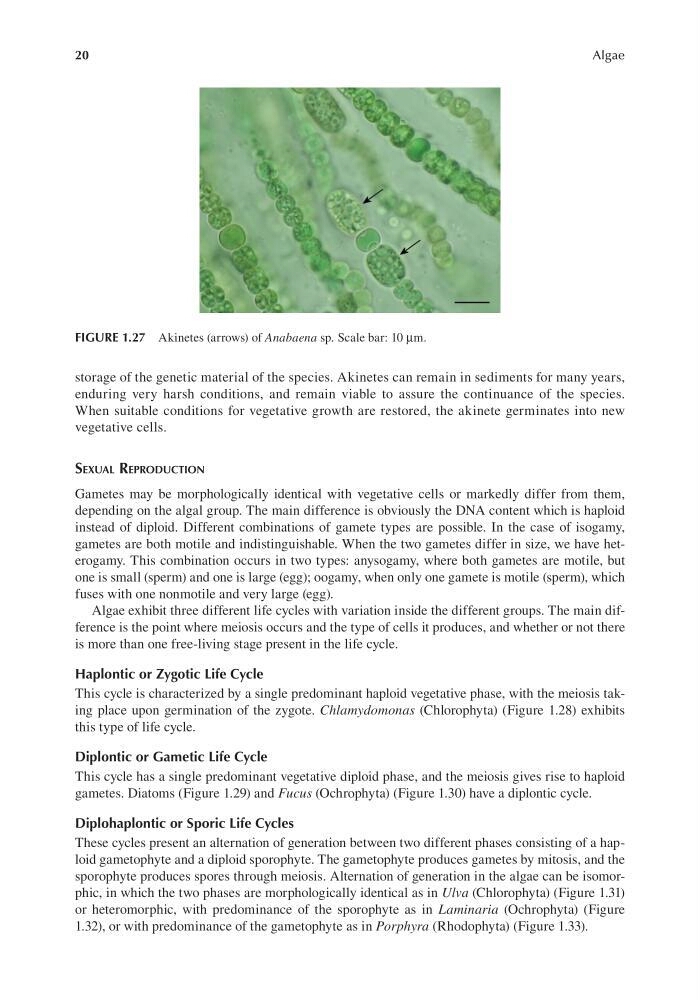
storage of the genetic material of the species. Akinetes can remain in sediments for many years,
enduring very harsh conditions, and remain viable to assure the continuance of the species.
When suitable conditions for vegetative growth are restored, the akinete germinates into new
vegetative cells.
sexUal reprodUcTion
Gametes may be morphologically identical with vegetative cells or markedly differ from them,
depending on the algal group. The main difference is obviously the DNA content which is haploid
instead of diploid. Different combinations of gamete types are possible. In the case of isogamy,
gametes are both motile and indistinguishable. When the two gametes differ in size, we have heterogamy. This combination occurs in two types: anysogamy, where both gametes are motile, but
one is small (sperm) and one is large (egg); oogamy, when only one gamete is motile (sperm), which
fuses with one nonmotile and very large (egg).
Algae exhibit three different life cycles with variation inside the different groups. The main difference is the point where meiosis occurs and the type of cells it produces, and whether or not there
is more than one free-living stage present in the life cycle.
Haplontic or Zygotic Life Cycle
This cycle is characterized by a single predominant haploid vegetative phase, with the meiosis taking place upon germination of the zygote. Chlamydomonas (Chlorophyta) (Figure 1.28) exhibits
this type of life cycle.
Diplontic or Gametic Life Cycle
This cycle has a single predominant vegetative diploid phase, and the meiosis gives rise to haploid
gametes. Diatoms (Figure 1.29) and Fucus (Ochrophyta) (Figure 1.30) have a diplontic cycle.
Diplohaplontic or Sporic Life Cycles
These cycles present an alternation of generation between two different phases consisting of a haploid gametophyte and a diploid sporophyte. The gametophyte produces gametes by mitosis, and the
sporophyte produces spores through meiosis. Alternation of generation in the algae can be isomorphic, in which the two phases are morphologically identical as in Ulva (Chlorophyta) (Figure 1.31)
or heteromorphic, with predominance of the sporophyte as in Laminaria (Ochrophyta) (Figure
1.32), or with predominance of the gametophyte as in Porphyra (Rhodophyta) (Figure 1.33).
FIGURE 1.27 Akinetes (arrows) of Anabaena sp. Scale bar: 10 μm.
Algae
storage of the genetic material of the species. Akinetes can remain in sediments for many years,
enduring very harsh conditions, and remain viable to assure the continuance of the species.
When suitable conditions for vegetative growth are restored, the akinete germinates into new
vegetative cells.
sexUal reprodUcTion
Gametes may be morphologically identical with vegetative cells or markedly differ from them,
depending on the algal group. The main difference is obviously the DNA content which is haploid
instead of diploid. Different combinations of gamete types are possible. In the case of isogamy,
gametes are both motile and indistinguishable. When the two gametes differ in size, we have heterogamy. This combination occurs in two types: anysogamy, where both gametes are motile, but
one is small (sperm) and one is large (egg); oogamy, when only one gamete is motile (sperm), which
fuses with one nonmotile and very large (egg).
Algae exhibit three different life cycles with variation inside the different groups. The main difference is the point where meiosis occurs and the type of cells it produces, and whether or not there
is more than one free-living stage present in the life cycle.
Haplontic or Zygotic Life Cycle
This cycle is characterized by a single predominant haploid vegetative phase, with the meiosis taking place upon germination of the zygote. Chlamydomonas (Chlorophyta) (Figure 1.28) exhibits
this type of life cycle.
Diplontic or Gametic Life Cycle
This cycle has a single predominant vegetative diploid phase, and the meiosis gives rise to haploid
gametes. Diatoms (Figure 1.29) and Fucus (Ochrophyta) (Figure 1.30) have a diplontic cycle.
Diplohaplontic or Sporic Life Cycles
These cycles present an alternation of generation between two different phases consisting of a haploid gametophyte and a diploid sporophyte. The gametophyte produces gametes by mitosis, and the
sporophyte produces spores through meiosis. Alternation of generation in the algae can be isomorphic, in which the two phases are morphologically identical as in Ulva (Chlorophyta) (Figure 1.31)
or heteromorphic, with predominance of the sporophyte as in Laminaria (Ochrophyta) (Figure
1.32), or with predominance of the gametophyte as in Porphyra (Rhodophyta) (Figure 1.33).
FIGURE 1.27 Akinetes (arrows) of Anabaena sp. Scale bar: 10 μm.