

116
Algae
switch and the FRET follow each other with a domino progression along the orderly organized and
closely packed proteins in the layer(s) of the crystal structure of the photoreceptor (Figure 2.73),
modulating the isomeric composition of the photoreceptive protein pool. As a consequence, B 462 ,
the signaling state of the protein energetically lower than A 498 , becomes the dominant isomer. It is
worthwhile to highlight that the photoreceptive protein switches from a photoisomerizable device
to a fluorescent dye.
The energy needed for the transition of the isomeric form A 498 to B 462 and the energy transferred
from one protein to the nearby protein derives not only from the photons absorbed during the photoreceptor screening by the eyespot, but also from the photons absorbed by the photoreceptor in the
no-screening period. These photons restore the photoreceptor isomeric composition with A 498 as
dominant isomer. Once the screening by the eyespot is over, the transition of B 462 to A 498 can again
occur due to the full spectrum light (natural light) impinging on the photoreceptor, and the isomeric
composition with A 498 as dominant isomer is again restored.
How the signal generated by the photoreceptor drives the Euglena movement?
Excitation light @ 365 nm
Excitation light @ 365 nm
Excitation light @ 436 nm
Excitation light @ 436 nm
Excitation light @ 365 nm
Excitation light @ 436 nm
20 time (s)
20 time (s)
10
0
10
0
20 time (s)
10
0
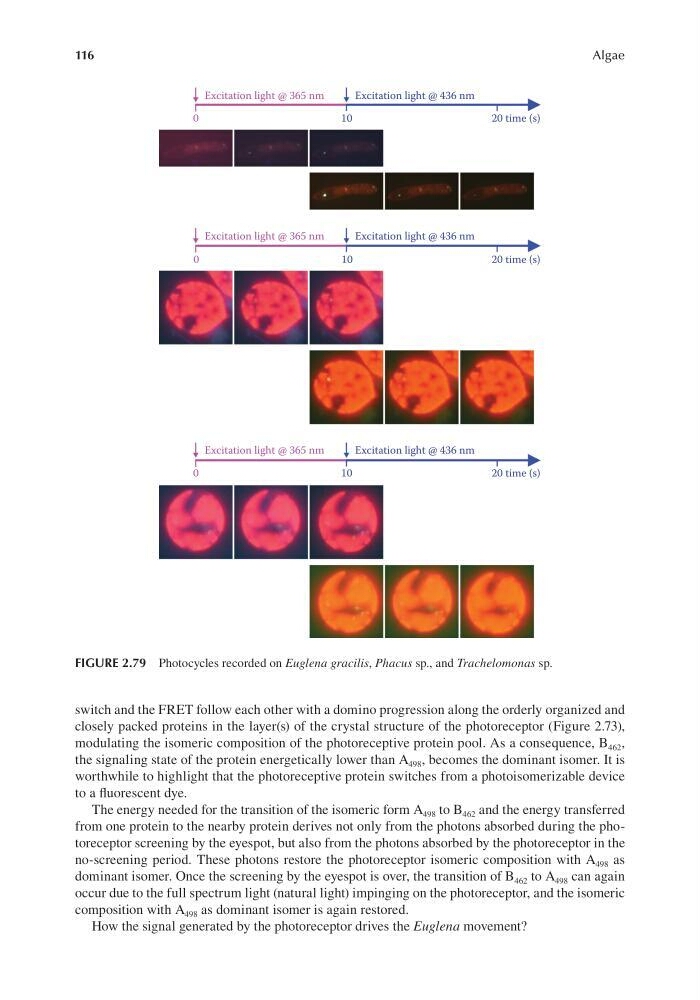
FIGURE 2.79 Photocycles recorded on Euglena gracilis, Phacus sp., and Trachelomonas sp.
Algae
switch and the FRET follow each other with a domino progression along the orderly organized and
closely packed proteins in the layer(s) of the crystal structure of the photoreceptor (Figure 2.73),
modulating the isomeric composition of the photoreceptive protein pool. As a consequence, B 462 ,
the signaling state of the protein energetically lower than A 498 , becomes the dominant isomer. It is
worthwhile to highlight that the photoreceptive protein switches from a photoisomerizable device
to a fluorescent dye.
The energy needed for the transition of the isomeric form A 498 to B 462 and the energy transferred
from one protein to the nearby protein derives not only from the photons absorbed during the photoreceptor screening by the eyespot, but also from the photons absorbed by the photoreceptor in the
no-screening period. These photons restore the photoreceptor isomeric composition with A 498 as
dominant isomer. Once the screening by the eyespot is over, the transition of B 462 to A 498 can again
occur due to the full spectrum light (natural light) impinging on the photoreceptor, and the isomeric
composition with A 498 as dominant isomer is again restored.
How the signal generated by the photoreceptor drives the Euglena movement?
Excitation light @ 365 nm
Excitation light @ 365 nm
Excitation light @ 436 nm
Excitation light @ 436 nm
Excitation light @ 365 nm
Excitation light @ 436 nm
20 time (s)
20 time (s)
10
0
10
0
20 time (s)
10
0
FIGURE 2.79 Photocycles recorded on Euglena gracilis, Phacus sp., and Trachelomonas sp.