

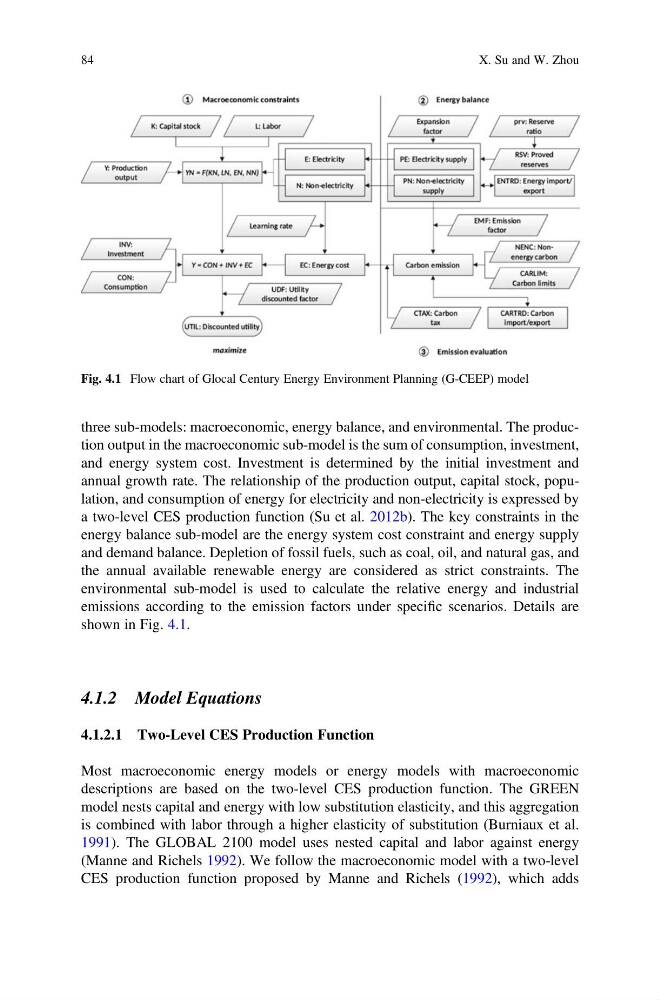
three sub-models: macroeconomic, energy balance, and environmental. The production output in the macroeconomic sub-model is the sum of consumption, investment,
and energy system cost. Investment is determined by the initial investment and
annual growth rate. The relationship of the production output, capital stock, population, and consumption of energy for electricity and non-electricity is expressed by
a two-level CES production function (Su et al. 2012b). The key constraints in the
energy balance sub-model are the energy system cost constraint and energy supply
and demand balance. Depletion of fossil fuels, such as coal, oil, and natural gas, and
the annual available renewable energy are considered as strict constraints. The
environmental sub-model is used to calculate the relative energy and industrial
emissions according to the emission factors under specific scenarios. Details are
shown in Fig. 4.1.
4.1.2 Model Equations
4.1.2.1 Two-Level CES Production Function
Most macroeconomic energy models or energy models with macroeconomic
descriptions are based on the two-level CES production function. The GREEN
model nests capital and energy with low substitution elasticity, and this aggregation
is combined with labor through a higher elasticity of substitution (Burniaux et al.
1991). The GLOBAL 2100 model uses nested capital and labor against energy
(Manne and Richels 1992). We follow the macroeconomic model with a two-level
CES production function proposed by Manne and Richels (1992), which adds
Fig. 4.1 Flow chart of Glocal Century Energy Environment Planning (G-CEEP) model
84
X. Su and W. Zhou
and energy system cost. Investment is determined by the initial investment and
annual growth rate. The relationship of the production output, capital stock, population, and consumption of energy for electricity and non-electricity is expressed by
a two-level CES production function (Su et al. 2012b). The key constraints in the
energy balance sub-model are the energy system cost constraint and energy supply
and demand balance. Depletion of fossil fuels, such as coal, oil, and natural gas, and
the annual available renewable energy are considered as strict constraints. The
environmental sub-model is used to calculate the relative energy and industrial
emissions according to the emission factors under specific scenarios. Details are
shown in Fig. 4.1.
4.1.2 Model Equations
4.1.2.1 Two-Level CES Production Function
Most macroeconomic energy models or energy models with macroeconomic
descriptions are based on the two-level CES production function. The GREEN
model nests capital and energy with low substitution elasticity, and this aggregation
is combined with labor through a higher elasticity of substitution (Burniaux et al.
1991). The GLOBAL 2100 model uses nested capital and labor against energy
(Manne and Richels 1992). We follow the macroeconomic model with a two-level
CES production function proposed by Manne and Richels (1992), which adds
Fig. 4.1 Flow chart of Glocal Century Energy Environment Planning (G-CEEP) model
84
X. Su and W. Zhou