

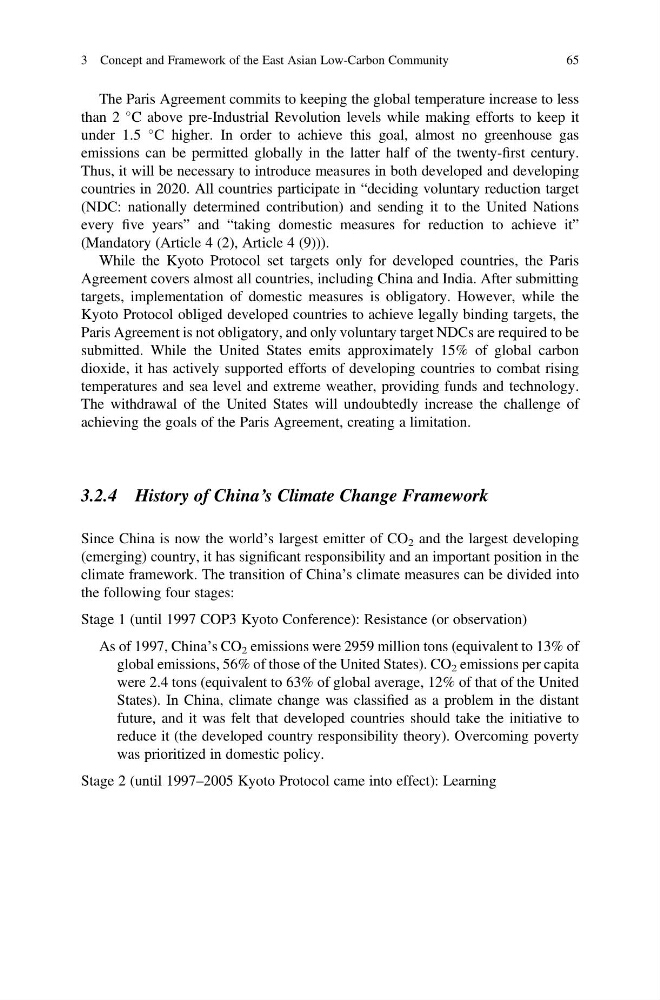
The Paris Agreement commits to keeping the global temperature increase to less
than 2
C above pre-Industrial Revolution levels while making efforts to keep it
under 1.5
C higher. In order to achieve this goal, almost no greenhouse gas
emissions can be permitted globally in the latter half of the twenty-first century.
Thus, it will be necessary to introduce measures in both developed and developing
countries in 2020. All countries participate in “deciding voluntary reduction target
(NDC: nationally determined contribution) and sending it to the United Nations
every five years” and “taking domestic measures for reduction to achieve it”
(Mandatory (Article 4 (2), Article 4 (9))).
While the Kyoto Protocol set targets only for developed countries, the Paris
Agreement covers almost all countries, including China and India. After submitting
targets, implementation of domestic measures is obligatory. However, while the
Kyoto Protocol obliged developed countries to achieve legally binding targets, the
Paris Agreement is not obligatory, and only voluntary target NDCs are required to be
submitted. While the United States emits approximately 15% of global carbon
dioxide, it has actively supported efforts of developing countries to combat rising
temperatures and sea level and extreme weather, providing funds and technology.
The withdrawal of the United States will undoubtedly increase the challenge of
achieving the goals of the Paris Agreement, creating a limitation.
3.2.4 History of China’s Climate Change Framework
Since China is now the world’s largest emitter of CO 2 and the largest developing
(emerging) country, it has significant responsibility and an important position in the
climate framework. The transition of China’s climate measures can be divided into
the following four stages:
Stage 1 (until 1997 COP3 Kyoto Conference): Resistance (or observation)
As of 1997, China’s CO 2 emissions were 2959 million tons (equivalent to 13% of
global emissions, 56% of those of the United States). CO 2 emissions per capita
were 2.4 tons (equivalent to 63% of global average, 12% of that of the United
States). In China, climate change was classified as a problem in the distant
future, and it was felt that developed countries should take the initiative to
reduce it (the developed country responsibility theory). Overcoming poverty
was prioritized in domestic policy.
Stage 2 (until 1997–2005 Kyoto Protocol came into effect): Learning
3 Concept and Framework of the East Asian Low-Carbon Community
65
than 2
C above pre-Industrial Revolution levels while making efforts to keep it
under 1.5
C higher. In order to achieve this goal, almost no greenhouse gas
emissions can be permitted globally in the latter half of the twenty-first century.
Thus, it will be necessary to introduce measures in both developed and developing
countries in 2020. All countries participate in “deciding voluntary reduction target
(NDC: nationally determined contribution) and sending it to the United Nations
every five years” and “taking domestic measures for reduction to achieve it”
(Mandatory (Article 4 (2), Article 4 (9))).
While the Kyoto Protocol set targets only for developed countries, the Paris
Agreement covers almost all countries, including China and India. After submitting
targets, implementation of domestic measures is obligatory. However, while the
Kyoto Protocol obliged developed countries to achieve legally binding targets, the
Paris Agreement is not obligatory, and only voluntary target NDCs are required to be
submitted. While the United States emits approximately 15% of global carbon
dioxide, it has actively supported efforts of developing countries to combat rising
temperatures and sea level and extreme weather, providing funds and technology.
The withdrawal of the United States will undoubtedly increase the challenge of
achieving the goals of the Paris Agreement, creating a limitation.
3.2.4 History of China’s Climate Change Framework
Since China is now the world’s largest emitter of CO 2 and the largest developing
(emerging) country, it has significant responsibility and an important position in the
climate framework. The transition of China’s climate measures can be divided into
the following four stages:
Stage 1 (until 1997 COP3 Kyoto Conference): Resistance (or observation)
As of 1997, China’s CO 2 emissions were 2959 million tons (equivalent to 13% of
global emissions, 56% of those of the United States). CO 2 emissions per capita
were 2.4 tons (equivalent to 63% of global average, 12% of that of the United
States). In China, climate change was classified as a problem in the distant
future, and it was felt that developed countries should take the initiative to
reduce it (the developed country responsibility theory). Overcoming poverty
was prioritized in domestic policy.
Stage 2 (until 1997–2005 Kyoto Protocol came into effect): Learning
3 Concept and Framework of the East Asian Low-Carbon Community
65