

1978, primary energy consumption in China has accelerated since the late 1970s; it
became the biggest energy consumer in Asia in 1977. Since 2001, when China
became a member of the World Trade Organization (WTO), energy consumption
has increased rapidly. In contrast, rapid growth in South Korea from the 1960s to the
1980s contributed stable and robust growth both in GDP and primary energy
consumption. However, the Asian Financial Crisis shrank the economy and primary
energy consumption of South Korea in 1998. In the 2000s, South Korea changed its
economic development model and maintained strong growth in both GDP and
energy consumption.
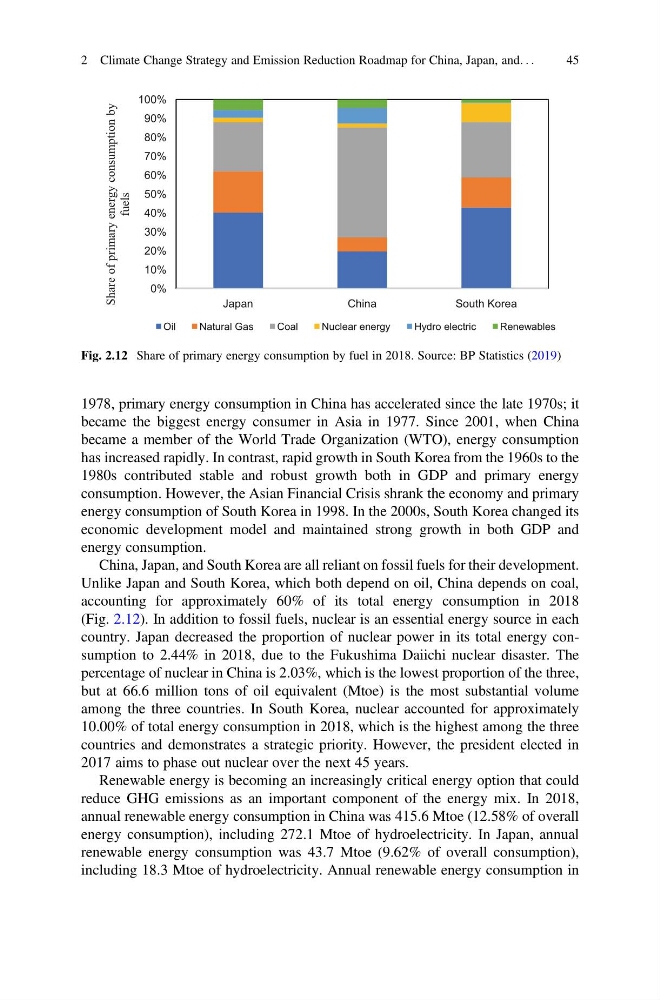
China, Japan, and South Korea are all reliant on fossil fuels for their development.
Unlike Japan and South Korea, which both depend on oil, China depends on coal,
accounting for approximately 60% of its total energy consumption in 2018
(Fig. 2.12). In addition to fossil fuels, nuclear is an essential energy source in each
country. Japan decreased the proportion of nuclear power in its total energy consumption to 2.44% in 2018, due to the Fukushima Daiichi nuclear disaster. The
percentage of nuclear in China is 2.03%, which is the lowest proportion of the three,
but at 66.6 million tons of oil equivalent (Mtoe) is the most substantial volume
among the three countries. In South Korea, nuclear accounted for approximately
10.00% of total energy consumption in 2018, which is the highest among the three
countries and demonstrates a strategic priority. However, the president elected in
2017 aims to phase out nuclear over the next 45 years.
Renewable energy is becoming an increasingly critical energy option that could
reduce GHG emissions as an important component of the energy mix. In 2018,
annual renewable energy consumption in China was 415.6 Mtoe (12.58% of overall
energy consumption), including 272.1 Mtoe of hydroelectricity. In Japan, annual
renewable energy consumption was 43.7 Mtoe (9.62% of overall consumption),
including 18.3 Mtoe of hydroelectricity. Annual renewable energy consumption in
0%
10%
20%
30%
40%
50%
60%
70%
80%
90%
100%
Japan
China
South Korea
Share of primary energy consumption by
fuels
Oil
Natural Gas
Coal
Nuclear energy
Hydro electric
Renewables
Fig. 2.12 Share of primary energy consumption by fuel in 2018. Source: BP Statistics (2019)
2 Climate Change Strategy and Emission Reduction Roadmap for China, Japan, and. . .
45
became the biggest energy consumer in Asia in 1977. Since 2001, when China
became a member of the World Trade Organization (WTO), energy consumption
has increased rapidly. In contrast, rapid growth in South Korea from the 1960s to the
1980s contributed stable and robust growth both in GDP and primary energy
consumption. However, the Asian Financial Crisis shrank the economy and primary
energy consumption of South Korea in 1998. In the 2000s, South Korea changed its
economic development model and maintained strong growth in both GDP and
energy consumption.
China, Japan, and South Korea are all reliant on fossil fuels for their development.
Unlike Japan and South Korea, which both depend on oil, China depends on coal,
accounting for approximately 60% of its total energy consumption in 2018
(Fig. 2.12). In addition to fossil fuels, nuclear is an essential energy source in each
country. Japan decreased the proportion of nuclear power in its total energy consumption to 2.44% in 2018, due to the Fukushima Daiichi nuclear disaster. The
percentage of nuclear in China is 2.03%, which is the lowest proportion of the three,
but at 66.6 million tons of oil equivalent (Mtoe) is the most substantial volume
among the three countries. In South Korea, nuclear accounted for approximately
10.00% of total energy consumption in 2018, which is the highest among the three
countries and demonstrates a strategic priority. However, the president elected in
2017 aims to phase out nuclear over the next 45 years.
Renewable energy is becoming an increasingly critical energy option that could
reduce GHG emissions as an important component of the energy mix. In 2018,
annual renewable energy consumption in China was 415.6 Mtoe (12.58% of overall
energy consumption), including 272.1 Mtoe of hydroelectricity. In Japan, annual
renewable energy consumption was 43.7 Mtoe (9.62% of overall consumption),
including 18.3 Mtoe of hydroelectricity. Annual renewable energy consumption in
0%
10%
20%
30%
40%
50%
60%
70%
80%
90%
100%
Japan
China
South Korea
Share of primary energy consumption by
fuels
Oil
Natural Gas
Coal
Nuclear energy
Hydro electric
Renewables
Fig. 2.12 Share of primary energy consumption by fuel in 2018. Source: BP Statistics (2019)
2 Climate Change Strategy and Emission Reduction Roadmap for China, Japan, and. . .
45