

18.4.5 Holistic Construction of the Pujiang Model Household
Waste Disposal System
There are three main reasons why waste separation in Pujiang has achieved great
results. First, in Pujiang, the PPP model was used to build a public-private partnership system in which the government purchases services from private companies.
The government established a recycling recovery system focusing on food waste by
securing high levels of waste discrimination and managing private companies. By
discriminating and recycling food waste from household waste, the effect of reducing waste by interim treatment was significantly increased, reducing the burden on
waste disposal plants, reducing the cost of transportation and disposal of waste by
collecting food waste, and reducing the financial burden. In 2014, the Pujiang
government set Zhangjiajie as a pilot area for separate waste collection and disposal,
distributing to each community (housing complexes in Zhenjiang) in 2016. Coverage of all rural areas reached 100% in 2017. In the same year, Pujiang was selected
by the Housing Department of China as a model for the country’s first separate
collection of rural waste and use of resources. Since 2018, Pujiang has been building
a waste collection and processing information system that will allow a move toward
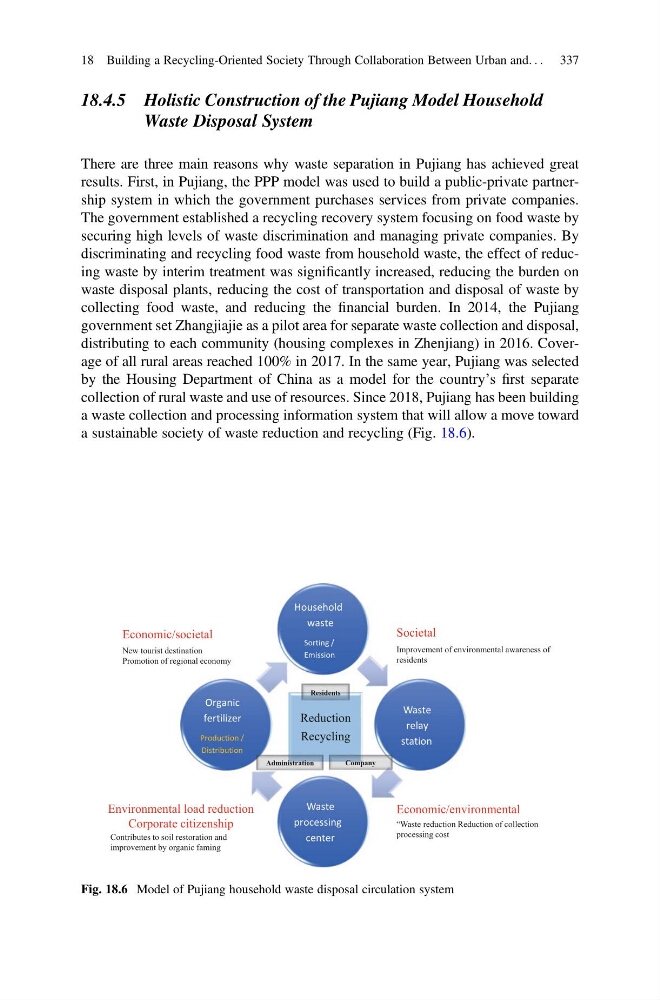
a sustainable society of waste reduction and recycling (Fig. 18.6).
Household
waste
Sorting /
Emission
Waste
relay
station
Waste
processing
center
Organic
fertilizer
Production /
Distribution
Societal
Economic/environmental
Environmental load reduction
Corporate citizenship
Economic/societal
Improvement of environmental awareness of
residents
“Waste reduction Reduction of collection
processing cost
Contributes to soil restoration and
improvement by organic faming
New tourist destination
Promotion of regional economy
Reduction
Recycling
Residents
Administration
Company
Fig. 18.6 Model of Pujiang household waste disposal circulation system
18 Building a Recycling-Oriented Society Through Collaboration Between Urban and. . . 337
Waste Disposal System
There are three main reasons why waste separation in Pujiang has achieved great
results. First, in Pujiang, the PPP model was used to build a public-private partnership system in which the government purchases services from private companies.
The government established a recycling recovery system focusing on food waste by
securing high levels of waste discrimination and managing private companies. By
discriminating and recycling food waste from household waste, the effect of reducing waste by interim treatment was significantly increased, reducing the burden on
waste disposal plants, reducing the cost of transportation and disposal of waste by
collecting food waste, and reducing the financial burden. In 2014, the Pujiang
government set Zhangjiajie as a pilot area for separate waste collection and disposal,
distributing to each community (housing complexes in Zhenjiang) in 2016. Coverage of all rural areas reached 100% in 2017. In the same year, Pujiang was selected
by the Housing Department of China as a model for the country’s first separate
collection of rural waste and use of resources. Since 2018, Pujiang has been building
a waste collection and processing information system that will allow a move toward
a sustainable society of waste reduction and recycling (Fig. 18.6).
Household
waste
Sorting /
Emission
Waste
relay
station
Waste
processing
center
Organic
fertilizer
Production /
Distribution
Societal
Economic/environmental
Environmental load reduction
Corporate citizenship
Economic/societal
Improvement of environmental awareness of
residents
“Waste reduction Reduction of collection
processing cost
Contributes to soil restoration and
improvement by organic faming
New tourist destination
Promotion of regional economy
Reduction
Recycling
Residents
Administration
Company
Fig. 18.6 Model of Pujiang household waste disposal circulation system
18 Building a Recycling-Oriented Society Through Collaboration Between Urban and. . . 337