

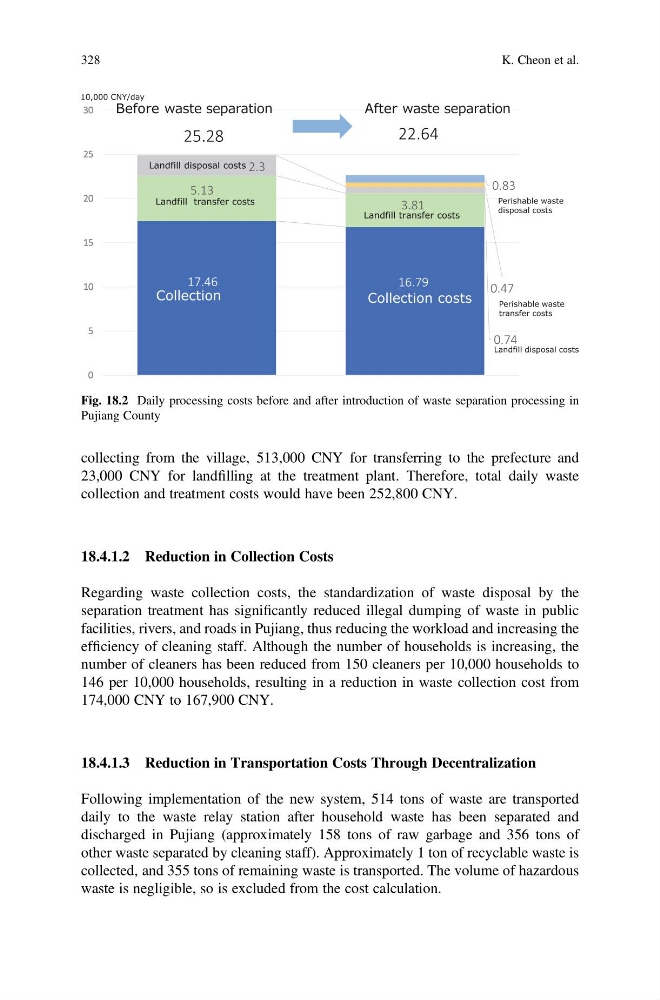
collecting from the village, 513,000 CNY for transferring to the prefecture and
23,000 CNY for landfilling at the treatment plant. Therefore, total daily waste
collection and treatment costs would have been 252,800 CNY.
18.4.1.2 Reduction in Collection Costs
Regarding waste collection costs, the standardization of waste disposal by the
separation treatment has significantly reduced illegal dumping of waste in public
facilities, rivers, and roads in Pujiang, thus reducing the workload and increasing the
efficiency of cleaning staff. Although the number of households is increasing, the
number of cleaners has been reduced from 150 cleaners per 10,000 households to
146 per 10,000 households, resulting in a reduction in waste collection cost from
174,000 CNY to 167,900 CNY.
18.4.1.3 Reduction in Transportation Costs Through Decentralization
Following implementation of the new system, 514 tons of waste are transported
daily to the waste relay station after household waste has been separated and
discharged in Pujiang (approximately 158 tons of raw garbage and 356 tons of
other waste separated by cleaning staff). Approximately 1 ton of recyclable waste is
collected, and 355 tons of remaining waste is transported. The volume of hazardous
waste is negligible, so is excluded from the cost calculation.
Fig. 18.2 Daily processing costs before and after introduction of waste separation processing in
Pujiang County
328
K. Cheon et al.
23,000 CNY for landfilling at the treatment plant. Therefore, total daily waste
collection and treatment costs would have been 252,800 CNY.
18.4.1.2 Reduction in Collection Costs
Regarding waste collection costs, the standardization of waste disposal by the
separation treatment has significantly reduced illegal dumping of waste in public
facilities, rivers, and roads in Pujiang, thus reducing the workload and increasing the
efficiency of cleaning staff. Although the number of households is increasing, the
number of cleaners has been reduced from 150 cleaners per 10,000 households to
146 per 10,000 households, resulting in a reduction in waste collection cost from
174,000 CNY to 167,900 CNY.
18.4.1.3 Reduction in Transportation Costs Through Decentralization
Following implementation of the new system, 514 tons of waste are transported
daily to the waste relay station after household waste has been separated and
discharged in Pujiang (approximately 158 tons of raw garbage and 356 tons of
other waste separated by cleaning staff). Approximately 1 ton of recyclable waste is
collected, and 355 tons of remaining waste is transported. The volume of hazardous
waste is negligible, so is excluded from the cost calculation.
Fig. 18.2 Daily processing costs before and after introduction of waste separation processing in
Pujiang County
328
K. Cheon et al.