

responsible for dumping and responsible for supervision by tracking by number
(with the “party-plus” system). With this system at its center, in collaboration with a
private company, a model for waste separation, collection, and processing centered
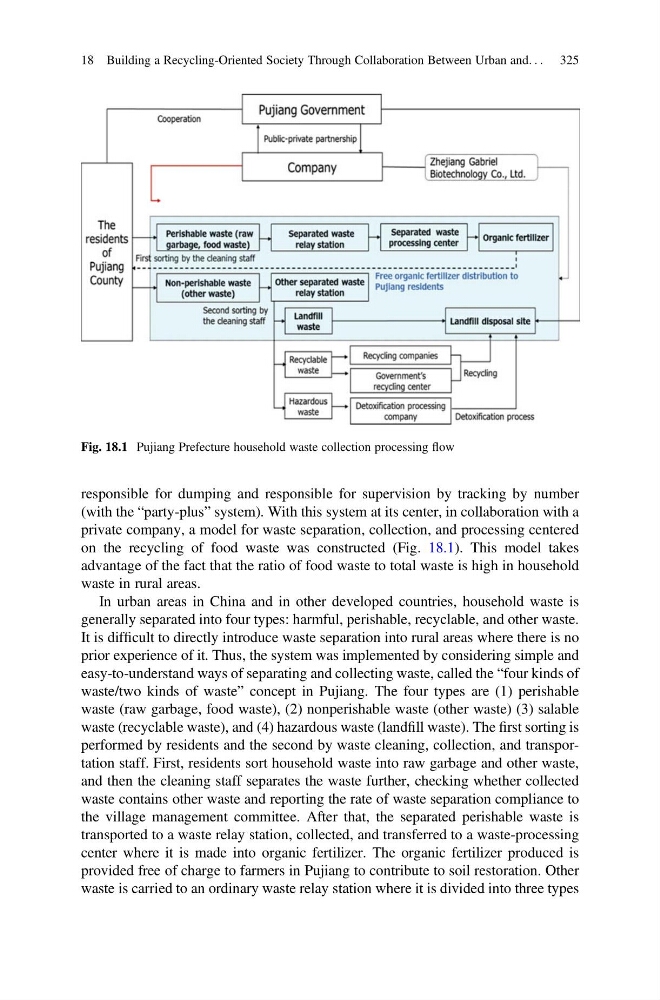
on the recycling of food waste was constructed (Fig. 18.1). This model takes
advantage of the fact that the ratio of food waste to total waste is high in household
waste in rural areas.
In urban areas in China and in other developed countries, household waste is
generally separated into four types: harmful, perishable, recyclable, and other waste.
It is difficult to directly introduce waste separation into rural areas where there is no
prior experience of it. Thus, the system was implemented by considering simple and
easy-to-understand ways of separating and collecting waste, called the “four kinds of
waste/two kinds of waste” concept in Pujiang. The four types are (1) perishable
waste (raw garbage, food waste), (2) nonperishable waste (other waste) (3) salable
waste (recyclable waste), and (4) hazardous waste (landfill waste). The first sorting is
performed by residents and the second by waste cleaning, collection, and transportation staff. First, residents sort household waste into raw garbage and other waste,
and then the cleaning staff separates the waste further, checking whether collected
waste contains other waste and reporting the rate of waste separation compliance to
the village management committee. After that, the separated perishable waste is
transported to a waste relay station, collected, and transferred to a waste-processing
center where it is made into organic fertilizer. The organic fertilizer produced is
provided free of charge to farmers in Pujiang to contribute to soil restoration. Other
waste is carried to an ordinary waste relay station where it is divided into three types
Fig. 18.1 Pujiang Prefecture household waste collection processing flow
18 Building a Recycling-Oriented Society Through Collaboration Between Urban and. . . 325
(with the “party-plus” system). With this system at its center, in collaboration with a
private company, a model for waste separation, collection, and processing centered
on the recycling of food waste was constructed (Fig. 18.1). This model takes
advantage of the fact that the ratio of food waste to total waste is high in household
waste in rural areas.
In urban areas in China and in other developed countries, household waste is
generally separated into four types: harmful, perishable, recyclable, and other waste.
It is difficult to directly introduce waste separation into rural areas where there is no
prior experience of it. Thus, the system was implemented by considering simple and
easy-to-understand ways of separating and collecting waste, called the “four kinds of
waste/two kinds of waste” concept in Pujiang. The four types are (1) perishable
waste (raw garbage, food waste), (2) nonperishable waste (other waste) (3) salable
waste (recyclable waste), and (4) hazardous waste (landfill waste). The first sorting is
performed by residents and the second by waste cleaning, collection, and transportation staff. First, residents sort household waste into raw garbage and other waste,
and then the cleaning staff separates the waste further, checking whether collected
waste contains other waste and reporting the rate of waste separation compliance to
the village management committee. After that, the separated perishable waste is
transported to a waste relay station, collected, and transferred to a waste-processing
center where it is made into organic fertilizer. The organic fertilizer produced is
provided free of charge to farmers in Pujiang to contribute to soil restoration. Other
waste is carried to an ordinary waste relay station where it is divided into three types
Fig. 18.1 Pujiang Prefecture household waste collection processing flow
18 Building a Recycling-Oriented Society Through Collaboration Between Urban and. . . 325