

1.3 cm in the last 16 years alone, affecting many cities and infrastructures facing the
sea (Earther 2020)
1.3.3 Economic Loss Due to Abnormal Weather
Extreme weather is usually based on local historical weather data and is the most
common 10% of the average for the past, according to the National Centers for
Environmental Information (NOAA). Extreme climates such as heatwaves,
droughts, storms, floods, gusts, and snowstorms are frequent within the global
range. Climate change has a tremendous negative impact on several global problems,
such as reduced labor productivity, the spread of infectious diseases, heatwaves, and
pollution.
According to a survey by the World Meteorological Organization (WMO), the
global economic loss due to abnormal weather in 2017 was 300 billion US dollars,
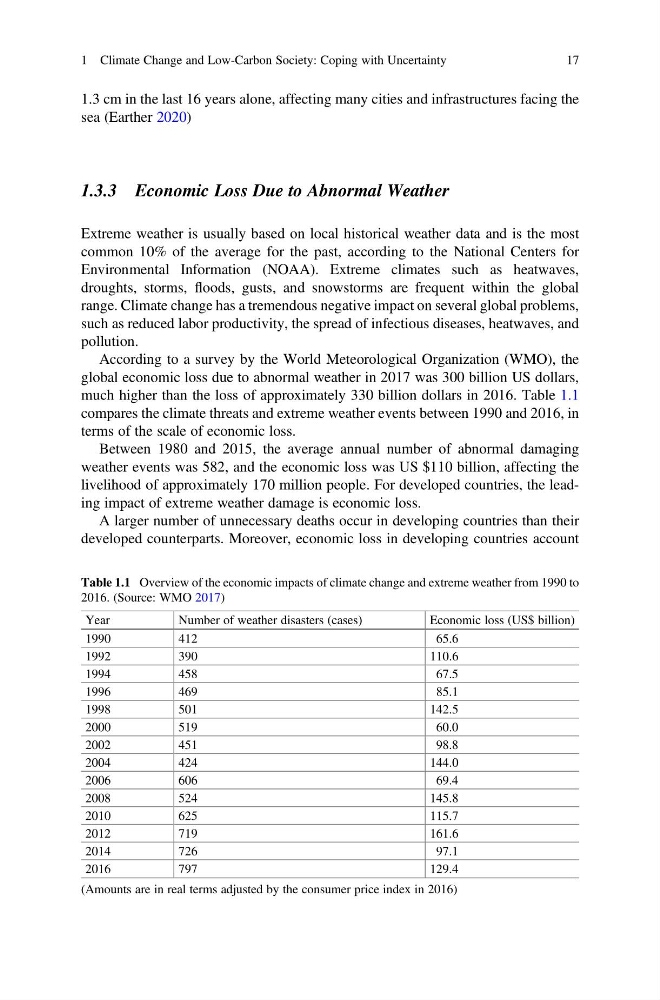
much higher than the loss of approximately 330 billion dollars in 2016. Table 1.1
compares the climate threats and extreme weather events between 1990 and 2016, in
terms of the scale of economic loss.
Between 1980 and 2015, the average annual number of abnormal damaging
weather events was 582, and the economic loss was US $110 billion, affecting the
livelihood of approximately 170 million people. For developed countries, the leading impact of extreme weather damage is economic loss.
A larger number of unnecessary deaths occur in developing countries than their
developed counterparts. Moreover, economic loss in developing countries account
Table 1.1 Overview of the economic impacts of climate change and extreme weather from 1990 to
2016. (Source: WMO 2017)
Year
Number of weather disasters (cases)
Economic loss (US$ billion)
1990
412
65.6
1992
390
110.6
1994
458
67.5
1996
469
85.1
1998
501
142.5
2000
519
60.0
2002
451
98.8
2004
424
144.0
2006
606
69.4
2008
524
145.8
2010
625
115.7
2012
719
161.6
2014
726
97.1
2016
797
129.4
(Amounts are in real terms adjusted by the consumer price index in 2016)
1 Climate Change and Low-Carbon Society: Coping with Uncertainty
17
sea (Earther 2020)
1.3.3 Economic Loss Due to Abnormal Weather
Extreme weather is usually based on local historical weather data and is the most
common 10% of the average for the past, according to the National Centers for
Environmental Information (NOAA). Extreme climates such as heatwaves,
droughts, storms, floods, gusts, and snowstorms are frequent within the global
range. Climate change has a tremendous negative impact on several global problems,
such as reduced labor productivity, the spread of infectious diseases, heatwaves, and
pollution.
According to a survey by the World Meteorological Organization (WMO), the
global economic loss due to abnormal weather in 2017 was 300 billion US dollars,
much higher than the loss of approximately 330 billion dollars in 2016. Table 1.1
compares the climate threats and extreme weather events between 1990 and 2016, in
terms of the scale of economic loss.
Between 1980 and 2015, the average annual number of abnormal damaging
weather events was 582, and the economic loss was US $110 billion, affecting the
livelihood of approximately 170 million people. For developed countries, the leading impact of extreme weather damage is economic loss.
A larger number of unnecessary deaths occur in developing countries than their
developed counterparts. Moreover, economic loss in developing countries account
Table 1.1 Overview of the economic impacts of climate change and extreme weather from 1990 to
2016. (Source: WMO 2017)
Year
Number of weather disasters (cases)
Economic loss (US$ billion)
1990
412
65.6
1992
390
110.6
1994
458
67.5
1996
469
85.1
1998
501
142.5
2000
519
60.0
2002
451
98.8
2004
424
144.0
2006
606
69.4
2008
524
145.8
2010
625
115.7
2012
719
161.6
2014
726
97.1
2016
797
129.4
(Amounts are in real terms adjusted by the consumer price index in 2016)
1 Climate Change and Low-Carbon Society: Coping with Uncertainty
17