

experience of participating in pilot projects (Chongqing). Therefore, implementation
was relatively easy, and sufficient funds could be raised to support the pilot projects.
Experience gained from the pilots is expected to inform a national market. Fujian
Province, the most recent pilot to adopt national standards and guidelines for carbon
verification, is an actual experiment for the future nationwide market. Finally, energy
consumption in China is concentrated in secondary and tertiary industries; pilot
regions whose industrial structure is of crucial national status thus offer an opportunity to reduce emissions both in the pilot regions and nationally.
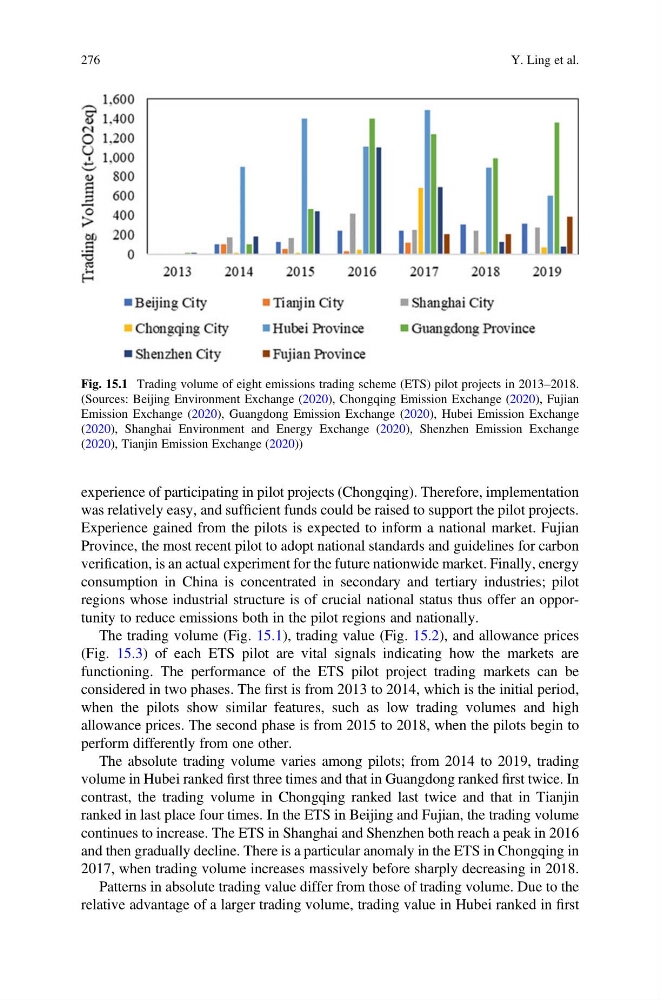
The trading volume (Fig. 15.1), trading value (Fig. 15.2), and allowance prices
(Fig. 15.3) of each ETS pilot are vital signals indicating how the markets are
functioning. The performance of the ETS pilot project trading markets can be
considered in two phases. The first is from 2013 to 2014, which is the initial period,
when the pilots show similar features, such as low trading volumes and high
allowance prices. The second phase is from 2015 to 2018, when the pilots begin to
perform differently from one other.
The absolute trading volume varies among pilots; from 2014 to 2019, trading
volume in Hubei ranked first three times and that in Guangdong ranked first twice. In
contrast, the trading volume in Chongqing ranked last twice and that in Tianjin
ranked in last place four times. In the ETS in Beijing and Fujian, the trading volume
continues to increase. The ETS in Shanghai and Shenzhen both reach a peak in 2016
and then gradually decline. There is a particular anomaly in the ETS in Chongqing in
2017, when trading volume increases massively before sharply decreasing in 2018.
Patterns in absolute trading value differ from those of trading volume. Due to the
relative advantage of a larger trading volume, trading value in Hubei ranked in first
Fig. 15.1 Trading volume of eight emissions trading scheme (ETS) pilot projects in 2013–2018.
(Sources: Beijing Environment Exchange (2020), Chongqing Emission Exchange (2020), Fujian
Emission Exchange (2020), Guangdong Emission Exchange (2020), Hubei Emission Exchange
(2020), Shanghai Environment and Energy Exchange (2020), Shenzhen Emission Exchange
(2020), Tianjin Emission Exchange (2020))
276
Y. Ling et al.
was relatively easy, and sufficient funds could be raised to support the pilot projects.
Experience gained from the pilots is expected to inform a national market. Fujian
Province, the most recent pilot to adopt national standards and guidelines for carbon
verification, is an actual experiment for the future nationwide market. Finally, energy
consumption in China is concentrated in secondary and tertiary industries; pilot
regions whose industrial structure is of crucial national status thus offer an opportunity to reduce emissions both in the pilot regions and nationally.
The trading volume (Fig. 15.1), trading value (Fig. 15.2), and allowance prices
(Fig. 15.3) of each ETS pilot are vital signals indicating how the markets are
functioning. The performance of the ETS pilot project trading markets can be
considered in two phases. The first is from 2013 to 2014, which is the initial period,
when the pilots show similar features, such as low trading volumes and high
allowance prices. The second phase is from 2015 to 2018, when the pilots begin to
perform differently from one other.
The absolute trading volume varies among pilots; from 2014 to 2019, trading
volume in Hubei ranked first three times and that in Guangdong ranked first twice. In
contrast, the trading volume in Chongqing ranked last twice and that in Tianjin
ranked in last place four times. In the ETS in Beijing and Fujian, the trading volume
continues to increase. The ETS in Shanghai and Shenzhen both reach a peak in 2016
and then gradually decline. There is a particular anomaly in the ETS in Chongqing in
2017, when trading volume increases massively before sharply decreasing in 2018.
Patterns in absolute trading value differ from those of trading volume. Due to the
relative advantage of a larger trading volume, trading value in Hubei ranked in first
Fig. 15.1 Trading volume of eight emissions trading scheme (ETS) pilot projects in 2013–2018.
(Sources: Beijing Environment Exchange (2020), Chongqing Emission Exchange (2020), Fujian
Emission Exchange (2020), Guangdong Emission Exchange (2020), Hubei Emission Exchange
(2020), Shanghai Environment and Energy Exchange (2020), Shenzhen Emission Exchange
(2020), Tianjin Emission Exchange (2020))
276
Y. Ling et al.