

recorded to increase by 1.1
C compared to before the Industrial Revolution” (WMO
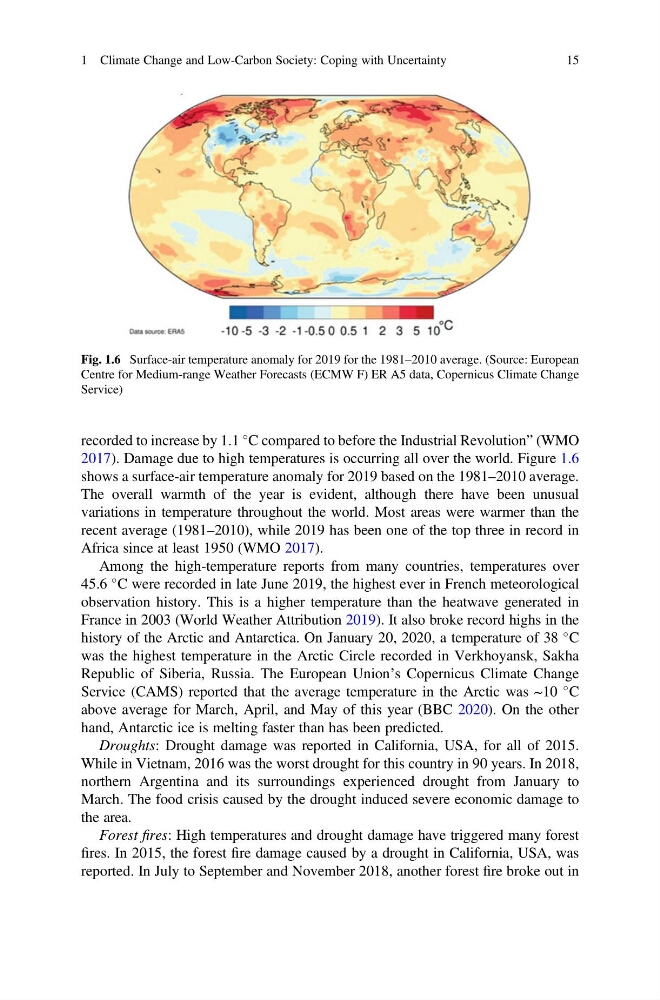
2017). Damage due to high temperatures is occurring all over the world. Figure 1.6
shows a surface-air temperature anomaly for 2019 based on the 1981–2010 average.
The overall warmth of the year is evident, although there have been unusual
variations in temperature throughout the world. Most areas were warmer than the
recent average (1981–2010), while 2019 has been one of the top three in record in
Africa since at least 1950 (WMO 2017).
Among the high-temperature reports from many countries, temperatures over
45.6
C were recorded in late June 2019, the highest ever in French meteorological
observation history. This is a higher temperature than the heatwave generated in
France in 2003 (World Weather Attribution 2019). It also broke record highs in the
history of the Arctic and Antarctica. On January 20, 2020, a temperature of 38
C
was the highest temperature in the Arctic Circle recorded in Verkhoyansk, Sakha
Republic of Siberia, Russia. The European Union’s Copernicus Climate Change
Service (CAMS) reported that the average temperature in the Arctic was ~10
C
above average for March, April, and May of this year (BBC 2020). On the other
hand, Antarctic ice is melting faster than has been predicted.
Droughts: Drought damage was reported in California, USA, for all of 2015.
While in Vietnam, 2016 was the worst drought for this country in 90 years. In 2018,
northern Argentina and its surroundings experienced drought from January to
March. The food crisis caused by the drought induced severe economic damage to
the area.
Forest fires: High temperatures and drought damage have triggered many forest
fires. In 2015, the forest fire damage caused by a drought in California, USA, was
reported. In July to September and November 2018, another forest fire broke out in
Fig. 1.6 Surface-air temperature anomaly for 2019 for the 1981–2010 average. (Source: European
Centre for Medium-range Weather Forecasts (ECMW F) ER A5 data, Copernicus Climate Change
Service)
1 Climate Change and Low-Carbon Society: Coping with Uncertainty
15
C compared to before the Industrial Revolution” (WMO
2017). Damage due to high temperatures is occurring all over the world. Figure 1.6
shows a surface-air temperature anomaly for 2019 based on the 1981–2010 average.
The overall warmth of the year is evident, although there have been unusual
variations in temperature throughout the world. Most areas were warmer than the
recent average (1981–2010), while 2019 has been one of the top three in record in
Africa since at least 1950 (WMO 2017).
Among the high-temperature reports from many countries, temperatures over
45.6
C were recorded in late June 2019, the highest ever in French meteorological
observation history. This is a higher temperature than the heatwave generated in
France in 2003 (World Weather Attribution 2019). It also broke record highs in the
history of the Arctic and Antarctica. On January 20, 2020, a temperature of 38
C
was the highest temperature in the Arctic Circle recorded in Verkhoyansk, Sakha
Republic of Siberia, Russia. The European Union’s Copernicus Climate Change
Service (CAMS) reported that the average temperature in the Arctic was ~10
C
above average for March, April, and May of this year (BBC 2020). On the other
hand, Antarctic ice is melting faster than has been predicted.
Droughts: Drought damage was reported in California, USA, for all of 2015.
While in Vietnam, 2016 was the worst drought for this country in 90 years. In 2018,
northern Argentina and its surroundings experienced drought from January to
March. The food crisis caused by the drought induced severe economic damage to
the area.
Forest fires: High temperatures and drought damage have triggered many forest
fires. In 2015, the forest fire damage caused by a drought in California, USA, was
reported. In July to September and November 2018, another forest fire broke out in
Fig. 1.6 Surface-air temperature anomaly for 2019 for the 1981–2010 average. (Source: European
Centre for Medium-range Weather Forecasts (ECMW F) ER A5 data, Copernicus Climate Change
Service)
1 Climate Change and Low-Carbon Society: Coping with Uncertainty
15