

1.2.4 Transition of World Cities and Climate Change
The result of the formation and development of civilizations is the emergence of
cities. Vere Gordon Childe named the result the Urban Revolution. He pointed out
that during this period, major revolutionary innovations occur such as language,
currency, punishment, and bronzeware in cultural, social, judicial, and technical
systems (Gordon 1950).
In each era, there is a world city (a global city) representative of the world. The
world city is a city that has mainly economic, political, and cultural central functions
and if of the most global importance and influence in that era. Since the Neolithic era,
irrigated agriculture has been carried out, especially in the river basins, promoting
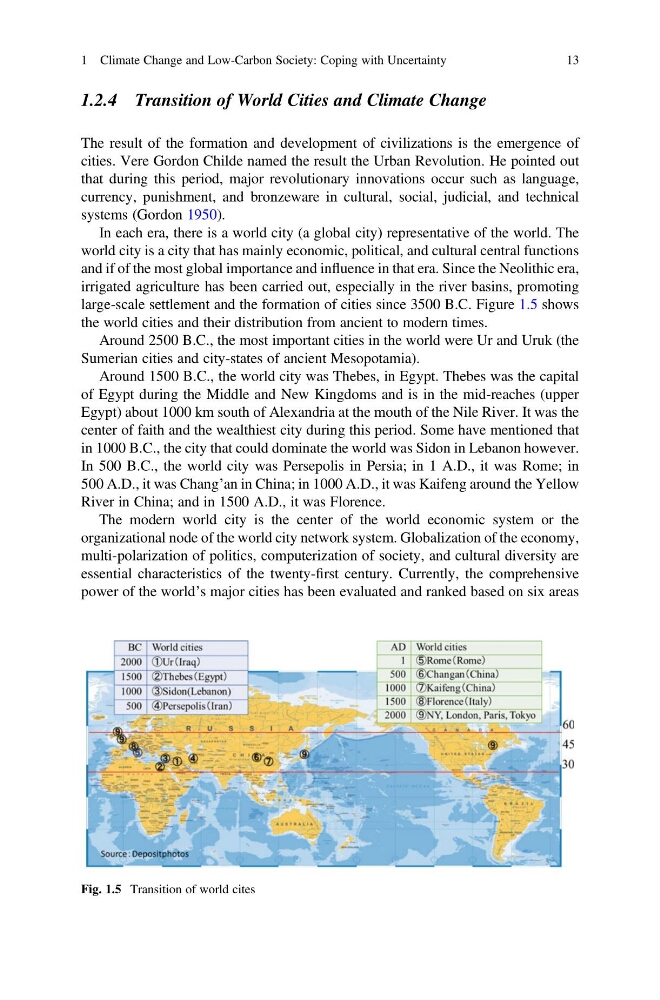
large-scale settlement and the formation of cities since 3500 B.C. Figure 1.5 shows
the world cities and their distribution from ancient to modern times.
Around 2500 B.C., the most important cities in the world were Ur and Uruk (the
Sumerian cities and city-states of ancient Mesopotamia).
Around 1500 B.C., the world city was Thebes, in Egypt. Thebes was the capital
of Egypt during the Middle and New Kingdoms and is in the mid-reaches (upper
Egypt) about 1000 km south of Alexandria at the mouth of the Nile River. It was the
center of faith and the wealthiest city during this period. Some have mentioned that
in 1000 B.C., the city that could dominate the world was Sidon in Lebanon however.
In 500 B.C., the world city was Persepolis in Persia; in 1 A.D., it was Rome; in
500 A.D., it was Chang’an in China; in 1000 A.D., it was Kaifeng around the Yellow
River in China; and in 1500 A.D., it was Florence.
The modern world city is the center of the world economic system or the
organizational node of the world city network system. Globalization of the economy,
multi-polarization of politics, computerization of society, and cultural diversity are
essential characteristics of the twenty-first century. Currently, the comprehensive
power of the world’s major cities has been evaluated and ranked based on six areas
Fig. 1.5 Transition of world cites
1 Climate Change and Low-Carbon Society: Coping with Uncertainty
13
The result of the formation and development of civilizations is the emergence of
cities. Vere Gordon Childe named the result the Urban Revolution. He pointed out
that during this period, major revolutionary innovations occur such as language,
currency, punishment, and bronzeware in cultural, social, judicial, and technical
systems (Gordon 1950).
In each era, there is a world city (a global city) representative of the world. The
world city is a city that has mainly economic, political, and cultural central functions
and if of the most global importance and influence in that era. Since the Neolithic era,
irrigated agriculture has been carried out, especially in the river basins, promoting
large-scale settlement and the formation of cities since 3500 B.C. Figure 1.5 shows
the world cities and their distribution from ancient to modern times.
Around 2500 B.C., the most important cities in the world were Ur and Uruk (the
Sumerian cities and city-states of ancient Mesopotamia).
Around 1500 B.C., the world city was Thebes, in Egypt. Thebes was the capital
of Egypt during the Middle and New Kingdoms and is in the mid-reaches (upper
Egypt) about 1000 km south of Alexandria at the mouth of the Nile River. It was the
center of faith and the wealthiest city during this period. Some have mentioned that
in 1000 B.C., the city that could dominate the world was Sidon in Lebanon however.
In 500 B.C., the world city was Persepolis in Persia; in 1 A.D., it was Rome; in
500 A.D., it was Chang’an in China; in 1000 A.D., it was Kaifeng around the Yellow
River in China; and in 1500 A.D., it was Florence.
The modern world city is the center of the world economic system or the
organizational node of the world city network system. Globalization of the economy,
multi-polarization of politics, computerization of society, and cultural diversity are
essential characteristics of the twenty-first century. Currently, the comprehensive
power of the world’s major cities has been evaluated and ranked based on six areas
Fig. 1.5 Transition of world cites
1 Climate Change and Low-Carbon Society: Coping with Uncertainty
13