

certain amount of rotating moment should act on the central pole so that electric
power can be generated.
As shown in Fig. 12.4, wind velocity varies widely throughout the year. Sometimes, a strong wind can blow from a certain direction during a short period, but
weak wind tends to blow frequently depending on the distribution characteristics in
Fig. 12.4. Wind that is strong enough to generate significant electric power occurs at
very low frequencies; therefore, for long periods of time, the windmill is exposed to
weak wind conditions. This is a very common disadvantage of windmill-type power
generation plants, regardless of location. In order to overcome this difficulty, a new
type of electric power generating system has been developed that combines four
electric generators. In this system, four of the same types of generator are installed
inside a pyramid box at the foot of the windmill generation system shown in
Fig. 12.5. Then, the number of working generators is automatically adjusted
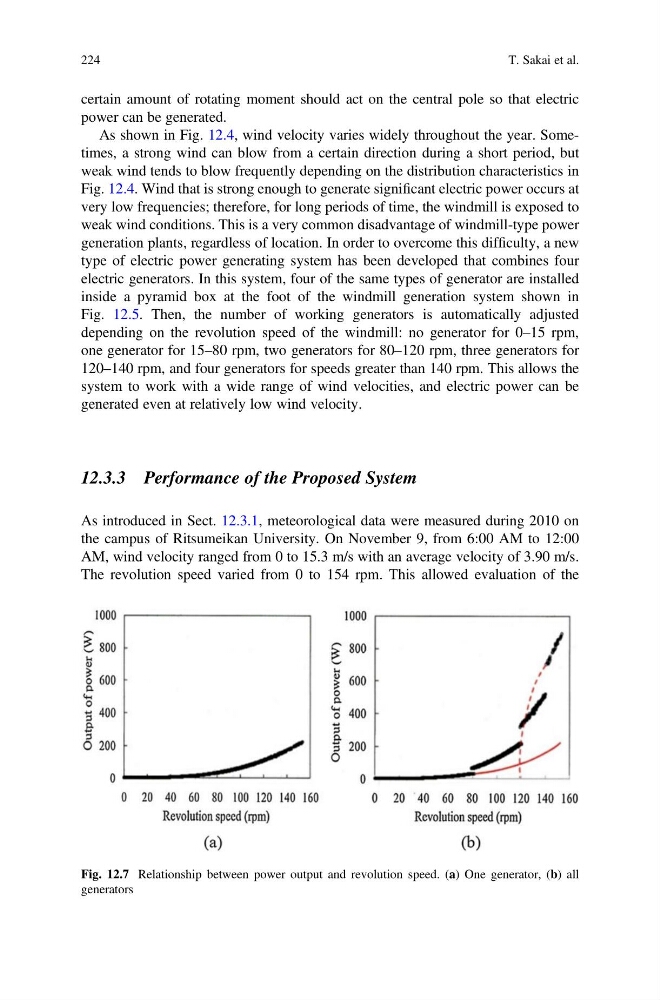
depending on the revolution speed of the windmill: no generator for 0–15 rpm,
one generator for 15–80 rpm, two generators for 80–120 rpm, three generators for
120–140 rpm, and four generators for speeds greater than 140 rpm. This allows the
system to work with a wide range of wind velocities, and electric power can be
generated even at relatively low wind velocity.
12.3.3 Performance of the Proposed System
As introduced in Sect. 12.3.1, meteorological data were measured during 2010 on
the campus of Ritsumeikan University. On November 9, from 6:00 AM to 12:00
AM, wind velocity ranged from 0 to 15.3 m/s with an average velocity of 3.90 m/s.
The revolution speed varied from 0 to 154 rpm. This allowed evaluation of the
Fig. 12.7 Relationship between power output and revolution speed. (a) One generator, (b) all
generators
224
T. Sakai et al.
power can be generated.
As shown in Fig. 12.4, wind velocity varies widely throughout the year. Sometimes, a strong wind can blow from a certain direction during a short period, but
weak wind tends to blow frequently depending on the distribution characteristics in
Fig. 12.4. Wind that is strong enough to generate significant electric power occurs at
very low frequencies; therefore, for long periods of time, the windmill is exposed to
weak wind conditions. This is a very common disadvantage of windmill-type power
generation plants, regardless of location. In order to overcome this difficulty, a new
type of electric power generating system has been developed that combines four
electric generators. In this system, four of the same types of generator are installed
inside a pyramid box at the foot of the windmill generation system shown in
Fig. 12.5. Then, the number of working generators is automatically adjusted
depending on the revolution speed of the windmill: no generator for 0–15 rpm,
one generator for 15–80 rpm, two generators for 80–120 rpm, three generators for
120–140 rpm, and four generators for speeds greater than 140 rpm. This allows the
system to work with a wide range of wind velocities, and electric power can be
generated even at relatively low wind velocity.
12.3.3 Performance of the Proposed System
As introduced in Sect. 12.3.1, meteorological data were measured during 2010 on
the campus of Ritsumeikan University. On November 9, from 6:00 AM to 12:00
AM, wind velocity ranged from 0 to 15.3 m/s with an average velocity of 3.90 m/s.
The revolution speed varied from 0 to 154 rpm. This allowed evaluation of the
Fig. 12.7 Relationship between power output and revolution speed. (a) One generator, (b) all
generators
224
T. Sakai et al.