

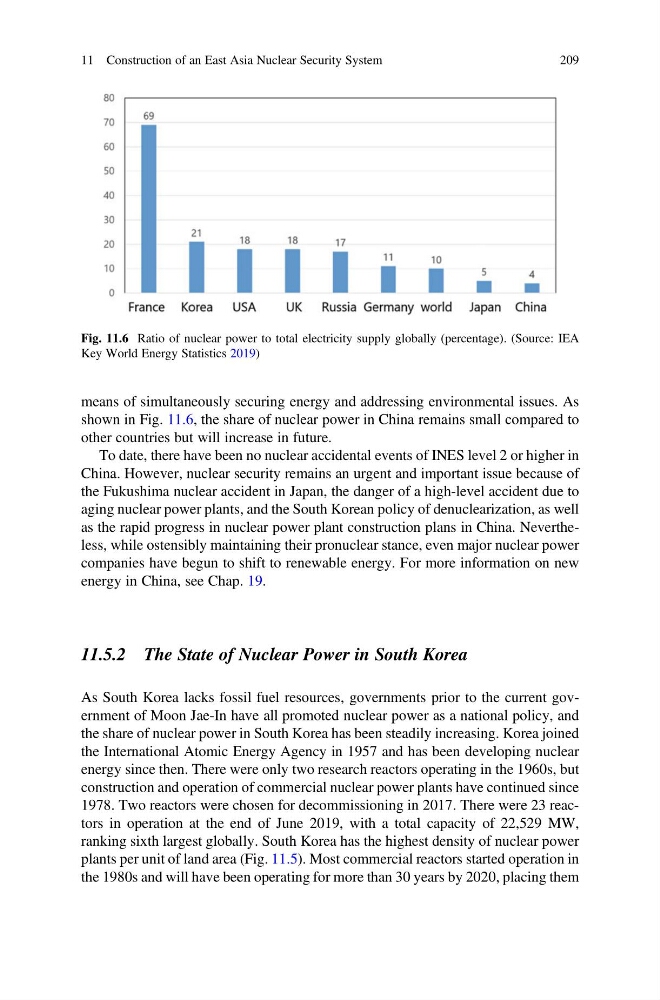
means of simultaneously securing energy and addressing environmental issues. As
shown in Fig. 11.6, the share of nuclear power in China remains small compared to
other countries but will increase in future.
To date, there have been no nuclear accidental events of INES level 2 or higher in
China. However, nuclear security remains an urgent and important issue because of
the Fukushima nuclear accident in Japan, the danger of a high-level accident due to
aging nuclear power plants, and the South Korean policy of denuclearization, as well
as the rapid progress in nuclear power plant construction plans in China. Nevertheless, while ostensibly maintaining their pronuclear stance, even major nuclear power
companies have begun to shift to renewable energy. For more information on new
energy in China, see Chap. 19.
11.5.2 The State of Nuclear Power in South Korea
As South Korea lacks fossil fuel resources, governments prior to the current government of Moon Jae-In have all promoted nuclear power as a national policy, and
the share of nuclear power in South Korea has been steadily increasing. Korea joined
the International Atomic Energy Agency in 1957 and has been developing nuclear
energy since then. There were only two research reactors operating in the 1960s, but
construction and operation of commercial nuclear power plants have continued since
1978. Two reactors were chosen for decommissioning in 2017. There were 23 reactors in operation at the end of June 2019, with a total capacity of 22,529 MW,
ranking sixth largest globally. South Korea has the highest density of nuclear power
plants per unit of land area (Fig. 11.5). Most commercial reactors started operation in
the 1980s and will have been operating for more than 30 years by 2020, placing them
Fig. 11.6 Ratio of nuclear power to total electricity supply globally (percentage). (Source: IEA
Key World Energy Statistics 2019)
11 Construction of an East Asia Nuclear Security System
209
shown in Fig. 11.6, the share of nuclear power in China remains small compared to
other countries but will increase in future.
To date, there have been no nuclear accidental events of INES level 2 or higher in
China. However, nuclear security remains an urgent and important issue because of
the Fukushima nuclear accident in Japan, the danger of a high-level accident due to
aging nuclear power plants, and the South Korean policy of denuclearization, as well
as the rapid progress in nuclear power plant construction plans in China. Nevertheless, while ostensibly maintaining their pronuclear stance, even major nuclear power
companies have begun to shift to renewable energy. For more information on new
energy in China, see Chap. 19.
11.5.2 The State of Nuclear Power in South Korea
As South Korea lacks fossil fuel resources, governments prior to the current government of Moon Jae-In have all promoted nuclear power as a national policy, and
the share of nuclear power in South Korea has been steadily increasing. Korea joined
the International Atomic Energy Agency in 1957 and has been developing nuclear
energy since then. There were only two research reactors operating in the 1960s, but
construction and operation of commercial nuclear power plants have continued since
1978. Two reactors were chosen for decommissioning in 2017. There were 23 reactors in operation at the end of June 2019, with a total capacity of 22,529 MW,
ranking sixth largest globally. South Korea has the highest density of nuclear power
plants per unit of land area (Fig. 11.5). Most commercial reactors started operation in
the 1980s and will have been operating for more than 30 years by 2020, placing them
Fig. 11.6 Ratio of nuclear power to total electricity supply globally (percentage). (Source: IEA
Key World Energy Statistics 2019)
11 Construction of an East Asia Nuclear Security System
209