

avoidable. In this context, design and manufacturing issues are related to the
fundamentals of nuclear technology; problems are gradually solved as technological
innovations are made. Nevertheless, current technology has its limits, and not all
technological problems can be solved.
Both studies described here limited their scope primarily to two countries. The
absence of a global analysis of accidents means that differences in types of nuclear
power plant have not been taken into account. Therefore, this chapter analyzes
accidental events in private nuclear power plants worldwide according to four
factors: country, reactor type, cause, and operational period.
11.3 Database of Accidents
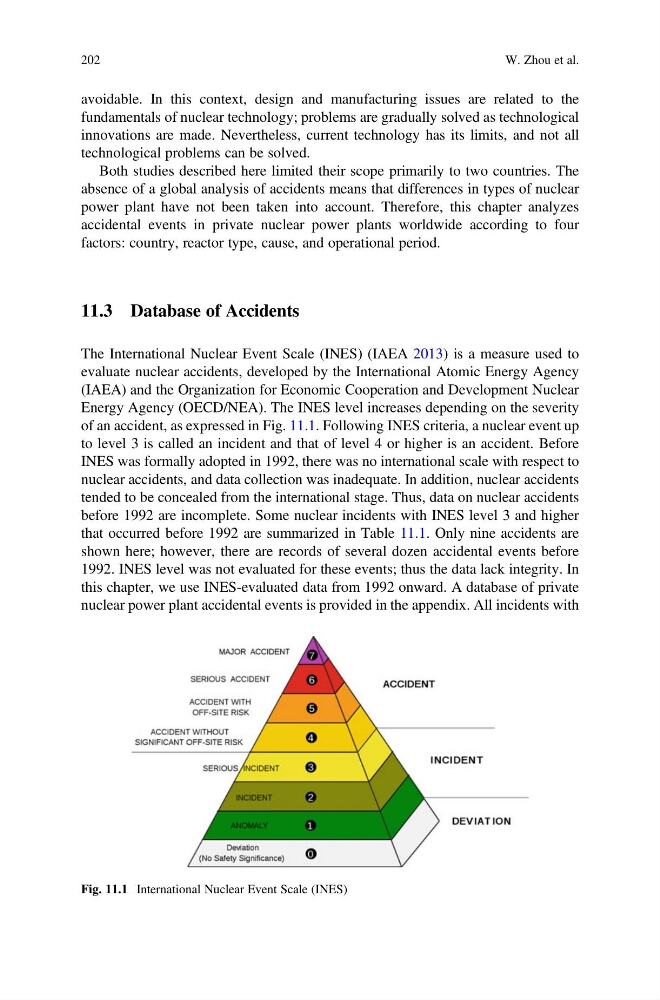
The International Nuclear Event Scale (INES) (IAEA 2013) is a measure used to
evaluate nuclear accidents, developed by the International Atomic Energy Agency
(IAEA) and the Organization for Economic Cooperation and Development Nuclear
Energy Agency (OECD/NEA). The INES level increases depending on the severity
of an accident, as expressed in Fig. 11.1. Following INES criteria, a nuclear event up
to level 3 is called an incident and that of level 4 or higher is an accident. Before
INES was formally adopted in 1992, there was no international scale with respect to
nuclear accidents, and data collection was inadequate. In addition, nuclear accidents
tended to be concealed from the international stage. Thus, data on nuclear accidents
before 1992 are incomplete. Some nuclear incidents with INES level 3 and higher
that occurred before 1992 are summarized in Table 11.1. Only nine accidents are
shown here; however, there are records of several dozen accidental events before
1992. INES level was not evaluated for these events; thus the data lack integrity. In
this chapter, we use INES-evaluated data from 1992 onward. A database of private
nuclear power plant accidental events is provided in the appendix. All incidents with
Fig. 11.1 International Nuclear Event Scale (INES)
202
W. Zhou et al.
fundamentals of nuclear technology; problems are gradually solved as technological
innovations are made. Nevertheless, current technology has its limits, and not all
technological problems can be solved.
Both studies described here limited their scope primarily to two countries. The
absence of a global analysis of accidents means that differences in types of nuclear
power plant have not been taken into account. Therefore, this chapter analyzes
accidental events in private nuclear power plants worldwide according to four
factors: country, reactor type, cause, and operational period.
11.3 Database of Accidents
The International Nuclear Event Scale (INES) (IAEA 2013) is a measure used to
evaluate nuclear accidents, developed by the International Atomic Energy Agency
(IAEA) and the Organization for Economic Cooperation and Development Nuclear
Energy Agency (OECD/NEA). The INES level increases depending on the severity
of an accident, as expressed in Fig. 11.1. Following INES criteria, a nuclear event up
to level 3 is called an incident and that of level 4 or higher is an accident. Before
INES was formally adopted in 1992, there was no international scale with respect to
nuclear accidents, and data collection was inadequate. In addition, nuclear accidents
tended to be concealed from the international stage. Thus, data on nuclear accidents
before 1992 are incomplete. Some nuclear incidents with INES level 3 and higher
that occurred before 1992 are summarized in Table 11.1. Only nine accidents are
shown here; however, there are records of several dozen accidental events before
1992. INES level was not evaluated for these events; thus the data lack integrity. In
this chapter, we use INES-evaluated data from 1992 onward. A database of private
nuclear power plant accidental events is provided in the appendix. All incidents with
Fig. 11.1 International Nuclear Event Scale (INES)
202
W. Zhou et al.