

10.3 Simulation Methods
10.3.1 Overview of a CGE Model
A CGE model is a comprehensive economic simulation model that is widely used to
provide economic impact assessments of public policy in areas such as trade, energy,
and the environment. The general equilibrium model, which is the theoretical basis
of a CGE model, describes an overall economy as an interaction among economic
agents such as households and firms in markets. In a standard CGE model, the
behavior of economic agents is assumed to be rational. Given the prices of goods and
services, households maximize their utility subject to budgetary constraints. Firms
minimize unit production costs with production technology constraints, given wage
rates, capital rental prices, and the prices of intermediate goods. A household budget
comprises labor income, capital income, and income transfer. General equilibrium
theory asserts that demand and supply in all markets considered in the model is
balanced through a price adjustment mechanism.
CGE models are referred to as computable because the mathematical formation of
the general equilibrium model as a nonlinear simultaneous equation is solvable
numerically. A CGE model itself is a nonlinear simultaneous equation whose
parameters are calibrated using an input–output table that describes interindustrial
trade flow and industry–household trade flow on various regional scales. The current
study uses a global input–output table, the Global Trade Analysis Project (GTAP)
9 database. Hosoe et al. (2015) explain the structure of CGE models in detail.
0
200
400
600
800
1,000
1,200
1,400
2007 2008 2009 2010 2011 2012 2013 2014 2015 2016 2017
1000 GWh
year
Renewables
Nuclear
Hydro
Oil-fired
Gas-fired
Coal-fired
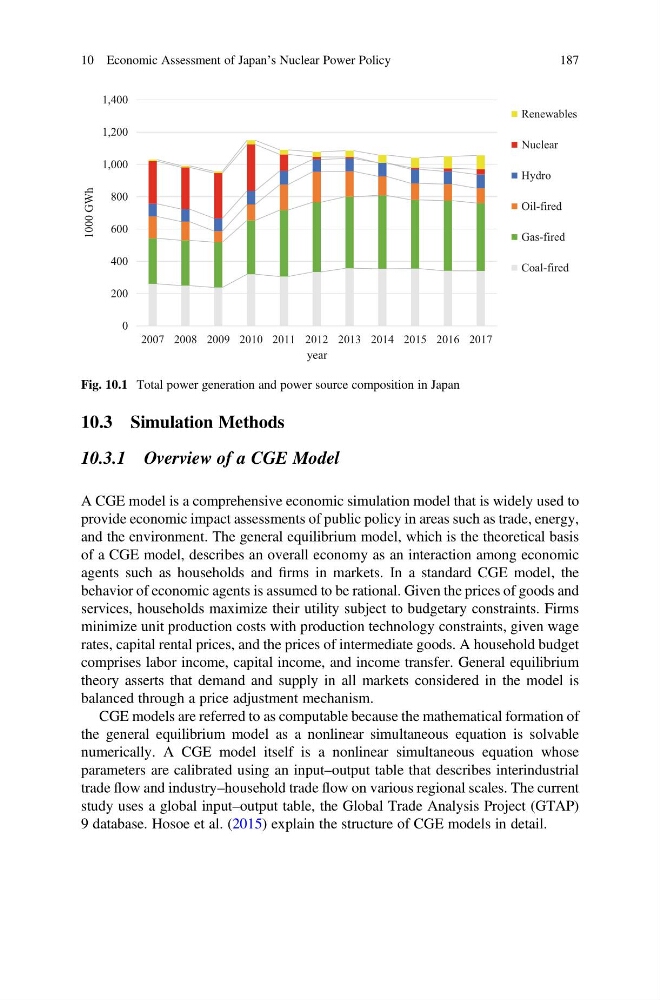
Fig. 10.1 Total power generation and power source composition in Japan
10 Economic Assessment of Japan’s Nuclear Power Policy
187
10.3.1 Overview of a CGE Model
A CGE model is a comprehensive economic simulation model that is widely used to
provide economic impact assessments of public policy in areas such as trade, energy,
and the environment. The general equilibrium model, which is the theoretical basis
of a CGE model, describes an overall economy as an interaction among economic
agents such as households and firms in markets. In a standard CGE model, the
behavior of economic agents is assumed to be rational. Given the prices of goods and
services, households maximize their utility subject to budgetary constraints. Firms
minimize unit production costs with production technology constraints, given wage
rates, capital rental prices, and the prices of intermediate goods. A household budget
comprises labor income, capital income, and income transfer. General equilibrium
theory asserts that demand and supply in all markets considered in the model is
balanced through a price adjustment mechanism.
CGE models are referred to as computable because the mathematical formation of
the general equilibrium model as a nonlinear simultaneous equation is solvable
numerically. A CGE model itself is a nonlinear simultaneous equation whose
parameters are calibrated using an input–output table that describes interindustrial
trade flow and industry–household trade flow on various regional scales. The current
study uses a global input–output table, the Global Trade Analysis Project (GTAP)
9 database. Hosoe et al. (2015) explain the structure of CGE models in detail.
0
200
400
600
800
1,000
1,200
1,400
2007 2008 2009 2010 2011 2012 2013 2014 2015 2016 2017
1000 GWh
year
Renewables
Nuclear
Hydro
Oil-fired
Gas-fired
Coal-fired
Fig. 10.1 Total power generation and power source composition in Japan
10 Economic Assessment of Japan’s Nuclear Power Policy
187