

2. The presence of a broad plain: a large population provides advantages to the
prosperity of a civilization. Therefore, a broad plain that may be easily populated
is needed.
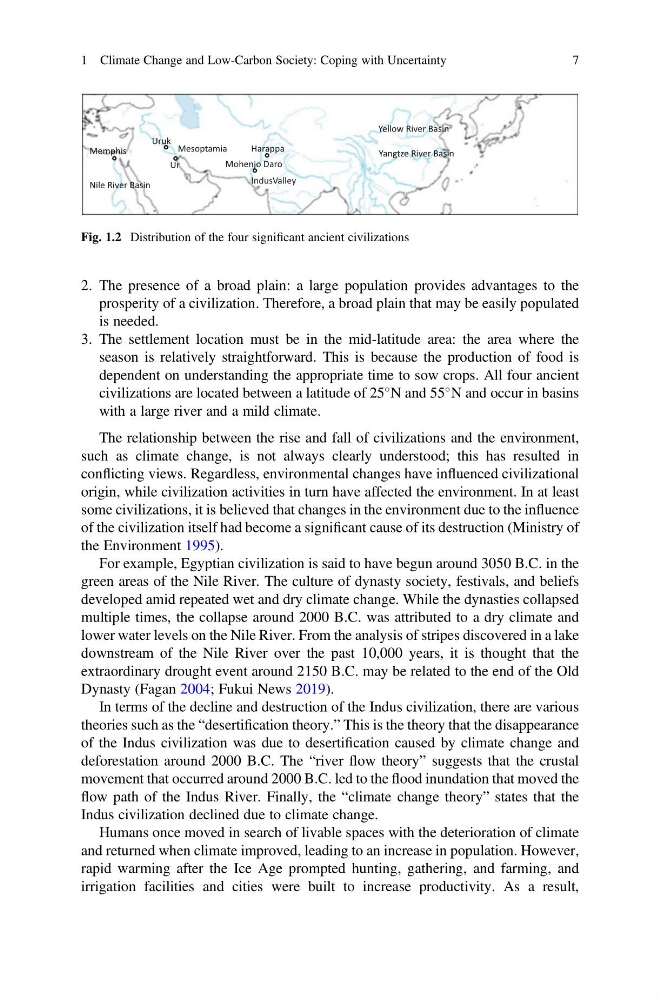
3. The settlement location must be in the mid-latitude area: the area where the
season is relatively straightforward. This is because the production of food is
dependent on understanding the appropriate time to sow crops. All four ancient
civilizations are located between a latitude of 25
N and 55
N and occur in basins
with a large river and a mild climate.
The relationship between the rise and fall of civilizations and the environment,
such as climate change, is not always clearly understood; this has resulted in
conflicting views. Regardless, environmental changes have influenced civilizational
origin, while civilization activities in turn have affected the environment. In at least
some civilizations, it is believed that changes in the environment due to the influence
of the civilization itself had become a significant cause of its destruction (Ministry of
the Environment 1995).
For example, Egyptian civilization is said to have begun around 3050 B.C. in the
green areas of the Nile River. The culture of dynasty society, festivals, and beliefs
developed amid repeated wet and dry climate change. While the dynasties collapsed
multiple times, the collapse around 2000 B.C. was attributed to a dry climate and
lower water levels on the Nile River. From the analysis of stripes discovered in a lake
downstream of the Nile River over the past 10,000 years, it is thought that the
extraordinary drought event around 2150 B.C. may be related to the end of the Old
Dynasty (Fagan 2004; Fukui News 2019).
In terms of the decline and destruction of the Indus civilization, there are various
theories such as the “desertification theory.” This is the theory that the disappearance
of the Indus civilization was due to desertification caused by climate change and
deforestation around 2000 B.C. The “river flow theory” suggests that the crustal
movement that occurred around 2000 B.C. led to the flood inundation that moved the
flow path of the Indus River. Finally, the “climate change theory” states that the
Indus civilization declined due to climate change.
Humans once moved in search of livable spaces with the deterioration of climate
and returned when climate improved, leading to an increase in population. However,
rapid warming after the Ice Age prompted hunting, gathering, and farming, and
irrigation facilities and cities were built to increase productivity. As a result,
Memphis
Nile River Basin
Uruk
Ur
Mesoptamia
Mohenjo Daro
Harappa
IndusValley
Yellow River Basin
Yangtze River Basin
Fig. 1.2 Distribution of the four significant ancient civilizations
1 Climate Change and Low-Carbon Society: Coping with Uncertainty
7
prosperity of a civilization. Therefore, a broad plain that may be easily populated
is needed.
3. The settlement location must be in the mid-latitude area: the area where the
season is relatively straightforward. This is because the production of food is
dependent on understanding the appropriate time to sow crops. All four ancient
civilizations are located between a latitude of 25
N and 55
N and occur in basins
with a large river and a mild climate.
The relationship between the rise and fall of civilizations and the environment,
such as climate change, is not always clearly understood; this has resulted in
conflicting views. Regardless, environmental changes have influenced civilizational
origin, while civilization activities in turn have affected the environment. In at least
some civilizations, it is believed that changes in the environment due to the influence
of the civilization itself had become a significant cause of its destruction (Ministry of
the Environment 1995).
For example, Egyptian civilization is said to have begun around 3050 B.C. in the
green areas of the Nile River. The culture of dynasty society, festivals, and beliefs
developed amid repeated wet and dry climate change. While the dynasties collapsed
multiple times, the collapse around 2000 B.C. was attributed to a dry climate and
lower water levels on the Nile River. From the analysis of stripes discovered in a lake
downstream of the Nile River over the past 10,000 years, it is thought that the
extraordinary drought event around 2150 B.C. may be related to the end of the Old
Dynasty (Fagan 2004; Fukui News 2019).
In terms of the decline and destruction of the Indus civilization, there are various
theories such as the “desertification theory.” This is the theory that the disappearance
of the Indus civilization was due to desertification caused by climate change and
deforestation around 2000 B.C. The “river flow theory” suggests that the crustal
movement that occurred around 2000 B.C. led to the flood inundation that moved the
flow path of the Indus River. Finally, the “climate change theory” states that the
Indus civilization declined due to climate change.
Humans once moved in search of livable spaces with the deterioration of climate
and returned when climate improved, leading to an increase in population. However,
rapid warming after the Ice Age prompted hunting, gathering, and farming, and
irrigation facilities and cities were built to increase productivity. As a result,
Memphis
Nile River Basin
Uruk
Ur
Mesoptamia
Mohenjo Daro
Harappa
IndusValley
Yellow River Basin
Yangtze River Basin
Fig. 1.2 Distribution of the four significant ancient civilizations
1 Climate Change and Low-Carbon Society: Coping with Uncertainty
7