

petroleum gas (LPG), or city gas. In contrast, conventional noncommercial
biomass takes the main role in fulfilling thermal requirements in rural areas.
Deficiencies are supplemented by coal or LPG-fueled stoves.
Scenario 1: Urban dominant cooperation
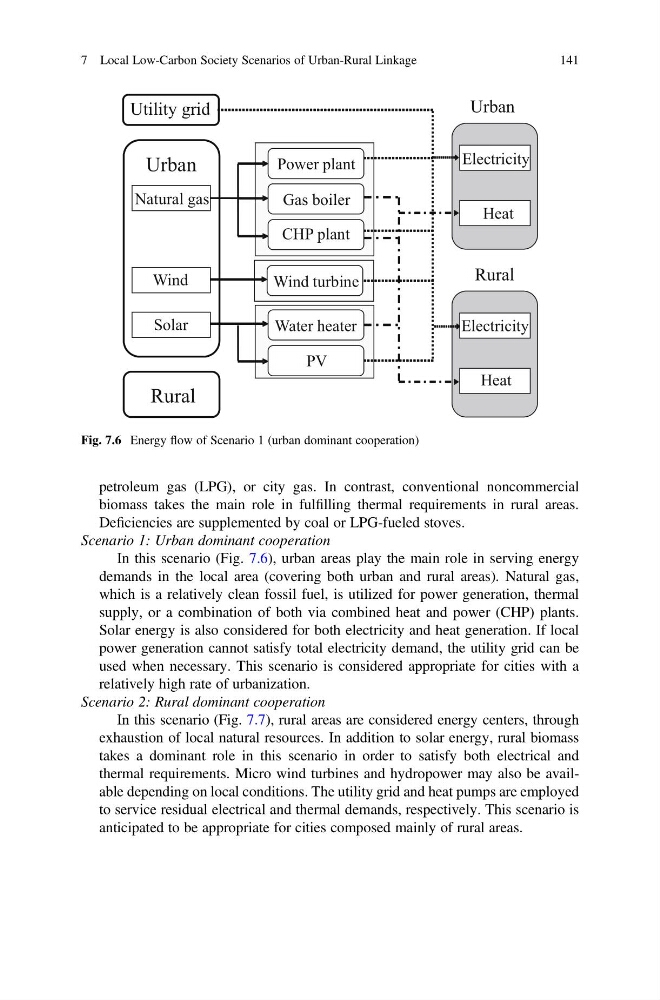
In this scenario (Fig. 7.6), urban areas play the main role in serving energy
demands in the local area (covering both urban and rural areas). Natural gas,
which is a relatively clean fossil fuel, is utilized for power generation, thermal
supply, or a combination of both via combined heat and power (CHP) plants.
Solar energy is also considered for both electricity and heat generation. If local
power generation cannot satisfy total electricity demand, the utility grid can be
used when necessary. This scenario is considered appropriate for cities with a
relatively high rate of urbanization.
Scenario 2: Rural dominant cooperation
In this scenario (Fig. 7.7), rural areas are considered energy centers, through
exhaustion of local natural resources. In addition to solar energy, rural biomass
takes a dominant role in this scenario in order to satisfy both electrical and
thermal requirements. Micro wind turbines and hydropower may also be available depending on local conditions. The utility grid and heat pumps are employed
to service residual electrical and thermal demands, respectively. This scenario is
anticipated to be appropriate for cities composed mainly of rural areas.
Electricity
Heat
Heat
Urban
Rural
Rural
Utility grid
Urban
Natural gas
Power plant
Gas boiler
CHP plant
Water heater
PV
Wind turbine
Wind
Solar
Electricity
Fig. 7.6 Energy flow of Scenario 1 (urban dominant cooperation)
7 Local Low-Carbon Society Scenarios of Urban-Rural Linkage
141
biomass takes the main role in fulfilling thermal requirements in rural areas.
Deficiencies are supplemented by coal or LPG-fueled stoves.
Scenario 1: Urban dominant cooperation
In this scenario (Fig. 7.6), urban areas play the main role in serving energy
demands in the local area (covering both urban and rural areas). Natural gas,
which is a relatively clean fossil fuel, is utilized for power generation, thermal
supply, or a combination of both via combined heat and power (CHP) plants.
Solar energy is also considered for both electricity and heat generation. If local
power generation cannot satisfy total electricity demand, the utility grid can be
used when necessary. This scenario is considered appropriate for cities with a
relatively high rate of urbanization.
Scenario 2: Rural dominant cooperation
In this scenario (Fig. 7.7), rural areas are considered energy centers, through
exhaustion of local natural resources. In addition to solar energy, rural biomass
takes a dominant role in this scenario in order to satisfy both electrical and
thermal requirements. Micro wind turbines and hydropower may also be available depending on local conditions. The utility grid and heat pumps are employed
to service residual electrical and thermal demands, respectively. This scenario is
anticipated to be appropriate for cities composed mainly of rural areas.
Electricity
Heat
Heat
Urban
Rural
Rural
Utility grid
Urban
Natural gas
Power plant
Gas boiler
CHP plant
Water heater
PV
Wind turbine
Wind
Solar
Electricity
Fig. 7.6 Energy flow of Scenario 1 (urban dominant cooperation)
7 Local Low-Carbon Society Scenarios of Urban-Rural Linkage
141