

7.2 Local Renewable Energy Stocks
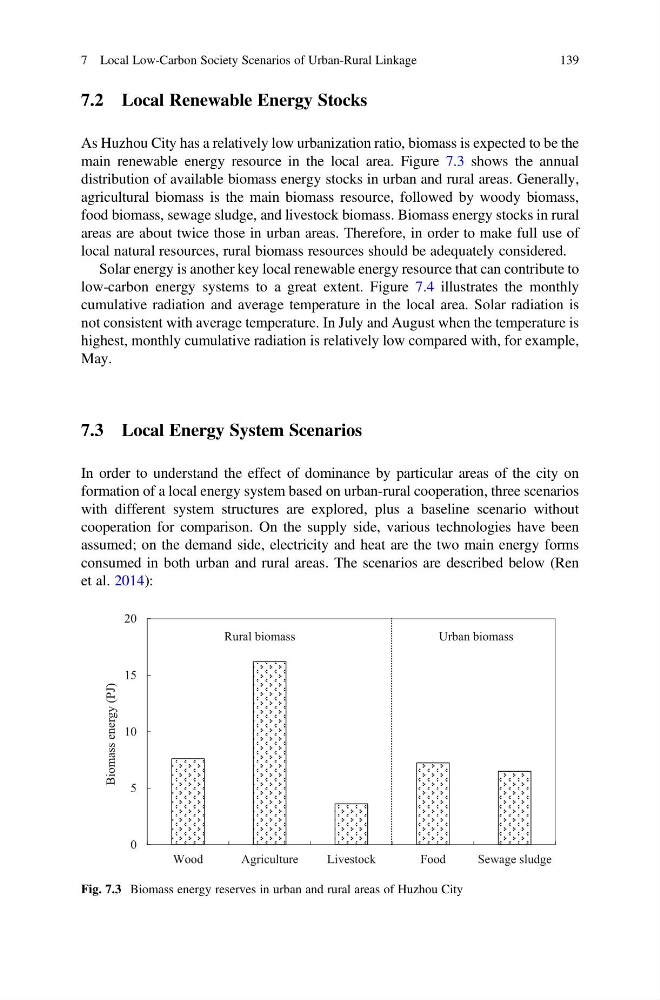
As Huzhou City has a relatively low urbanization ratio, biomass is expected to be the
main renewable energy resource in the local area. Figure 7.3 shows the annual
distribution of available biomass energy stocks in urban and rural areas. Generally,
agricultural biomass is the main biomass resource, followed by woody biomass,
food biomass, sewage sludge, and livestock biomass. Biomass energy stocks in rural
areas are about twice those in urban areas. Therefore, in order to make full use of
local natural resources, rural biomass resources should be adequately considered.
Solar energy is another key local renewable energy resource that can contribute to
low-carbon energy systems to a great extent. Figure 7.4 illustrates the monthly
cumulative radiation and average temperature in the local area. Solar radiation is
not consistent with average temperature. In July and August when the temperature is
highest, monthly cumulative radiation is relatively low compared with, for example,
May.
7.3 Local Energy System Scenarios
In order to understand the effect of dominance by particular areas of the city on
formation of a local energy system based on urban-rural cooperation, three scenarios
with different system structures are explored, plus a baseline scenario without
cooperation for comparison. On the supply side, various technologies have been
assumed; on the demand side, electricity and heat are the two main energy forms
consumed in both urban and rural areas. The scenarios are described below (Ren
et al. 2014):
0
5
10
15
20
Wood
Agriculture
Livestock
Food
Sewage sludge
)
J
P
(
y
g
r
e
n
e
s
s
a
m
o
i
B
Rural biomass
Urban biomass
Fig. 7.3 Biomass energy reserves in urban and rural areas of Huzhou City
7 Local Low-Carbon Society Scenarios of Urban-Rural Linkage
139
As Huzhou City has a relatively low urbanization ratio, biomass is expected to be the
main renewable energy resource in the local area. Figure 7.3 shows the annual
distribution of available biomass energy stocks in urban and rural areas. Generally,
agricultural biomass is the main biomass resource, followed by woody biomass,
food biomass, sewage sludge, and livestock biomass. Biomass energy stocks in rural
areas are about twice those in urban areas. Therefore, in order to make full use of
local natural resources, rural biomass resources should be adequately considered.
Solar energy is another key local renewable energy resource that can contribute to
low-carbon energy systems to a great extent. Figure 7.4 illustrates the monthly
cumulative radiation and average temperature in the local area. Solar radiation is
not consistent with average temperature. In July and August when the temperature is
highest, monthly cumulative radiation is relatively low compared with, for example,
May.
7.3 Local Energy System Scenarios
In order to understand the effect of dominance by particular areas of the city on
formation of a local energy system based on urban-rural cooperation, three scenarios
with different system structures are explored, plus a baseline scenario without
cooperation for comparison. On the supply side, various technologies have been
assumed; on the demand side, electricity and heat are the two main energy forms
consumed in both urban and rural areas. The scenarios are described below (Ren
et al. 2014):
0
5
10
15
20
Wood
Agriculture
Livestock
Food
Sewage sludge
)
J
P
(
y
g
r
e
n
e
s
s
a
m
o
i
B
Rural biomass
Urban biomass
Fig. 7.3 Biomass energy reserves in urban and rural areas of Huzhou City
7 Local Low-Carbon Society Scenarios of Urban-Rural Linkage
139