

Market information includes the energy tariffs and financial data of the DER
equipment, including capital, operating, and maintenance costs, together with the
interest rate on the investment. Sometimes, policy-related data, such as carbon tax
rates, are also provided.
The outputs to be determined by the tool while minimizing cost are:
• Technology (or combination of technologies) installed and their respective
capacities
• Hourly operating schedules for installed equipment
• Total cost and carbon emissions of supplying the total energy requirement
through either DER or macro grid generation or, more typically, a combination
of both
6.3 Objective Function
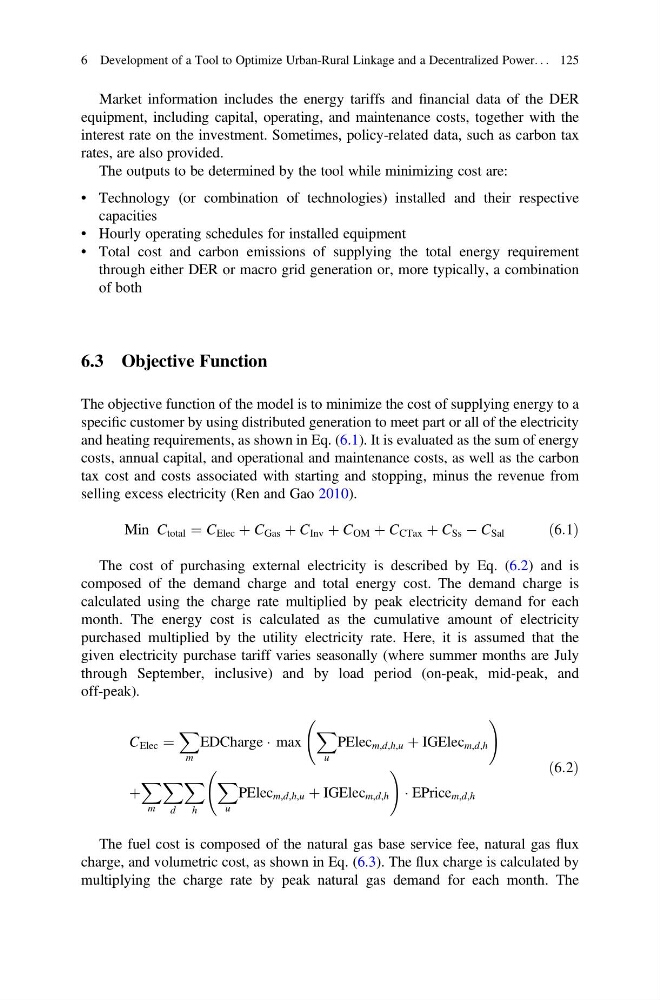
The objective function of the model is to minimize the cost of supplying energy to a
specific customer by using distributed generation to meet part or all of the electricity
and heating requirements, as shown in Eq. (6.1). It is evaluated as the sum of energy
costs, annual capital, and operational and maintenance costs, as well as the carbon
tax cost and costs associated with starting and stopping, minus the revenue from
selling excess electricity (Ren and Gao 2010).
Min C total ¼ C Elec þ C Gas þ C Inv þ C OM þ C CTax þ C Ss À C Sal
ð6:1Þ
The cost of purchasing external electricity is described by Eq. (6.2) and is
composed of the demand charge and total energy cost. The demand charge is
calculated using the charge rate multiplied by peak electricity demand for each
month. The energy cost is calculated as the cumulative amount of electricity
purchased multiplied by the utility electricity rate. Here, it is assumed that the
given electricity purchase tariff varies seasonally (where summer months are July
through September, inclusive) and by load period (on-peak, mid-peak, and
off-peak).
C Elec ¼
X
m
EDCharge Á max
X
u
PElec m,d,h,u þ IGElec m,d,h
!
þ
X
m
X
d
X
h
X
u
PElec m,d,h,u þ IGElec m,d,h
!
Á EPrice m,d,h
ð6:2Þ
The fuel cost is composed of the natural gas base service fee, natural gas flux
charge, and volumetric cost, as shown in Eq. (6.3). The flux charge is calculated by
multiplying the charge rate by peak natural gas demand for each month. The
6 Development of a Tool to Optimize Urban-Rural Linkage and a Decentralized Power. . . 125
equipment, including capital, operating, and maintenance costs, together with the
interest rate on the investment. Sometimes, policy-related data, such as carbon tax
rates, are also provided.
The outputs to be determined by the tool while minimizing cost are:
• Technology (or combination of technologies) installed and their respective
capacities
• Hourly operating schedules for installed equipment
• Total cost and carbon emissions of supplying the total energy requirement
through either DER or macro grid generation or, more typically, a combination
of both
6.3 Objective Function
The objective function of the model is to minimize the cost of supplying energy to a
specific customer by using distributed generation to meet part or all of the electricity
and heating requirements, as shown in Eq. (6.1). It is evaluated as the sum of energy
costs, annual capital, and operational and maintenance costs, as well as the carbon
tax cost and costs associated with starting and stopping, minus the revenue from
selling excess electricity (Ren and Gao 2010).
Min C total ¼ C Elec þ C Gas þ C Inv þ C OM þ C CTax þ C Ss À C Sal
ð6:1Þ
The cost of purchasing external electricity is described by Eq. (6.2) and is
composed of the demand charge and total energy cost. The demand charge is
calculated using the charge rate multiplied by peak electricity demand for each
month. The energy cost is calculated as the cumulative amount of electricity
purchased multiplied by the utility electricity rate. Here, it is assumed that the
given electricity purchase tariff varies seasonally (where summer months are July
through September, inclusive) and by load period (on-peak, mid-peak, and
off-peak).
C Elec ¼
X
m
EDCharge Á max
X
u
PElec m,d,h,u þ IGElec m,d,h
!
þ
X
m
X
d
X
h
X
u
PElec m,d,h,u þ IGElec m,d,h
!
Á EPrice m,d,h
ð6:2Þ
The fuel cost is composed of the natural gas base service fee, natural gas flux
charge, and volumetric cost, as shown in Eq. (6.3). The flux charge is calculated by
multiplying the charge rate by peak natural gas demand for each month. The
6 Development of a Tool to Optimize Urban-Rural Linkage and a Decentralized Power. . . 125