

86
5 Lattice Dynamics of Molecular Crystals
5.2.1 Atomic Array
5.2.1.1 Simple array
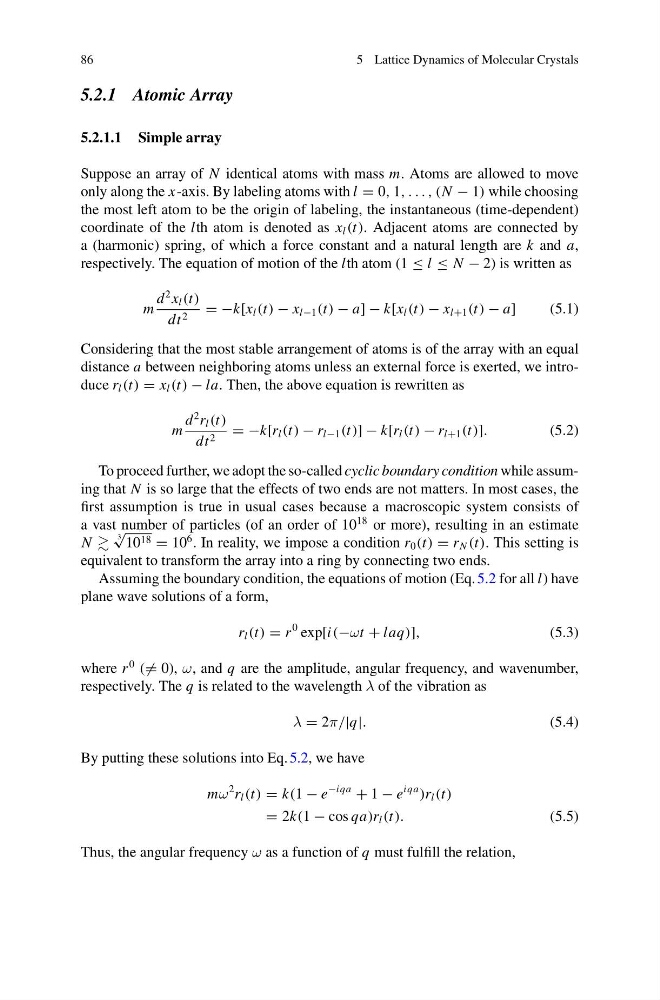
Suppose an array of N identical atoms with mass m. Atoms are allowed to move
only along the x-axis. By labeling atoms with l = 0, 1, . . . , (N − 1) while choosing
the most left atom to be the origin of labeling, the instantaneous (time-dependent)
coordinate of the lth atom is denoted as x l (t). Adjacent atoms are connected by
a (harmonic) spring, of which a force constant and a natural length are k and a,
respectively. The equation of motion of the lth atom (1 ≤ l ≤ N − 2) is written as
m
d
2 x l (t)
dt 2 = −k[x l (t) − x l−1 (t) − a] − k[x l (t) − x l+1 (t) − a]
(5.1)
Considering that the most stable arrangement of atoms is of the array with an equal
distance a between neighboring atoms unless an external force is exerted, we introduce r l (t) = x l (t) − la. Then, the above equation is rewritten as
m
d
2 r l (t)
dt 2 = −k[r l (t) − r l−1 (t)] − k[r l (t) − r l+1 (t)].
(5.2)
To proceed further, we adopt the so-called cyclic boundary condition while assuming that N is so large that the effects of two ends are not matters. In most cases, the
first assumption is true in usual cases because a macroscopic system consists of
a vast number of particles (of an order of 10
18 or more), resulting in an estimate
N
3
√
10 18 = 10
6 . In reality, we impose a condition r 0 (t) = r N (t). This setting is
equivalent to transform the array into a ring by connecting two ends.
Assuming the boundary condition, the equations of motion (Eq. 5.2 for all l) have
plane wave solutions of a form,
r l (t) = r
0 exp[i(−ωt + laq)],
(5.3)
where r
0 ( = 0), ω, and q are the amplitude, angular frequency, and wavenumber,
respectively. The q is related to the wavelength λ of the vibration as
λ = 2π/|q|.
(5.4)
By putting these solutions into Eq. 5.2, we have
mω
2 r l (t) = k(1 − e
−iqa
+ 1 − e
iqa
)r l (t)
= 2k(1 − cos qa)r l (t).
(5.5)
Thus, the angular frequency ω as a function of q must fulfill the relation,
5 Lattice Dynamics of Molecular Crystals
5.2.1 Atomic Array
5.2.1.1 Simple array
Suppose an array of N identical atoms with mass m. Atoms are allowed to move
only along the x-axis. By labeling atoms with l = 0, 1, . . . , (N − 1) while choosing
the most left atom to be the origin of labeling, the instantaneous (time-dependent)
coordinate of the lth atom is denoted as x l (t). Adjacent atoms are connected by
a (harmonic) spring, of which a force constant and a natural length are k and a,
respectively. The equation of motion of the lth atom (1 ≤ l ≤ N − 2) is written as
m
d
2 x l (t)
dt 2 = −k[x l (t) − x l−1 (t) − a] − k[x l (t) − x l+1 (t) − a]
(5.1)
Considering that the most stable arrangement of atoms is of the array with an equal
distance a between neighboring atoms unless an external force is exerted, we introduce r l (t) = x l (t) − la. Then, the above equation is rewritten as
m
d
2 r l (t)
dt 2 = −k[r l (t) − r l−1 (t)] − k[r l (t) − r l+1 (t)].
(5.2)
To proceed further, we adopt the so-called cyclic boundary condition while assuming that N is so large that the effects of two ends are not matters. In most cases, the
first assumption is true in usual cases because a macroscopic system consists of
a vast number of particles (of an order of 10
18 or more), resulting in an estimate
N
3
√
10 18 = 10
6 . In reality, we impose a condition r 0 (t) = r N (t). This setting is
equivalent to transform the array into a ring by connecting two ends.
Assuming the boundary condition, the equations of motion (Eq. 5.2 for all l) have
plane wave solutions of a form,
r l (t) = r
0 exp[i(−ωt + laq)],
(5.3)
where r
0 ( = 0), ω, and q are the amplitude, angular frequency, and wavenumber,
respectively. The q is related to the wavelength λ of the vibration as
λ = 2π/|q|.
(5.4)
By putting these solutions into Eq. 5.2, we have
mω
2 r l (t) = k(1 − e
−iqa
+ 1 − e
iqa
)r l (t)
= 2k(1 − cos qa)r l (t).
(5.5)
Thus, the angular frequency ω as a function of q must fulfill the relation,