

4.3 Molecular Shape and Crystal Structure
75
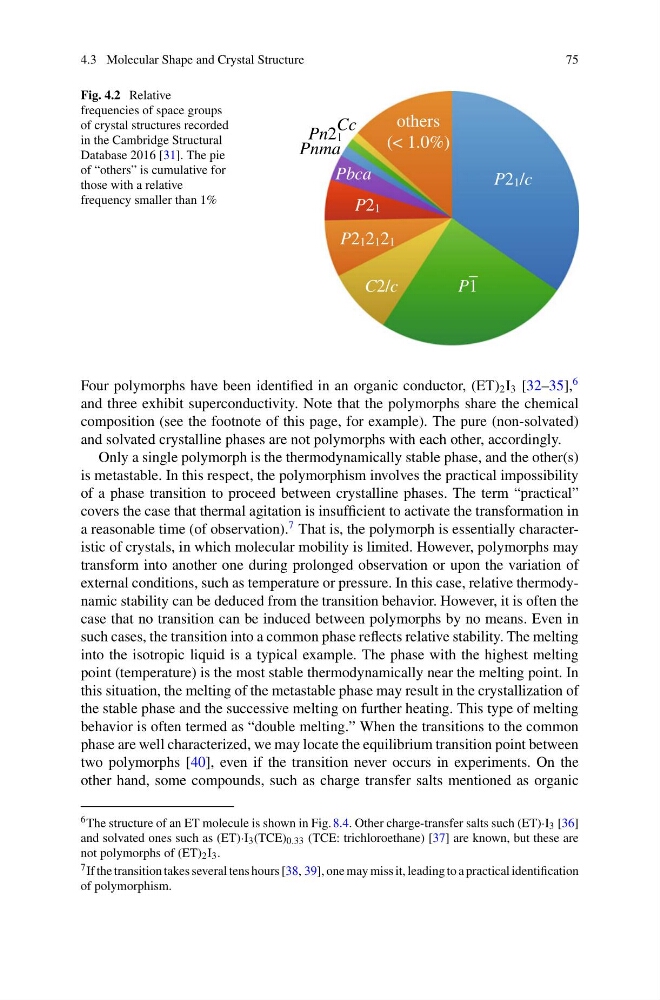
Fig. 4.2 Relative
frequencies of space groups
of crystal structures recorded
in the Cambridge Structural
Database 2016 [31]. The pie
of “others” is cumulative for
those with a relative
frequency smaller than 1%
P21/c
P1
–
C2/c
P212121
P21
Pbca
others
(< 1.0%)
Pnma
Pn21
Cc
Four polymorphs have been identified in an organic conductor, (ET) 2 I 3 [32–35],
6
and three exhibit superconductivity. Note that the polymorphs share the chemical
composition (see the footnote of this page, for example). The pure (non-solvated)
and solvated crystalline phases are not polymorphs with each other, accordingly.
Only a single polymorph is the thermodynamically stable phase, and the other(s)
is metastable. In this respect, the polymorphism involves the practical impossibility
of a phase transition to proceed between crystalline phases. The term “practical”
covers the case that thermal agitation is insufficient to activate the transformation in
a reasonable time (of observation).
7 That is, the polymorph is essentially characteristic of crystals, in which molecular mobility is limited. However, polymorphs may
transform into another one during prolonged observation or upon the variation of
external conditions, such as temperature or pressure. In this case, relative thermodynamic stability can be deduced from the transition behavior. However, it is often the
case that no transition can be induced between polymorphs by no means. Even in
such cases, the transition into a common phase reflects relative stability. The melting
into the isotropic liquid is a typical example. The phase with the highest melting
point (temperature) is the most stable thermodynamically near the melting point. In
this situation, the melting of the metastable phase may result in the crystallization of
the stable phase and the successive melting on further heating. This type of melting
behavior is often termed as “double melting.” When the transitions to the common
phase are well characterized, we may locate the equilibrium transition point between
two polymorphs [40], even if the transition never occurs in experiments. On the
other hand, some compounds, such as charge transfer salts mentioned as organic
6 The structure of an ET molecule is shown in Fig. 8.4. Other charge-transfer salts such (ET)·I 3 [36]
and solvated ones such as (ET)·I 3 (TCE) 0.33 (TCE: trichloroethane) [37] are known, but these are
not polymorphs of (ET) 2 I 3 .
7 If the transition takes several tens hours [38, 39], one may miss it, leading to a practical identification
of polymorphism.
75
Fig. 4.2 Relative
frequencies of space groups
of crystal structures recorded
in the Cambridge Structural
Database 2016 [31]. The pie
of “others” is cumulative for
those with a relative
frequency smaller than 1%
P21/c
P1
–
C2/c
P212121
P21
Pbca
others
(< 1.0%)
Pnma
Pn21
Cc
Four polymorphs have been identified in an organic conductor, (ET) 2 I 3 [32–35],
6
and three exhibit superconductivity. Note that the polymorphs share the chemical
composition (see the footnote of this page, for example). The pure (non-solvated)
and solvated crystalline phases are not polymorphs with each other, accordingly.
Only a single polymorph is the thermodynamically stable phase, and the other(s)
is metastable. In this respect, the polymorphism involves the practical impossibility
of a phase transition to proceed between crystalline phases. The term “practical”
covers the case that thermal agitation is insufficient to activate the transformation in
a reasonable time (of observation).
7 That is, the polymorph is essentially characteristic of crystals, in which molecular mobility is limited. However, polymorphs may
transform into another one during prolonged observation or upon the variation of
external conditions, such as temperature or pressure. In this case, relative thermodynamic stability can be deduced from the transition behavior. However, it is often the
case that no transition can be induced between polymorphs by no means. Even in
such cases, the transition into a common phase reflects relative stability. The melting
into the isotropic liquid is a typical example. The phase with the highest melting
point (temperature) is the most stable thermodynamically near the melting point. In
this situation, the melting of the metastable phase may result in the crystallization of
the stable phase and the successive melting on further heating. This type of melting
behavior is often termed as “double melting.” When the transitions to the common
phase are well characterized, we may locate the equilibrium transition point between
two polymorphs [40], even if the transition never occurs in experiments. On the
other hand, some compounds, such as charge transfer salts mentioned as organic
6 The structure of an ET molecule is shown in Fig. 8.4. Other charge-transfer salts such (ET)·I 3 [36]
and solvated ones such as (ET)·I 3 (TCE) 0.33 (TCE: trichloroethane) [37] are known, but these are
not polymorphs of (ET) 2 I 3 .
7 If the transition takes several tens hours [38, 39], one may miss it, leading to a practical identification
of polymorphism.