

4.3 Molecular Shape and Crystal Structure
73
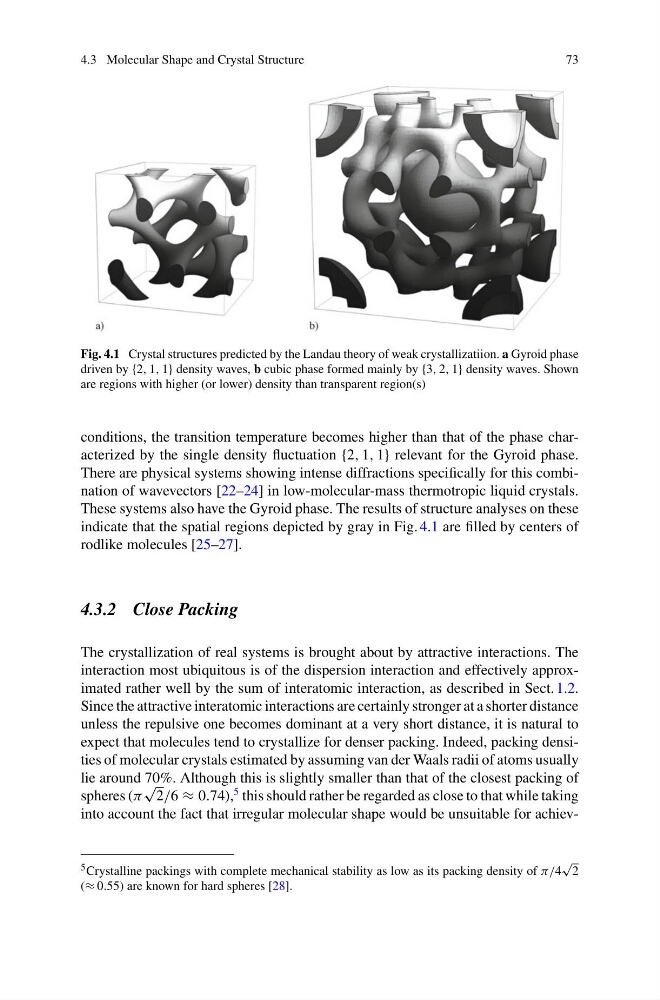
Fig. 4.1 Crystal structures predicted by the Landau theory of weak crystallizatiion. a Gyroid phase
driven by {2, 1, 1} density waves, b cubic phase formed mainly by {3, 2, 1} density waves. Shown
are regions with higher (or lower) density than transparent region(s)
conditions, the transition temperature becomes higher than that of the phase characterized by the single density fluctuation {2, 1, 1} relevant for the Gyroid phase.
There are physical systems showing intense diffractions specifically for this combination of wavevectors [22–24] in low-molecular-mass thermotropic liquid crystals.
These systems also have the Gyroid phase. The results of structure analyses on these
indicate that the spatial regions depicted by gray in Fig. 4.1 are filled by centers of
rodlike molecules [25–27].
4.3.2 Close Packing
The crystallization of real systems is brought about by attractive interactions. The
interaction most ubiquitous is of the dispersion interaction and effectively approximated rather well by the sum of interatomic interaction, as described in Sect. 1.2.
Since the attractive interatomic interactions are certainly stronger at a shorter distance
unless the repulsive one becomes dominant at a very short distance, it is natural to
expect that molecules tend to crystallize for denser packing. Indeed, packing densities of molecular crystals estimated by assuming van der Waals radii of atoms usually
lie around 70%. Although this is slightly smaller than that of the closest packing of
spheres (π
√
2/6 ≈ 0.74),
5 this should rather be regarded as close to that while taking
into account the fact that irregular molecular shape would be unsuitable for achiev5 Crystalline packings with complete mechanical stability as low as its packing density of π/4
√
2
(≈ 0.55) are known for hard spheres [28].
73
Fig. 4.1 Crystal structures predicted by the Landau theory of weak crystallizatiion. a Gyroid phase
driven by {2, 1, 1} density waves, b cubic phase formed mainly by {3, 2, 1} density waves. Shown
are regions with higher (or lower) density than transparent region(s)
conditions, the transition temperature becomes higher than that of the phase characterized by the single density fluctuation {2, 1, 1} relevant for the Gyroid phase.
There are physical systems showing intense diffractions specifically for this combination of wavevectors [22–24] in low-molecular-mass thermotropic liquid crystals.
These systems also have the Gyroid phase. The results of structure analyses on these
indicate that the spatial regions depicted by gray in Fig. 4.1 are filled by centers of
rodlike molecules [25–27].
4.3.2 Close Packing
The crystallization of real systems is brought about by attractive interactions. The
interaction most ubiquitous is of the dispersion interaction and effectively approximated rather well by the sum of interatomic interaction, as described in Sect. 1.2.
Since the attractive interatomic interactions are certainly stronger at a shorter distance
unless the repulsive one becomes dominant at a very short distance, it is natural to
expect that molecules tend to crystallize for denser packing. Indeed, packing densities of molecular crystals estimated by assuming van der Waals radii of atoms usually
lie around 70%. Although this is slightly smaller than that of the closest packing of
spheres (π
√
2/6 ≈ 0.74),
5 this should rather be regarded as close to that while taking
into account the fact that irregular molecular shape would be unsuitable for achiev5 Crystalline packings with complete mechanical stability as low as its packing density of π/4
√
2
(≈ 0.55) are known for hard spheres [28].