

4.2 Diffraction and Modern Definition of Crystals
69
A(q) =
j=0,N
f j δ(r − ja) exp(iqr)
= f
◦
j=0,N
exp(i jqa)
= f
◦ 1 − exp(i Nqa)
1 − exp(iqa)
= f
◦ exp
−i
(N − 1)qa
2
sin
Nqa
2
sin
qa
2
.
(4.5)
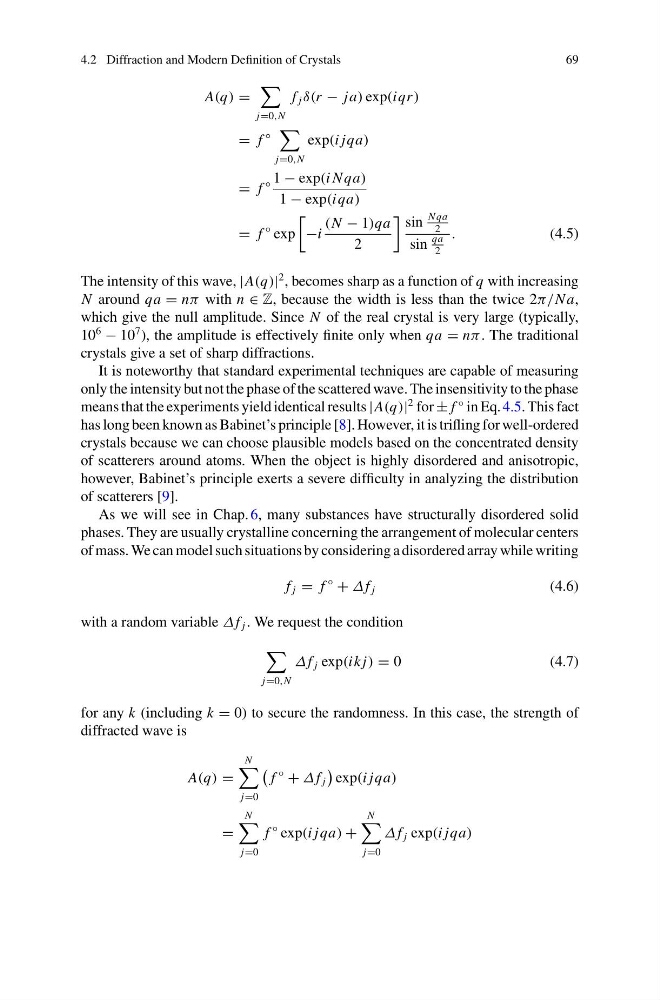
The intensity of this wave, |A(q)|
2 , becomes sharp as a function of q with increasing
N around qa = nπ with n ∈ Z, because the width is less than the twice 2π/N a,
which give the null amplitude. Since N of the real crystal is very large (typically,
10
6
− 10
7 ), the amplitude is effectively finite only when qa = nπ . The traditional
crystals give a set of sharp diffractions.
It is noteworthy that standard experimental techniques are capable of measuring
only the intensity but not the phase of the scattered wave. The insensitivity to the phase
means that the experiments yield identical results |A(q)|
2 for ± f
◦ in Eq. 4.5. This fact
has long been known as Babinet’s principle [8]. However, it is trifling for well-ordered
crystals because we can choose plausible models based on the concentrated density
of scatterers around atoms. When the object is highly disordered and anisotropic,
however, Babinet’s principle exerts a severe difficulty in analyzing the distribution
of scatterers [9].
As we will see in Chap. 6, many substances have structurally disordered solid
phases. They are usually crystalline concerning the arrangement of molecular centers
of mass. We can model such situations by considering a disordered array while writing
f j = f
◦
+ Δf j
(4.6)
with a random variable Δf j . We request the condition
j=0,N
Δf j exp(ik j) = 0
(4.7)
for any k (including k = 0) to secure the randomness. In this case, the strength of
diffracted wave is
A(q) =
N
j=0
f
◦
+ Δf j
exp(i jqa)
=
N
j=0
f
◦ exp(i jqa) +
N
j=0
Δf j exp(i jqa)
69
A(q) =
j=0,N
f j δ(r − ja) exp(iqr)
= f
◦
j=0,N
exp(i jqa)
= f
◦ 1 − exp(i Nqa)
1 − exp(iqa)
= f
◦ exp
−i
(N − 1)qa
2
sin
Nqa
2
sin
qa
2
.
(4.5)
The intensity of this wave, |A(q)|
2 , becomes sharp as a function of q with increasing
N around qa = nπ with n ∈ Z, because the width is less than the twice 2π/N a,
which give the null amplitude. Since N of the real crystal is very large (typically,
10
6
− 10
7 ), the amplitude is effectively finite only when qa = nπ . The traditional
crystals give a set of sharp diffractions.
It is noteworthy that standard experimental techniques are capable of measuring
only the intensity but not the phase of the scattered wave. The insensitivity to the phase
means that the experiments yield identical results |A(q)|
2 for ± f
◦ in Eq. 4.5. This fact
has long been known as Babinet’s principle [8]. However, it is trifling for well-ordered
crystals because we can choose plausible models based on the concentrated density
of scatterers around atoms. When the object is highly disordered and anisotropic,
however, Babinet’s principle exerts a severe difficulty in analyzing the distribution
of scatterers [9].
As we will see in Chap. 6, many substances have structurally disordered solid
phases. They are usually crystalline concerning the arrangement of molecular centers
of mass. We can model such situations by considering a disordered array while writing
f j = f
◦
+ Δf j
(4.6)
with a random variable Δf j . We request the condition
j=0,N
Δf j exp(ik j) = 0
(4.7)
for any k (including k = 0) to secure the randomness. In this case, the strength of
diffracted wave is
A(q) =
N
j=0
f
◦
+ Δf j
exp(i jqa)
=
N
j=0
f
◦ exp(i jqa) +
N
j=0
Δf j exp(i jqa)