

3.2 Molecular Association
61
Suppose a liquid consisting of molecules with a single H-bonding site, e.g., a
hydroxyl group. Since the enthalpic gain by a single H-bond is roughly constant,
we denote it as −ε HB . Then, we can write the gain upon a formation of n-mer via
formations of m H-bonds as Δh HB = −mε HB . We can imagine two types of structures
of an n-mer: linear (m = n − 1) and cyclic (m = n). The formation of n-mer also
affects entropy. Because the formation of n-mer reduces the translational entropy by
a factor n, suppose that the total entropy is reduced by n. Then, putting s 0 (T ) be the
entropy per mole of the liquid of monomers, the change in chemical potential upon
the n-mer formation is written as
Δμ linear =
n − 1
n
[−ε HB + T s 0 (T )]
(3.25)
for the formation of linear n-mers, or
Δμ cyclic = −ε HB +
n − 1
n
T s 0 (T )
(3.26)
for the formation of cyclic n-mers. Equation 3.25 indicates that the sign of Δμ linear
depends not on n but solely on the temperature while its magnitude depends on n.
Larger the size of the cluster n, the larger the absolute magnitude of Δμ linear . On the
other hand, Eq. 3.26 implies that n governs not only the magnitude but also the sign of
Δμ linear in cyclic n-mers. Smaller the n, the higher the temperature where the Δμ cyclic
becomes positive. Further, it always holds that Δμ cyclic − Δμ linear = −ε HB /n < 0.
Thus, cyclic n-mers are more stable than linear ones with the same n unless the
entropy arising from the internal flexibility of the n-mer is seriously considered. This
simple discussion suggests that there are some systems of which the properties are
well accounted for by considering only a limited number of small cyclic aggregates.
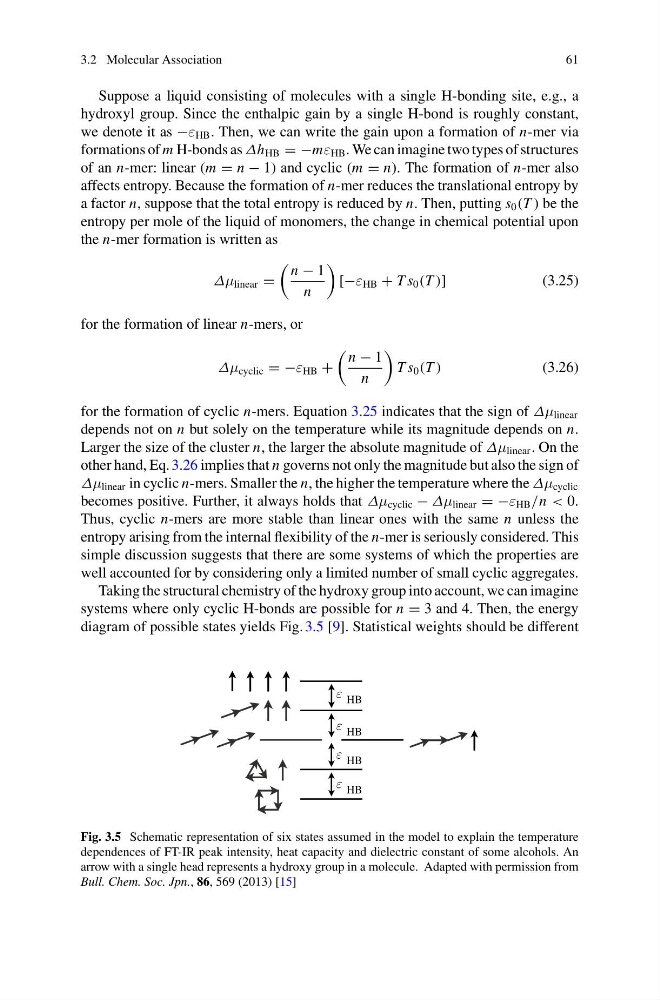
Taking the structural chemistry of the hydroxy group into account, we can imagine
systems where only cyclic H-bonds are possible for n = 3 and 4. Then, the energy
diagram of possible states yields Fig. 3.5 [9]. Statistical weights should be different
ε HB
ε HB
ε HB
ε HB
Fig. 3.5 Schematic representation of six states assumed in the model to explain the temperature
dependences of FT-IR peak intensity, heat capacity and dielectric constant of some alcohols. An
arrow with a single head represents a hydroxy group in a molecule. Adapted with permission from
Bull. Chem. Soc. Jpn., 86, 569 (2013) [15]
61
Suppose a liquid consisting of molecules with a single H-bonding site, e.g., a
hydroxyl group. Since the enthalpic gain by a single H-bond is roughly constant,
we denote it as −ε HB . Then, we can write the gain upon a formation of n-mer via
formations of m H-bonds as Δh HB = −mε HB . We can imagine two types of structures
of an n-mer: linear (m = n − 1) and cyclic (m = n). The formation of n-mer also
affects entropy. Because the formation of n-mer reduces the translational entropy by
a factor n, suppose that the total entropy is reduced by n. Then, putting s 0 (T ) be the
entropy per mole of the liquid of monomers, the change in chemical potential upon
the n-mer formation is written as
Δμ linear =
n − 1
n
[−ε HB + T s 0 (T )]
(3.25)
for the formation of linear n-mers, or
Δμ cyclic = −ε HB +
n − 1
n
T s 0 (T )
(3.26)
for the formation of cyclic n-mers. Equation 3.25 indicates that the sign of Δμ linear
depends not on n but solely on the temperature while its magnitude depends on n.
Larger the size of the cluster n, the larger the absolute magnitude of Δμ linear . On the
other hand, Eq. 3.26 implies that n governs not only the magnitude but also the sign of
Δμ linear in cyclic n-mers. Smaller the n, the higher the temperature where the Δμ cyclic
becomes positive. Further, it always holds that Δμ cyclic − Δμ linear = −ε HB /n < 0.
Thus, cyclic n-mers are more stable than linear ones with the same n unless the
entropy arising from the internal flexibility of the n-mer is seriously considered. This
simple discussion suggests that there are some systems of which the properties are
well accounted for by considering only a limited number of small cyclic aggregates.
Taking the structural chemistry of the hydroxy group into account, we can imagine
systems where only cyclic H-bonds are possible for n = 3 and 4. Then, the energy
diagram of possible states yields Fig. 3.5 [9]. Statistical weights should be different
ε HB
ε HB
ε HB
ε HB
Fig. 3.5 Schematic representation of six states assumed in the model to explain the temperature
dependences of FT-IR peak intensity, heat capacity and dielectric constant of some alcohols. An
arrow with a single head represents a hydroxy group in a molecule. Adapted with permission from
Bull. Chem. Soc. Jpn., 86, 569 (2013) [15]