

50
2 Phase Transitions
where d is the dimensionality of the system. It is emphasized that the functional
dependences of the correlation function G(r ) on the distance (r ) are entirely different
between Eqs. 2.66 and 2.69. The power-law dependence of Eq. 2.69 indicates the
absence of a characteristic length at the critical point (t = 0). The spatial distribution
of the local order parameter is fractal, accordingly.
The divergence of the correlation length (Eq. 2.64) at the critical point implies that
the physical significance of microscopic details of systems diminishes on approaching the critical point. Indeed, it is believed that critical behaviors are classified into a
limited number of classes (universality classes), depending on essential features of
systems such as spatial dimensionality, the number of freedom of the order parameter,
and the range of interaction. Here, the degree of the freedom of the order parameter
concerns with, for example, the difference between a discrete Ising spin [5] (with
only two, up and down states) and a classical spin in the three-dimension (the spin
head sweeps a spherical surface).
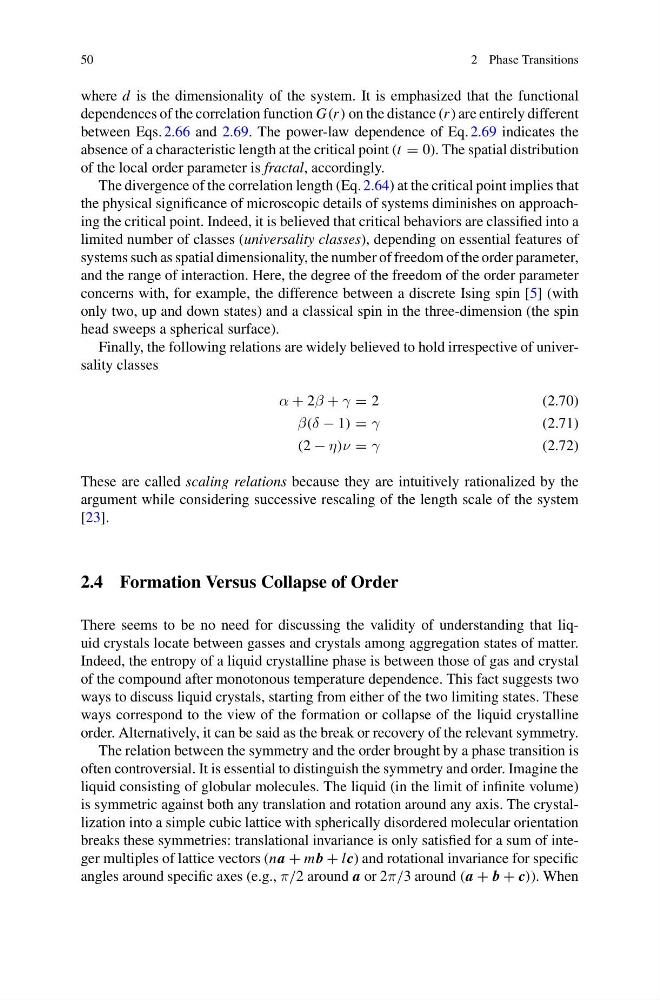
Finally, the following relations are widely believed to hold irrespective of universality classes
α + 2β + γ = 2
(2.70)
β(δ − 1) = γ
(2.71)
(2 − η)ν = γ
(2.72)
These are called scaling relations because they are intuitively rationalized by the
argument while considering successive rescaling of the length scale of the system
[23].
2.4 Formation Versus Collapse of Order
There seems to be no need for discussing the validity of understanding that liquid crystals locate between gasses and crystals among aggregation states of matter.
Indeed, the entropy of a liquid crystalline phase is between those of gas and crystal
of the compound after monotonous temperature dependence. This fact suggests two
ways to discuss liquid crystals, starting from either of the two limiting states. These
ways correspond to the view of the formation or collapse of the liquid crystalline
order. Alternatively, it can be said as the break or recovery of the relevant symmetry.
The relation between the symmetry and the order brought by a phase transition is
often controversial. It is essential to distinguish the symmetry and order. Imagine the
liquid consisting of globular molecules. The liquid (in the limit of infinite volume)
is symmetric against both any translation and rotation around any axis. The crystallization into a simple cubic lattice with spherically disordered molecular orientation
breaks these symmetries: translational invariance is only satisfied for a sum of integer multiples of lattice vectors (na + mb + l c) and rotational invariance for specific
angles around specific axes (e.g., π/2 around a or 2π/3 around (a + b + c)). When
2 Phase Transitions
where d is the dimensionality of the system. It is emphasized that the functional
dependences of the correlation function G(r ) on the distance (r ) are entirely different
between Eqs. 2.66 and 2.69. The power-law dependence of Eq. 2.69 indicates the
absence of a characteristic length at the critical point (t = 0). The spatial distribution
of the local order parameter is fractal, accordingly.
The divergence of the correlation length (Eq. 2.64) at the critical point implies that
the physical significance of microscopic details of systems diminishes on approaching the critical point. Indeed, it is believed that critical behaviors are classified into a
limited number of classes (universality classes), depending on essential features of
systems such as spatial dimensionality, the number of freedom of the order parameter,
and the range of interaction. Here, the degree of the freedom of the order parameter
concerns with, for example, the difference between a discrete Ising spin [5] (with
only two, up and down states) and a classical spin in the three-dimension (the spin
head sweeps a spherical surface).
Finally, the following relations are widely believed to hold irrespective of universality classes
α + 2β + γ = 2
(2.70)
β(δ − 1) = γ
(2.71)
(2 − η)ν = γ
(2.72)
These are called scaling relations because they are intuitively rationalized by the
argument while considering successive rescaling of the length scale of the system
[23].
2.4 Formation Versus Collapse of Order
There seems to be no need for discussing the validity of understanding that liquid crystals locate between gasses and crystals among aggregation states of matter.
Indeed, the entropy of a liquid crystalline phase is between those of gas and crystal
of the compound after monotonous temperature dependence. This fact suggests two
ways to discuss liquid crystals, starting from either of the two limiting states. These
ways correspond to the view of the formation or collapse of the liquid crystalline
order. Alternatively, it can be said as the break or recovery of the relevant symmetry.
The relation between the symmetry and the order brought by a phase transition is
often controversial. It is essential to distinguish the symmetry and order. Imagine the
liquid consisting of globular molecules. The liquid (in the limit of infinite volume)
is symmetric against both any translation and rotation around any axis. The crystallization into a simple cubic lattice with spherically disordered molecular orientation
breaks these symmetries: translational invariance is only satisfied for a sum of integer multiples of lattice vectors (na + mb + l c) and rotational invariance for specific
angles around specific axes (e.g., π/2 around a or 2π/3 around (a + b + c)). When