

46
2 Phase Transitions
more than one dimension. For example, if the symmetric phase has a tetragonal unit
cell (a = b = c), and expected orders are within the ab plane, a minimal expansion
of thermodynamic potential up to the fourth-order has the form
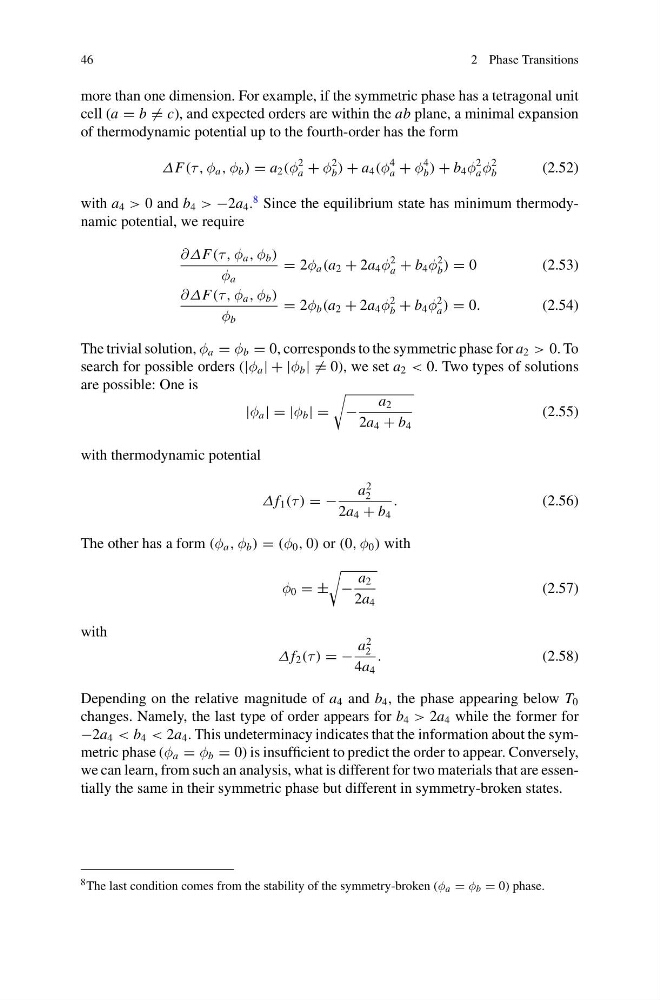
ΔF(τ , φ a , φ b ) = a 2 (φ
2
a + φ
2
b ) + a 4 (φ
4
a + φ
4
b ) + b 4 φ
2
a φ
2
b
(2.52)
with a 4 > 0 and b 4 > −2a 4 .
8 Since the equilibrium state has minimum thermodynamic potential, we require
∂ΔF(τ , φ a , φ b )
φ a
= 2φ a (a 2 + 2a 4 φ
2
a + b 4 φ
2
b ) = 0
(2.53)
∂ΔF(τ , φ a , φ b )
φ b
= 2φ b (a 2 + 2a 4 φ
2
b + b 4 φ
2
a ) = 0.
(2.54)
The trivial solution, φ a = φ b = 0, corresponds to the symmetric phase for a 2 > 0. To
search for possible orders (|φ a | + |φ b | = 0), we set a 2 < 0. Two types of solutions
are possible: One is
|φ a | = |φ b | =
−
a 2
2a 4 + b 4
(2.55)
with thermodynamic potential
Δf 1 (τ ) = −
a
2
2
2a 4 + b 4
.
(2.56)
The other has a form (φ a , φ b ) = (φ 0 , 0) or (0, φ 0 ) with
φ 0 = ±
−
a 2
2a 4
(2.57)
with
Δf 2 (τ ) = −
a
2
2
4a 4
.
(2.58)
Depending on the relative magnitude of a 4 and b 4 , the phase appearing below T 0
changes. Namely, the last type of order appears for b 4 > 2a 4 while the former for
−2a 4 < b 4 < 2a 4 . This undeterminacy indicates that the information about the symmetric phase (φ a = φ b = 0) is insufficient to predict the order to appear. Conversely,
we can learn, from such an analysis, what is different for two materials that are essentially the same in their symmetric phase but different in symmetry-broken states.
8 The last condition comes from the stability of the symmetry-broken (φ a = φ b = 0) phase.
2 Phase Transitions
more than one dimension. For example, if the symmetric phase has a tetragonal unit
cell (a = b = c), and expected orders are within the ab plane, a minimal expansion
of thermodynamic potential up to the fourth-order has the form
ΔF(τ , φ a , φ b ) = a 2 (φ
2
a + φ
2
b ) + a 4 (φ
4
a + φ
4
b ) + b 4 φ
2
a φ
2
b
(2.52)
with a 4 > 0 and b 4 > −2a 4 .
8 Since the equilibrium state has minimum thermodynamic potential, we require
∂ΔF(τ , φ a , φ b )
φ a
= 2φ a (a 2 + 2a 4 φ
2
a + b 4 φ
2
b ) = 0
(2.53)
∂ΔF(τ , φ a , φ b )
φ b
= 2φ b (a 2 + 2a 4 φ
2
b + b 4 φ
2
a ) = 0.
(2.54)
The trivial solution, φ a = φ b = 0, corresponds to the symmetric phase for a 2 > 0. To
search for possible orders (|φ a | + |φ b | = 0), we set a 2 < 0. Two types of solutions
are possible: One is
|φ a | = |φ b | =
−
a 2
2a 4 + b 4
(2.55)
with thermodynamic potential
Δf 1 (τ ) = −
a
2
2
2a 4 + b 4
.
(2.56)
The other has a form (φ a , φ b ) = (φ 0 , 0) or (0, φ 0 ) with
φ 0 = ±
−
a 2
2a 4
(2.57)
with
Δf 2 (τ ) = −
a
2
2
4a 4
.
(2.58)
Depending on the relative magnitude of a 4 and b 4 , the phase appearing below T 0
changes. Namely, the last type of order appears for b 4 > 2a 4 while the former for
−2a 4 < b 4 < 2a 4 . This undeterminacy indicates that the information about the symmetric phase (φ a = φ b = 0) is insufficient to predict the order to appear. Conversely,
we can learn, from such an analysis, what is different for two materials that are essentially the same in their symmetric phase but different in symmetry-broken states.
8 The last condition comes from the stability of the symmetry-broken (φ a = φ b = 0) phase.