

38
2 Phase Transitions
accessible at a higher side (T trs + ΔT ) than a lower side (T trs − ΔT ) because the
necessary barrier hight
Δg(T trs ± ΔT ) = ΔT Δ trs s
(2.20)
is mostly equal. This circumstance partly explains why the supercooling is more
often than the superheating.
It is noteworthy that both ΔG(T ) and γ(T ) depend not only on the mother phase
but also on the new phase. If the mother phase has plural candidates of a resulting
new phase, the minimal size of a critical domain differs depending on the resulting
phase. There is no reason why the size is smaller for the most stable phase than
others. Thus, the preference for a metastable phase can occur.
The nucleation is a factor affecting kinetics and even the occurrence itself of phase
transitions. However, there are cases that the nucleation does not play any role. If
the transition is a consequence of the instability of a phase, i.e., the thermodynamic
stability is lost at the transition point, the transition proceeds without any barrier to
overcome. The so-called spinodal decomposition, a kind of phase separation, is a
widely observed example.
The nucleation is not the only factor to affect the time evolution of the phase
transition (phase transition kinetics). If the new phase is anisotropic as a crystalline
phase, the phase transition will proceed anisotropically, accordingly. For example,
if a molecule is rodlike, the molecule coming from the isotropic liquid prefers to
adhere laterally to the surface for the growth, because the contact area mostly controls
the microscopic enthalpy gain. The resulting crystal would preferably grow into a
disk. Thus, depending on the system, the growing domain will have a characteristic
“dimension” (d = 1, 2, 3). In the case of the disk, d = 2 results. Similarly, highly
anisotropic growth (d = 1) and isotropic growth (d = 3) lead to rodlike and spherical
domains.
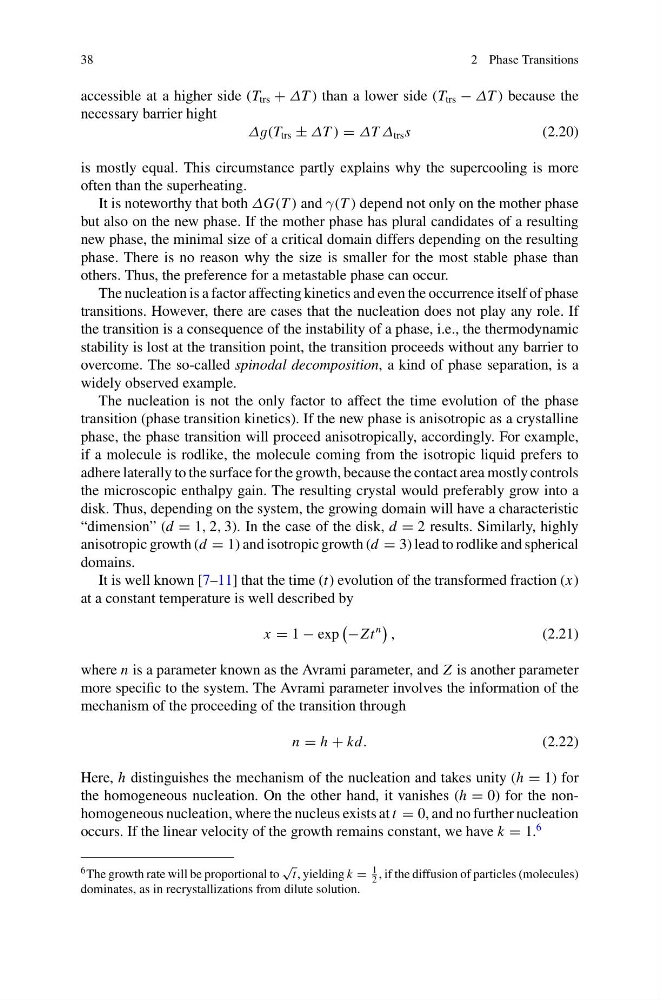
It is well known [7–11] that the time (t) evolution of the transformed fraction (x)
at a constant temperature is well described by
x = 1 − exp
−Zt
n
,
(2.21)
where n is a parameter known as the Avrami parameter, and Z is another parameter
more specific to the system. The Avrami parameter involves the information of the
mechanism of the proceeding of the transition through
n = h + kd.
(2.22)
Here, h distinguishes the mechanism of the nucleation and takes unity (h = 1) for
the homogeneous nucleation. On the other hand, it vanishes (h = 0) for the nonhomogeneous nucleation, where the nucleus exists at t = 0, and no further nucleation
occurs. If the linear velocity of the growth remains constant, we have k = 1.
6
6 The growth rate will be proportional to
√
t, yielding k =
1
2 , if the diffusion of particles (molecules)
dominates, as in recrystallizations from dilute solution.
2 Phase Transitions
accessible at a higher side (T trs + ΔT ) than a lower side (T trs − ΔT ) because the
necessary barrier hight
Δg(T trs ± ΔT ) = ΔT Δ trs s
(2.20)
is mostly equal. This circumstance partly explains why the supercooling is more
often than the superheating.
It is noteworthy that both ΔG(T ) and γ(T ) depend not only on the mother phase
but also on the new phase. If the mother phase has plural candidates of a resulting
new phase, the minimal size of a critical domain differs depending on the resulting
phase. There is no reason why the size is smaller for the most stable phase than
others. Thus, the preference for a metastable phase can occur.
The nucleation is a factor affecting kinetics and even the occurrence itself of phase
transitions. However, there are cases that the nucleation does not play any role. If
the transition is a consequence of the instability of a phase, i.e., the thermodynamic
stability is lost at the transition point, the transition proceeds without any barrier to
overcome. The so-called spinodal decomposition, a kind of phase separation, is a
widely observed example.
The nucleation is not the only factor to affect the time evolution of the phase
transition (phase transition kinetics). If the new phase is anisotropic as a crystalline
phase, the phase transition will proceed anisotropically, accordingly. For example,
if a molecule is rodlike, the molecule coming from the isotropic liquid prefers to
adhere laterally to the surface for the growth, because the contact area mostly controls
the microscopic enthalpy gain. The resulting crystal would preferably grow into a
disk. Thus, depending on the system, the growing domain will have a characteristic
“dimension” (d = 1, 2, 3). In the case of the disk, d = 2 results. Similarly, highly
anisotropic growth (d = 1) and isotropic growth (d = 3) lead to rodlike and spherical
domains.
It is well known [7–11] that the time (t) evolution of the transformed fraction (x)
at a constant temperature is well described by
x = 1 − exp
−Zt
n
,
(2.21)
where n is a parameter known as the Avrami parameter, and Z is another parameter
more specific to the system. The Avrami parameter involves the information of the
mechanism of the proceeding of the transition through
n = h + kd.
(2.22)
Here, h distinguishes the mechanism of the nucleation and takes unity (h = 1) for
the homogeneous nucleation. On the other hand, it vanishes (h = 0) for the nonhomogeneous nucleation, where the nucleus exists at t = 0, and no further nucleation
occurs. If the linear velocity of the growth remains constant, we have k = 1.
6
6 The growth rate will be proportional to
√
t, yielding k =
1
2 , if the diffusion of particles (molecules)
dominates, as in recrystallizations from dilute solution.