

36
2 Phase Transitions
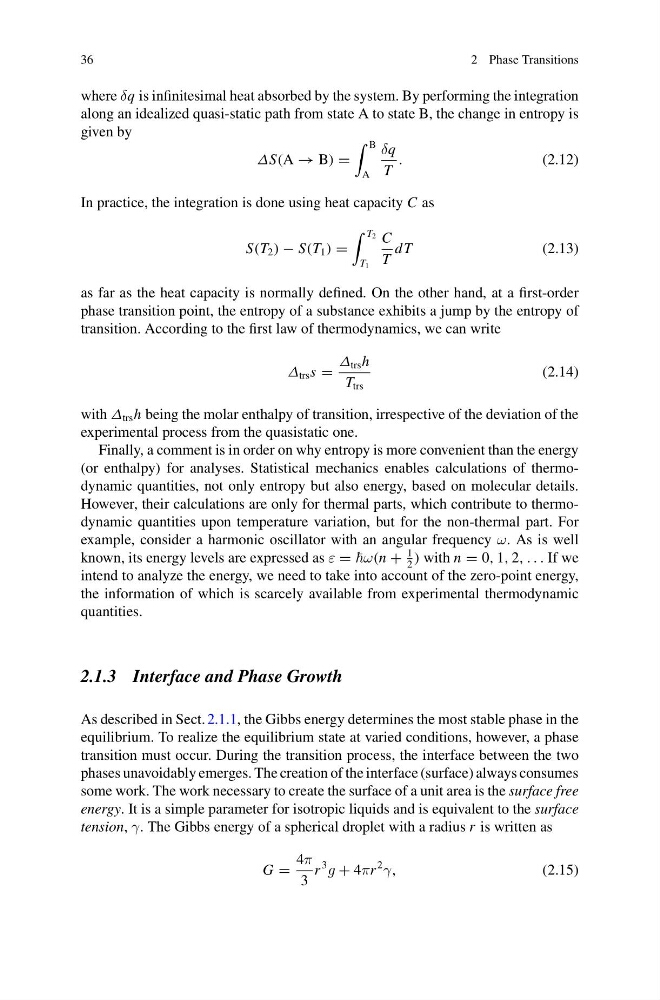
where δq is infinitesimal heat absorbed by the system. By performing the integration
along an idealized quasi-static path from state A to state B, the change in entropy is
given by
ΔS(A → B) =
B
A
δq
T
.
(2.12)
In practice, the integration is done using heat capacity C as
S(T 2 ) − S(T 1 ) =
T 2
T 1
C
T
dT
(2.13)
as far as the heat capacity is normally defined. On the other hand, at a first-order
phase transition point, the entropy of a substance exhibits a jump by the entropy of
transition. According to the first law of thermodynamics, we can write
Δ trs s =
Δ trs h
T trs
(2.14)
with Δ trs h being the molar enthalpy of transition, irrespective of the deviation of the
experimental process from the quasistatic one.
Finally, a comment is in order on why entropy is more convenient than the energy
(or enthalpy) for analyses. Statistical mechanics enables calculations of thermodynamic quantities, not only entropy but also energy, based on molecular details.
However, their calculations are only for thermal parts, which contribute to thermodynamic quantities upon temperature variation, but for the non-thermal part. For
example, consider a harmonic oscillator with an angular frequency ω. As is well
known, its energy levels are expressed as ε = ω(n +
1
2
) with n = 0, 1, 2, . . . If we
intend to analyze the energy, we need to take into account of the zero-point energy,
the information of which is scarcely available from experimental thermodynamic
quantities.
2.1.3 Interface and Phase Growth
As described in Sect. 2.1.1, the Gibbs energy determines the most stable phase in the
equilibrium. To realize the equilibrium state at varied conditions, however, a phase
transition must occur. During the transition process, the interface between the two
phases unavoidably emerges. The creation of the interface (surface) always consumes
some work. The work necessary to create the surface of a unit area is the surface free
energy. It is a simple parameter for isotropic liquids and is equivalent to the surface
tension, γ. The Gibbs energy of a spherical droplet with a radius r is written as
G =
4π
3
r
3
g + 4πr
2
γ,
(2.15)
2 Phase Transitions
where δq is infinitesimal heat absorbed by the system. By performing the integration
along an idealized quasi-static path from state A to state B, the change in entropy is
given by
ΔS(A → B) =
B
A
δq
T
.
(2.12)
In practice, the integration is done using heat capacity C as
S(T 2 ) − S(T 1 ) =
T 2
T 1
C
T
dT
(2.13)
as far as the heat capacity is normally defined. On the other hand, at a first-order
phase transition point, the entropy of a substance exhibits a jump by the entropy of
transition. According to the first law of thermodynamics, we can write
Δ trs s =
Δ trs h
T trs
(2.14)
with Δ trs h being the molar enthalpy of transition, irrespective of the deviation of the
experimental process from the quasistatic one.
Finally, a comment is in order on why entropy is more convenient than the energy
(or enthalpy) for analyses. Statistical mechanics enables calculations of thermodynamic quantities, not only entropy but also energy, based on molecular details.
However, their calculations are only for thermal parts, which contribute to thermodynamic quantities upon temperature variation, but for the non-thermal part. For
example, consider a harmonic oscillator with an angular frequency ω. As is well
known, its energy levels are expressed as ε = ω(n +
1
2
) with n = 0, 1, 2, . . . If we
intend to analyze the energy, we need to take into account of the zero-point energy,
the information of which is scarcely available from experimental thermodynamic
quantities.
2.1.3 Interface and Phase Growth
As described in Sect. 2.1.1, the Gibbs energy determines the most stable phase in the
equilibrium. To realize the equilibrium state at varied conditions, however, a phase
transition must occur. During the transition process, the interface between the two
phases unavoidably emerges. The creation of the interface (surface) always consumes
some work. The work necessary to create the surface of a unit area is the surface free
energy. It is a simple parameter for isotropic liquids and is equivalent to the surface
tension, γ. The Gibbs energy of a spherical droplet with a radius r is written as
G =
4π
3
r
3
g + 4πr
2
γ,
(2.15)