

1.2 Intermolecular Interaction
19
v(r i j ) = A
σ
r i j
12
− B
σ
r i j
6
,
(1.63)
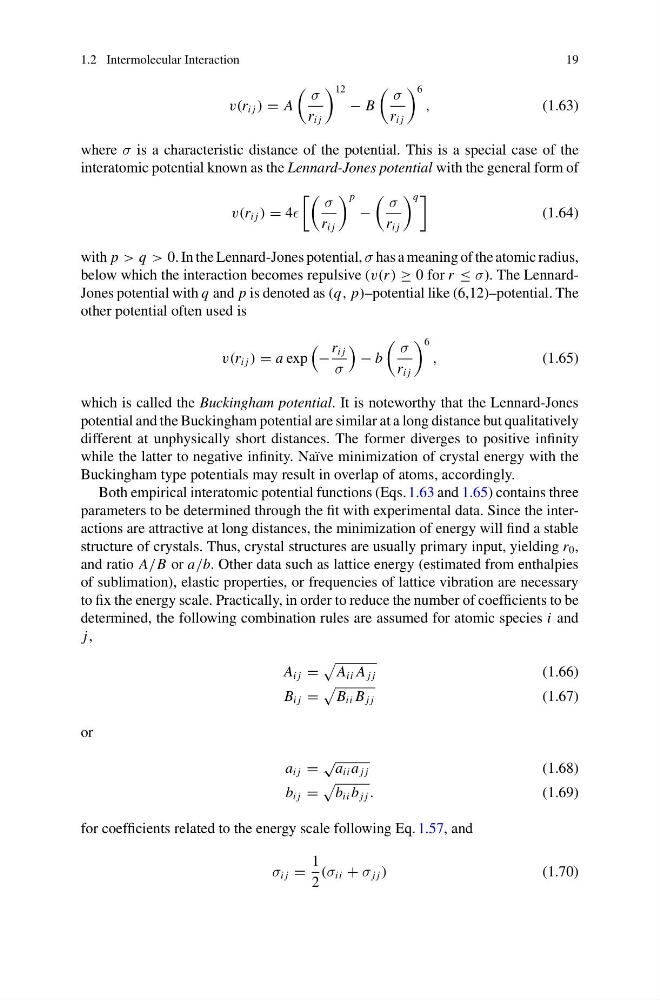
where σ is a characteristic distance of the potential. This is a special case of the
interatomic potential known as the Lennard-Jones potential with the general form of
v(r i j ) = 4
σ
r i j
p
−
σ
r i j
q
(1.64)
with p > q > 0. In the Lennard-Jones potential, σ has a meaning of the atomic radius,
below which the interaction becomes repulsive (v(r ) ≥ 0 for r ≤ σ). The LennardJones potential with q and p is denoted as (q, p)–potential like (6,12)–potential. The
other potential often used is
v(r i j ) = a exp
−
r i j
σ
− b
σ
r i j
6
,
(1.65)
which is called the Buckingham potential. It is noteworthy that the Lennard-Jones
potential and the Buckingham potential are similar at a long distance but qualitatively
different at unphysically short distances. The former diverges to positive infinity
while the latter to negative infinity. Naïve minimization of crystal energy with the
Buckingham type potentials may result in overlap of atoms, accordingly.
Both empirical interatomic potential functions (Eqs. 1.63 and 1.65) contains three
parameters to be determined through the fit with experimental data. Since the interactions are attractive at long distances, the minimization of energy will find a stable
structure of crystals. Thus, crystal structures are usually primary input, yielding r 0 ,
and ratio A/B or a/b. Other data such as lattice energy (estimated from enthalpies
of sublimation), elastic properties, or frequencies of lattice vibration are necessary
to fix the energy scale. Practically, in order to reduce the number of coefficients to be
determined, the following combination rules are assumed for atomic species i and
j,
A i j =
A ii A j j
(1.66)
B i j =
B ii B j j
(1.67)
or
a i j =
√
a ii a j j
(1.68)
b i j =
b ii b j j .
(1.69)
for coefficients related to the energy scale following Eq. 1.57, and
σ i j =
1
2
(σ ii + σ j j )
(1.70)
19
v(r i j ) = A
σ
r i j
12
− B
σ
r i j
6
,
(1.63)
where σ is a characteristic distance of the potential. This is a special case of the
interatomic potential known as the Lennard-Jones potential with the general form of
v(r i j ) = 4
σ
r i j
p
−
σ
r i j
q
(1.64)
with p > q > 0. In the Lennard-Jones potential, σ has a meaning of the atomic radius,
below which the interaction becomes repulsive (v(r ) ≥ 0 for r ≤ σ). The LennardJones potential with q and p is denoted as (q, p)–potential like (6,12)–potential. The
other potential often used is
v(r i j ) = a exp
−
r i j
σ
− b
σ
r i j
6
,
(1.65)
which is called the Buckingham potential. It is noteworthy that the Lennard-Jones
potential and the Buckingham potential are similar at a long distance but qualitatively
different at unphysically short distances. The former diverges to positive infinity
while the latter to negative infinity. Naïve minimization of crystal energy with the
Buckingham type potentials may result in overlap of atoms, accordingly.
Both empirical interatomic potential functions (Eqs. 1.63 and 1.65) contains three
parameters to be determined through the fit with experimental data. Since the interactions are attractive at long distances, the minimization of energy will find a stable
structure of crystals. Thus, crystal structures are usually primary input, yielding r 0 ,
and ratio A/B or a/b. Other data such as lattice energy (estimated from enthalpies
of sublimation), elastic properties, or frequencies of lattice vibration are necessary
to fix the energy scale. Practically, in order to reduce the number of coefficients to be
determined, the following combination rules are assumed for atomic species i and
j,
A i j =
A ii A j j
(1.66)
B i j =
B ii B j j
(1.67)
or
a i j =
√
a ii a j j
(1.68)
b i j =
b ii b j j .
(1.69)
for coefficients related to the energy scale following Eq. 1.57, and
σ i j =
1
2
(σ ii + σ j j )
(1.70)