

9.4 Conformational Disordering of Alkyl Groups
191
9.4.4.3 Structural Implications for Layered Smectics
The almost fully molten state of alkyl chains leads to a question of whether the traditional view of layered structures of smectics is valid or not. The traditional view
assumes the formation of layers by whole molecules. More precisely, the centers
of molecules form planes. To make more explicit the question, suppose the following mesogenic molecule: It consists of two parts, the rigid aromatic core and alkyl
chain, the lengths of which are equal to each other. Molecules are mostly normal to
the smectic layers, i.e., the (local) director is normal to each layer. Since smectics
ever reported are non-polar, each layer is formed by a mixture of equal amounts of
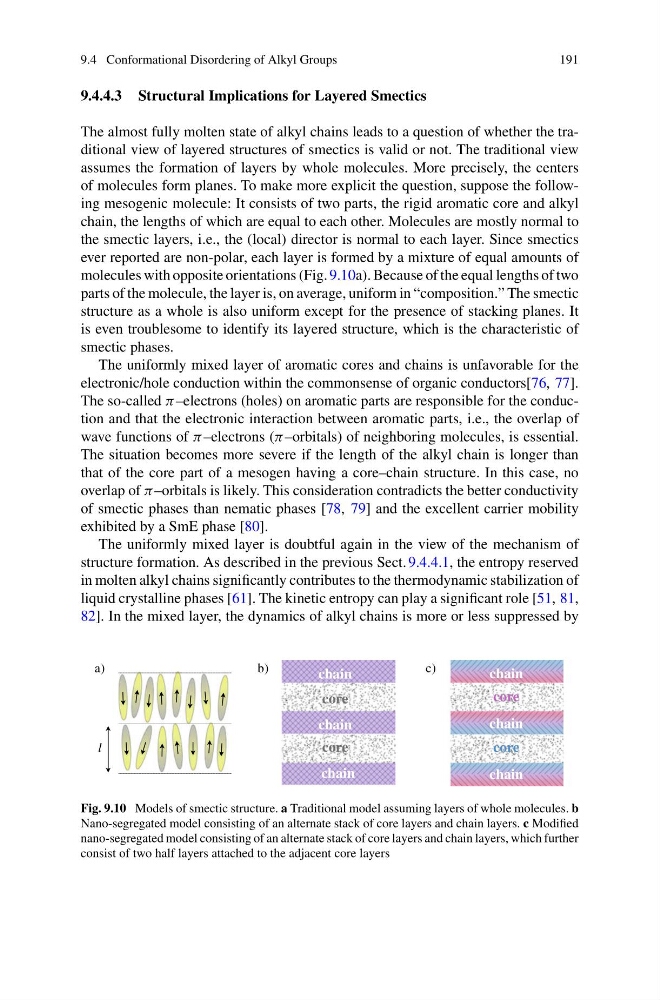
molecules with opposite orientations (Fig. 9.10a). Because of the equal lengths of two
parts of the molecule, the layer is, on average, uniform in “composition.” The smectic
structure as a whole is also uniform except for the presence of stacking planes. It
is even troublesome to identify its layered structure, which is the characteristic of
smectic phases.
The uniformly mixed layer of aromatic cores and chains is unfavorable for the
electronic/hole conduction within the commonsense of organic conductors[76, 77].
The so-called π –electrons (holes) on aromatic parts are responsible for the conduction and that the electronic interaction between aromatic parts, i.e., the overlap of
wave functions of π –electrons (π –orbitals) of neighboring molecules, is essential.
The situation becomes more severe if the length of the alkyl chain is longer than
that of the core part of a mesogen having a core–chain structure. In this case, no
overlap of π –orbitals is likely. This consideration contradicts the better conductivity
of smectic phases than nematic phases [78, 79] and the excellent carrier mobility
exhibited by a SmE phase [80].
The uniformly mixed layer is doubtful again in the view of the mechanism of
structure formation. As described in the previous Sect. 9.4.4.1, the entropy reserved
in molten alkyl chains significantly contributes to the thermodynamic stabilization of
liquid crystalline phases [61]. The kinetic entropy can play a significant role [51, 81,
82]. In the mixed layer, the dynamics of alkyl chains is more or less suppressed by
l
chain
chain
chain
core
core
core
core
chain
chain
chain
a)
b)
c)
Fig. 9.10 Models of smectic structure. a Traditional model assuming layers of whole molecules. b
Nano-segregated model consisting of an alternate stack of core layers and chain layers. c Modified
nano-segregated model consisting of an alternate stack of core layers and chain layers, which further
consist of two half layers attached to the adjacent core layers
191
9.4.4.3 Structural Implications for Layered Smectics
The almost fully molten state of alkyl chains leads to a question of whether the traditional view of layered structures of smectics is valid or not. The traditional view
assumes the formation of layers by whole molecules. More precisely, the centers
of molecules form planes. To make more explicit the question, suppose the following mesogenic molecule: It consists of two parts, the rigid aromatic core and alkyl
chain, the lengths of which are equal to each other. Molecules are mostly normal to
the smectic layers, i.e., the (local) director is normal to each layer. Since smectics
ever reported are non-polar, each layer is formed by a mixture of equal amounts of
molecules with opposite orientations (Fig. 9.10a). Because of the equal lengths of two
parts of the molecule, the layer is, on average, uniform in “composition.” The smectic
structure as a whole is also uniform except for the presence of stacking planes. It
is even troublesome to identify its layered structure, which is the characteristic of
smectic phases.
The uniformly mixed layer of aromatic cores and chains is unfavorable for the
electronic/hole conduction within the commonsense of organic conductors[76, 77].
The so-called π –electrons (holes) on aromatic parts are responsible for the conduction and that the electronic interaction between aromatic parts, i.e., the overlap of
wave functions of π –electrons (π –orbitals) of neighboring molecules, is essential.
The situation becomes more severe if the length of the alkyl chain is longer than
that of the core part of a mesogen having a core–chain structure. In this case, no
overlap of π –orbitals is likely. This consideration contradicts the better conductivity
of smectic phases than nematic phases [78, 79] and the excellent carrier mobility
exhibited by a SmE phase [80].
The uniformly mixed layer is doubtful again in the view of the mechanism of
structure formation. As described in the previous Sect. 9.4.4.1, the entropy reserved
in molten alkyl chains significantly contributes to the thermodynamic stabilization of
liquid crystalline phases [61]. The kinetic entropy can play a significant role [51, 81,
82]. In the mixed layer, the dynamics of alkyl chains is more or less suppressed by
l
chain
chain
chain
core
core
core
core
chain
chain
chain
a)
b)
c)
Fig. 9.10 Models of smectic structure. a Traditional model assuming layers of whole molecules. b
Nano-segregated model consisting of an alternate stack of core layers and chain layers. c Modified
nano-segregated model consisting of an alternate stack of core layers and chain layers, which further
consist of two half layers attached to the adjacent core layers