

9.4 Conformational Disordering of Alkyl Groups
187
cates linear dependences separately depending on the parity of the length due to the
odd-even effect. The slope favorably compares with R ln 3, which corresponds to
the entropy increment due to the threefold disorder around a C–C bond. Namely, the
slope indicates that the molecular conformation is (almost) fully disordered in the
isotropic liquid of linear alkanes. This finding naturally leads us to the expectation
that the alkyl chain attached to the mesogenic core is (almost) fully molten in the
isotropic liquid exhibited by mesogens.
To reach a conclusion with broad applicability about the melting of alkyl chains,
we need to analyze the most ordered liquid crystalline phase. Among orthogonal
mesophases exhibited by calamitic mesogens, the closest to an ordered crystal (OC)
is the smectic E (SmE, also known as crystal E [CrE]) phase (Sect. 7.1.2.2). The
SmE phase has a layered structure but has no two-dimensional fluidity. Although the
rotation of the molecule around the molecular long axis perpendicular to the layer is
restricted, the molecules possess distinctions of neither head and tail nor front and
rear.
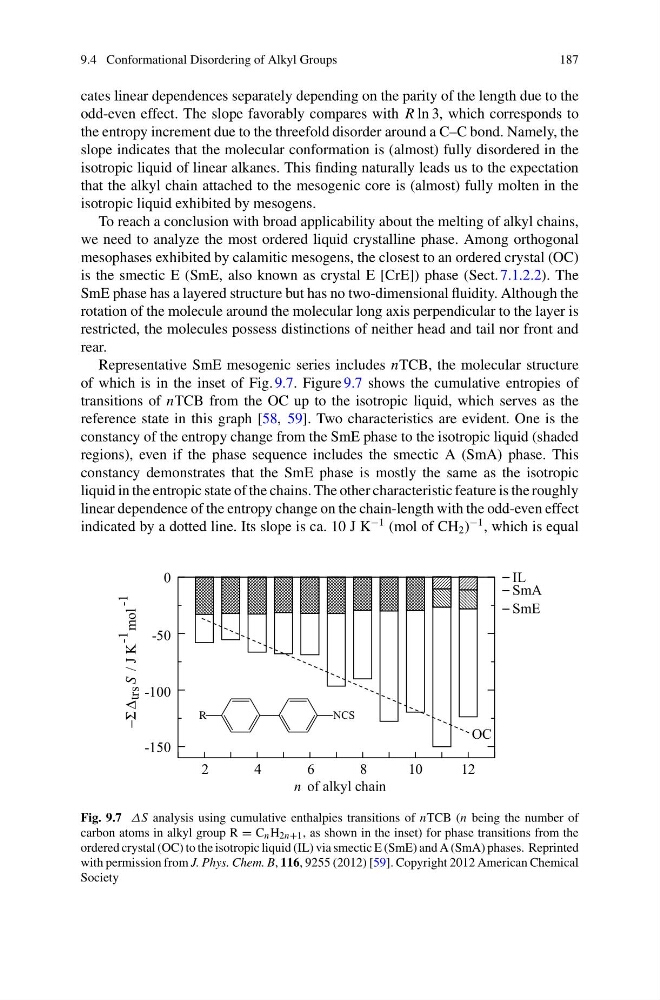
Representative SmE mesogenic series includes nTCB, the molecular structure
of which is in the inset of Fig. 9.7. Figure 9.7 shows the cumulative entropies of
transitions of nTCB from the OC up to the isotropic liquid, which serves as the
reference state in this graph [58, 59]. Two characteristics are evident. One is the
constancy of the entropy change from the SmE phase to the isotropic liquid (shaded
regions), even if the phase sequence includes the smectic A (SmA) phase. This
constancy demonstrates that the SmE phase is mostly the same as the isotropic
liquid in the entropic state of the chains. The other characteristic feature is the roughly
linear dependence of the entropy change on the chain-length with the odd-even effect
indicated by a dotted line. Its slope is ca. 10 J K
−1 (mol of CH 2 )
−1 , which is equal
R
NCS
-150
-100
-50
0
−Σ Δ
trs S / J K
-1
mol
-1
2
4
6
8
10
12
n of alkyl chain
IL
SmA
SmE
OC
Fig. 9.7 ΔS analysis using cumulative enthalpies transitions of nTCB (n being the number of
carbon atoms in alkyl group R = C n H 2n+1 , as shown in the inset) for phase transitions from the
ordered crystal (OC) to the isotropic liquid (IL) via smectic E (SmE) and A (SmA) phases. Reprinted
with permission from J. Phys. Chem. B, 116, 9255 (2012) [59]. Copyright 2012 American Chemical
Society
187
cates linear dependences separately depending on the parity of the length due to the
odd-even effect. The slope favorably compares with R ln 3, which corresponds to
the entropy increment due to the threefold disorder around a C–C bond. Namely, the
slope indicates that the molecular conformation is (almost) fully disordered in the
isotropic liquid of linear alkanes. This finding naturally leads us to the expectation
that the alkyl chain attached to the mesogenic core is (almost) fully molten in the
isotropic liquid exhibited by mesogens.
To reach a conclusion with broad applicability about the melting of alkyl chains,
we need to analyze the most ordered liquid crystalline phase. Among orthogonal
mesophases exhibited by calamitic mesogens, the closest to an ordered crystal (OC)
is the smectic E (SmE, also known as crystal E [CrE]) phase (Sect. 7.1.2.2). The
SmE phase has a layered structure but has no two-dimensional fluidity. Although the
rotation of the molecule around the molecular long axis perpendicular to the layer is
restricted, the molecules possess distinctions of neither head and tail nor front and
rear.
Representative SmE mesogenic series includes nTCB, the molecular structure
of which is in the inset of Fig. 9.7. Figure 9.7 shows the cumulative entropies of
transitions of nTCB from the OC up to the isotropic liquid, which serves as the
reference state in this graph [58, 59]. Two characteristics are evident. One is the
constancy of the entropy change from the SmE phase to the isotropic liquid (shaded
regions), even if the phase sequence includes the smectic A (SmA) phase. This
constancy demonstrates that the SmE phase is mostly the same as the isotropic
liquid in the entropic state of the chains. The other characteristic feature is the roughly
linear dependence of the entropy change on the chain-length with the odd-even effect
indicated by a dotted line. Its slope is ca. 10 J K
−1 (mol of CH 2 )
−1 , which is equal
R
NCS
-150
-100
-50
0
−Σ Δ
trs S / J K
-1
mol
-1
2
4
6
8
10
12
n of alkyl chain
IL
SmA
SmE
OC
Fig. 9.7 ΔS analysis using cumulative enthalpies transitions of nTCB (n being the number of
carbon atoms in alkyl group R = C n H 2n+1 , as shown in the inset) for phase transitions from the
ordered crystal (OC) to the isotropic liquid (IL) via smectic E (SmE) and A (SmA) phases. Reprinted
with permission from J. Phys. Chem. B, 116, 9255 (2012) [59]. Copyright 2012 American Chemical
Society