

174
8 Molecular Glasses
the glassy plastic crystal of ethanol suggests the presence of the boson peak [38]
whereas that of the glass of the disordered phase of p-chloronitrobenzene, the residual entropy of which implies the freezing of the head-to-tail disorder of molecules
[28], does not but with additional heat capacity beyond the Debye one [37].
8.3 Possibility of Ideal Glass Transitions
Since the heat capacity of liquids (irrespective of stable or supercooled) is larger than
that of the crystal, a naïve extrapolation of their entropies toward the low-temperature
side leads to their crossing at some temperature, often called the Kauzmann temperature, T K . Namely,
S liquid (T ) < S crystal (T )
(8.27)
for T < T K . Figure 8.6 illustrates the situation. Considering Boltzmann’s principle
(Eq. 2.8), however, it is expected that the liquid with (at least) positional disorder
should have a larger entropy than the crystal that has positional order. Equation 8.27
certainly contradicts this expectation [39]. This contradictory situation is known as
the Kauzmann paradox. The easiest way to avoid this catastrophic situation is to
assume a phase transition above T K . Indeed, T g is always higher than but close to T K .
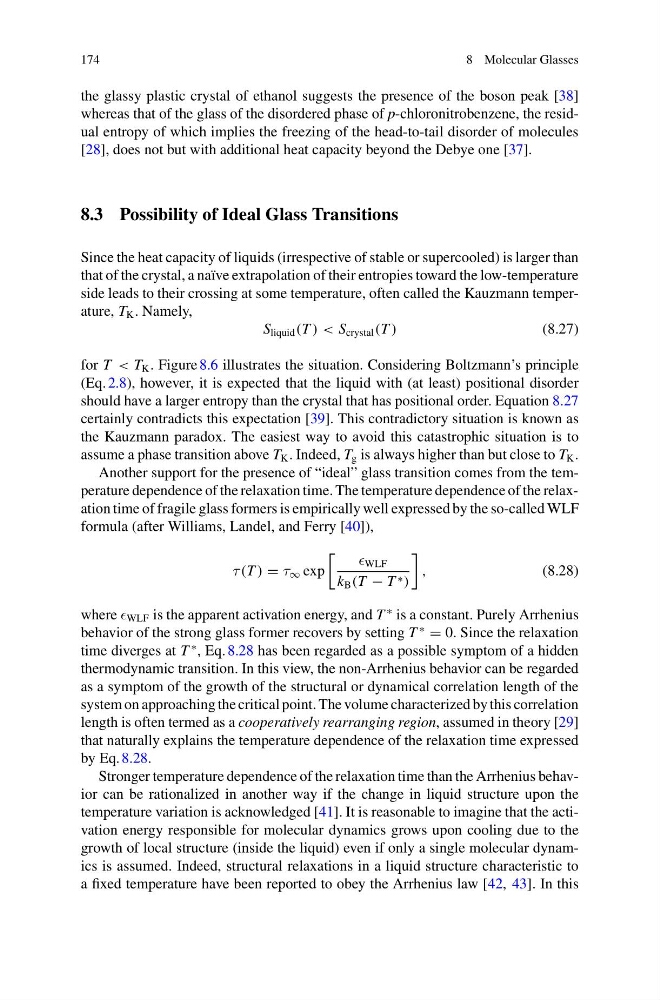
Another support for the presence of “ideal” glass transition comes from the temperature dependence of the relaxation time. The temperature dependence of the relaxation time of fragile glass formers is empirically well expressed by the so-called WLF
formula (after Williams, Landel, and Ferry [40]),
τ (T ) = τ ∞ exp
WLF
k B (T − T ∗ )
,
(8.28)
where WLF is the apparent activation energy, and T
∗ is a constant. Purely Arrhenius
behavior of the strong glass former recovers by setting T
∗
= 0. Since the relaxation
time diverges at T
∗ , Eq. 8.28 has been regarded as a possible symptom of a hidden
thermodynamic transition. In this view, the non-Arrhenius behavior can be regarded
as a symptom of the growth of the structural or dynamical correlation length of the
system on approaching the critical point. The volume characterized by this correlation
length is often termed as a cooperatively rearranging region, assumed in theory [29]
that naturally explains the temperature dependence of the relaxation time expressed
by Eq. 8.28.
Stronger temperature dependence of the relaxation time than the Arrhenius behavior can be rationalized in another way if the change in liquid structure upon the
temperature variation is acknowledged [41]. It is reasonable to imagine that the activation energy responsible for molecular dynamics grows upon cooling due to the
growth of local structure (inside the liquid) even if only a single molecular dynamics is assumed. Indeed, structural relaxations in a liquid structure characteristic to
a fixed temperature have been reported to obey the Arrhenius law [42, 43]. In this
8 Molecular Glasses
the glassy plastic crystal of ethanol suggests the presence of the boson peak [38]
whereas that of the glass of the disordered phase of p-chloronitrobenzene, the residual entropy of which implies the freezing of the head-to-tail disorder of molecules
[28], does not but with additional heat capacity beyond the Debye one [37].
8.3 Possibility of Ideal Glass Transitions
Since the heat capacity of liquids (irrespective of stable or supercooled) is larger than
that of the crystal, a naïve extrapolation of their entropies toward the low-temperature
side leads to their crossing at some temperature, often called the Kauzmann temperature, T K . Namely,
S liquid (T ) < S crystal (T )
(8.27)
for T < T K . Figure 8.6 illustrates the situation. Considering Boltzmann’s principle
(Eq. 2.8), however, it is expected that the liquid with (at least) positional disorder
should have a larger entropy than the crystal that has positional order. Equation 8.27
certainly contradicts this expectation [39]. This contradictory situation is known as
the Kauzmann paradox. The easiest way to avoid this catastrophic situation is to
assume a phase transition above T K . Indeed, T g is always higher than but close to T K .
Another support for the presence of “ideal” glass transition comes from the temperature dependence of the relaxation time. The temperature dependence of the relaxation time of fragile glass formers is empirically well expressed by the so-called WLF
formula (after Williams, Landel, and Ferry [40]),
τ (T ) = τ ∞ exp
WLF
k B (T − T ∗ )
,
(8.28)
where WLF is the apparent activation energy, and T
∗ is a constant. Purely Arrhenius
behavior of the strong glass former recovers by setting T
∗
= 0. Since the relaxation
time diverges at T
∗ , Eq. 8.28 has been regarded as a possible symptom of a hidden
thermodynamic transition. In this view, the non-Arrhenius behavior can be regarded
as a symptom of the growth of the structural or dynamical correlation length of the
system on approaching the critical point. The volume characterized by this correlation
length is often termed as a cooperatively rearranging region, assumed in theory [29]
that naturally explains the temperature dependence of the relaxation time expressed
by Eq. 8.28.
Stronger temperature dependence of the relaxation time than the Arrhenius behavior can be rationalized in another way if the change in liquid structure upon the
temperature variation is acknowledged [41]. It is reasonable to imagine that the activation energy responsible for molecular dynamics grows upon cooling due to the
growth of local structure (inside the liquid) even if only a single molecular dynamics is assumed. Indeed, structural relaxations in a liquid structure characteristic to
a fixed temperature have been reported to obey the Arrhenius law [42, 43]. In this