

146
7 Liquid Crystals
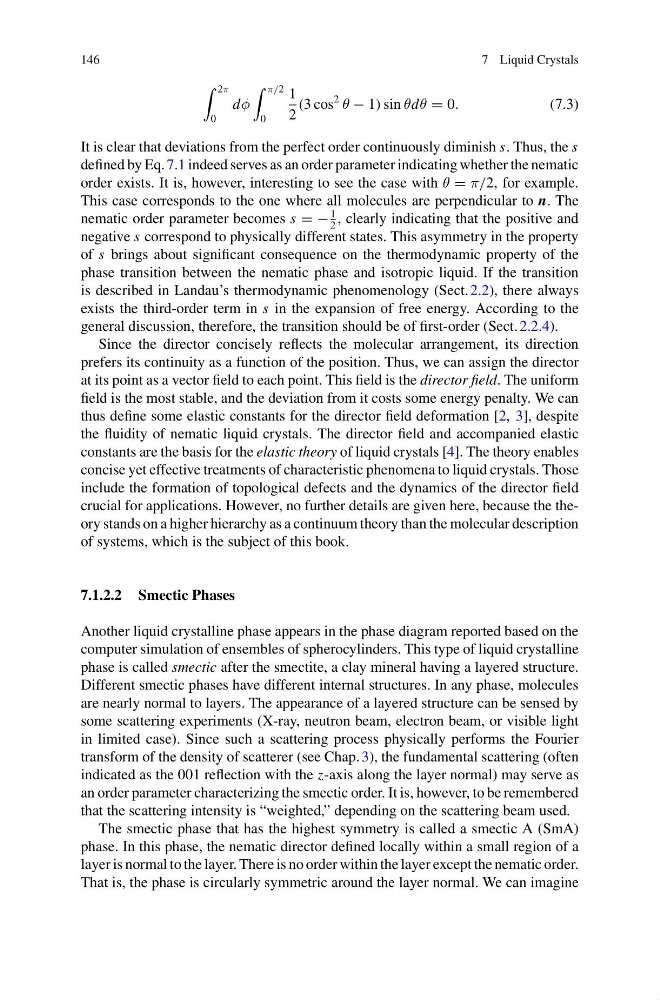
2π
0
dφ
π/2
0
1
2
(3 cos
2
θ − 1) sin θdθ = 0.
(7.3)
It is clear that deviations from the perfect order continuously diminish s. Thus, the s
defined by Eq. 7.1 indeed serves as an order parameter indicating whether the nematic
order exists. It is, however, interesting to see the case with θ = π/2, for example.
This case corresponds to the one where all molecules are perpendicular to n. The
nematic order parameter becomes s = −
1
2
, clearly indicating that the positive and
negative s correspond to physically different states. This asymmetry in the property
of s brings about significant consequence on the thermodynamic property of the
phase transition between the nematic phase and isotropic liquid. If the transition
is described in Landau’s thermodynamic phenomenology (Sect. 2.2), there always
exists the third-order term in s in the expansion of free energy. According to the
general discussion, therefore, the transition should be of first-order (Sect. 2.2.4).
Since the director concisely reflects the molecular arrangement, its direction
prefers its continuity as a function of the position. Thus, we can assign the director
at its point as a vector field to each point. This field is the director field. The uniform
field is the most stable, and the deviation from it costs some energy penalty. We can
thus define some elastic constants for the director field deformation [2, 3], despite
the fluidity of nematic liquid crystals. The director field and accompanied elastic
constants are the basis for the elastic theory of liquid crystals [4]. The theory enables
concise yet effective treatments of characteristic phenomena to liquid crystals. Those
include the formation of topological defects and the dynamics of the director field
crucial for applications. However, no further details are given here, because the theory stands on a higher hierarchy as a continuum theory than the molecular description
of systems, which is the subject of this book.
7.1.2.2 Smectic Phases
Another liquid crystalline phase appears in the phase diagram reported based on the
computer simulation of ensembles of spherocylinders. This type of liquid crystalline
phase is called smectic after the smectite, a clay mineral having a layered structure.
Different smectic phases have different internal structures. In any phase, molecules
are nearly normal to layers. The appearance of a layered structure can be sensed by
some scattering experiments (X-ray, neutron beam, electron beam, or visible light
in limited case). Since such a scattering process physically performs the Fourier
transform of the density of scatterer (see Chap. 3), the fundamental scattering (often
indicated as the 001 reflection with the z-axis along the layer normal) may serve as
an order parameter characterizing the smectic order. It is, however, to be remembered
that the scattering intensity is “weighted,” depending on the scattering beam used.
The smectic phase that has the highest symmetry is called a smectic A (SmA)
phase. In this phase, the nematic director defined locally within a small region of a
layer is normal to the layer. There is no order within the layer except the nematic order.
That is, the phase is circularly symmetric around the layer normal. We can imagine
7 Liquid Crystals
2π
0
dφ
π/2
0
1
2
(3 cos
2
θ − 1) sin θdθ = 0.
(7.3)
It is clear that deviations from the perfect order continuously diminish s. Thus, the s
defined by Eq. 7.1 indeed serves as an order parameter indicating whether the nematic
order exists. It is, however, interesting to see the case with θ = π/2, for example.
This case corresponds to the one where all molecules are perpendicular to n. The
nematic order parameter becomes s = −
1
2
, clearly indicating that the positive and
negative s correspond to physically different states. This asymmetry in the property
of s brings about significant consequence on the thermodynamic property of the
phase transition between the nematic phase and isotropic liquid. If the transition
is described in Landau’s thermodynamic phenomenology (Sect. 2.2), there always
exists the third-order term in s in the expansion of free energy. According to the
general discussion, therefore, the transition should be of first-order (Sect. 2.2.4).
Since the director concisely reflects the molecular arrangement, its direction
prefers its continuity as a function of the position. Thus, we can assign the director
at its point as a vector field to each point. This field is the director field. The uniform
field is the most stable, and the deviation from it costs some energy penalty. We can
thus define some elastic constants for the director field deformation [2, 3], despite
the fluidity of nematic liquid crystals. The director field and accompanied elastic
constants are the basis for the elastic theory of liquid crystals [4]. The theory enables
concise yet effective treatments of characteristic phenomena to liquid crystals. Those
include the formation of topological defects and the dynamics of the director field
crucial for applications. However, no further details are given here, because the theory stands on a higher hierarchy as a continuum theory than the molecular description
of systems, which is the subject of this book.
7.1.2.2 Smectic Phases
Another liquid crystalline phase appears in the phase diagram reported based on the
computer simulation of ensembles of spherocylinders. This type of liquid crystalline
phase is called smectic after the smectite, a clay mineral having a layered structure.
Different smectic phases have different internal structures. In any phase, molecules
are nearly normal to layers. The appearance of a layered structure can be sensed by
some scattering experiments (X-ray, neutron beam, electron beam, or visible light
in limited case). Since such a scattering process physically performs the Fourier
transform of the density of scatterer (see Chap. 3), the fundamental scattering (often
indicated as the 001 reflection with the z-axis along the layer normal) may serve as
an order parameter characterizing the smectic order. It is, however, to be remembered
that the scattering intensity is “weighted,” depending on the scattering beam used.
The smectic phase that has the highest symmetry is called a smectic A (SmA)
phase. In this phase, the nematic director defined locally within a small region of a
layer is normal to the layer. There is no order within the layer except the nematic order.
That is, the phase is circularly symmetric around the layer normal. We can imagine