

1.1 Hierarchy of Materials
3
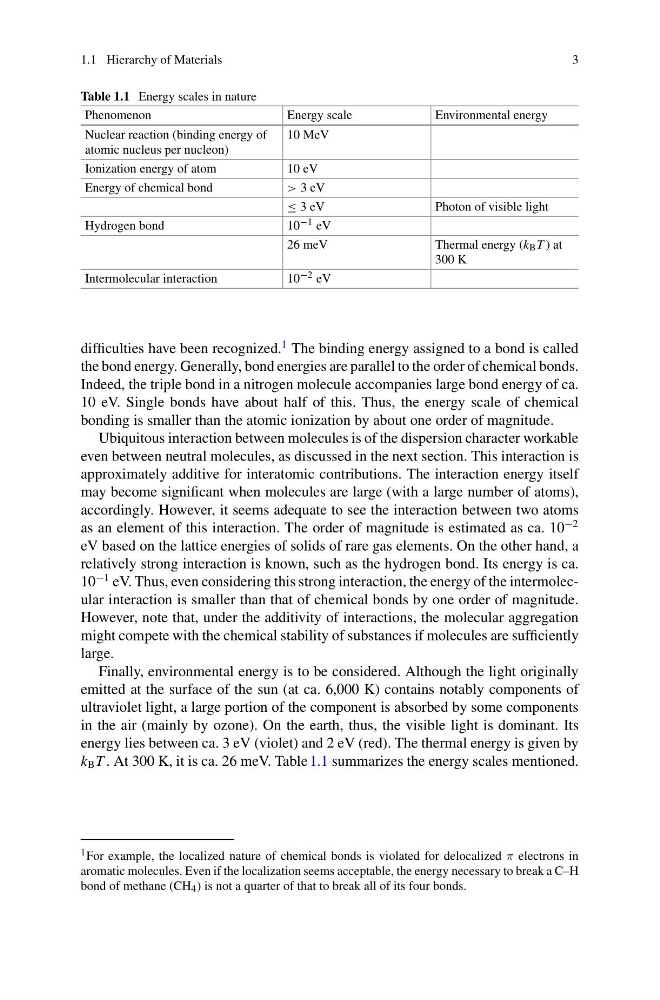
Table 1.1 Energy scales in nature
Phenomenon
Energy scale
Environmental energy
Nuclear reaction (binding energy of
atomic nucleus per nucleon)
10 MeV
Ionization energy of atom
10 eV
Energy of chemical bond
> 3 eV
≤ 3 eV
Photon of visible light
Hydrogen bond
10 −1 eV
26 meV
Thermal energy (k B T ) at
300 K
Intermolecular interaction
10 −2 eV
difficulties have been recognized.
1 The binding energy assigned to a bond is called
the bond energy. Generally, bond energies are parallel to the order of chemical bonds.
Indeed, the triple bond in a nitrogen molecule accompanies large bond energy of ca.
10 eV. Single bonds have about half of this. Thus, the energy scale of chemical
bonding is smaller than the atomic ionization by about one order of magnitude.
Ubiquitous interaction between molecules is of the dispersion character workable
even between neutral molecules, as discussed in the next section. This interaction is
approximately additive for interatomic contributions. The interaction energy itself
may become significant when molecules are large (with a large number of atoms),
accordingly. However, it seems adequate to see the interaction between two atoms
as an element of this interaction. The order of magnitude is estimated as ca. 10
−2
eV based on the lattice energies of solids of rare gas elements. On the other hand, a
relatively strong interaction is known, such as the hydrogen bond. Its energy is ca.
10
−1 eV. Thus, even considering this strong interaction, the energy of the intermolecular interaction is smaller than that of chemical bonds by one order of magnitude.
However, note that, under the additivity of interactions, the molecular aggregation
might compete with the chemical stability of substances if molecules are sufficiently
large.
Finally, environmental energy is to be considered. Although the light originally
emitted at the surface of the sun (at ca. 6,000 K) contains notably components of
ultraviolet light, a large portion of the component is absorbed by some components
in the air (mainly by ozone). On the earth, thus, the visible light is dominant. Its
energy lies between ca. 3 eV (violet) and 2 eV (red). The thermal energy is given by
k B T . At 300 K, it is ca. 26 meV. Table 1.1 summarizes the energy scales mentioned.
1 For example, the localized nature of chemical bonds is violated for delocalized π electrons in
aromatic molecules. Even if the localization seems acceptable, the energy necessary to break a C–H
bond of methane (CH 4 ) is not a quarter of that to break all of its four bonds.
3
Table 1.1 Energy scales in nature
Phenomenon
Energy scale
Environmental energy
Nuclear reaction (binding energy of
atomic nucleus per nucleon)
10 MeV
Ionization energy of atom
10 eV
Energy of chemical bond
> 3 eV
≤ 3 eV
Photon of visible light
Hydrogen bond
10 −1 eV
26 meV
Thermal energy (k B T ) at
300 K
Intermolecular interaction
10 −2 eV
difficulties have been recognized.
1 The binding energy assigned to a bond is called
the bond energy. Generally, bond energies are parallel to the order of chemical bonds.
Indeed, the triple bond in a nitrogen molecule accompanies large bond energy of ca.
10 eV. Single bonds have about half of this. Thus, the energy scale of chemical
bonding is smaller than the atomic ionization by about one order of magnitude.
Ubiquitous interaction between molecules is of the dispersion character workable
even between neutral molecules, as discussed in the next section. This interaction is
approximately additive for interatomic contributions. The interaction energy itself
may become significant when molecules are large (with a large number of atoms),
accordingly. However, it seems adequate to see the interaction between two atoms
as an element of this interaction. The order of magnitude is estimated as ca. 10
−2
eV based on the lattice energies of solids of rare gas elements. On the other hand, a
relatively strong interaction is known, such as the hydrogen bond. Its energy is ca.
10
−1 eV. Thus, even considering this strong interaction, the energy of the intermolecular interaction is smaller than that of chemical bonds by one order of magnitude.
However, note that, under the additivity of interactions, the molecular aggregation
might compete with the chemical stability of substances if molecules are sufficiently
large.
Finally, environmental energy is to be considered. Although the light originally
emitted at the surface of the sun (at ca. 6,000 K) contains notably components of
ultraviolet light, a large portion of the component is absorbed by some components
in the air (mainly by ozone). On the earth, thus, the visible light is dominant. Its
energy lies between ca. 3 eV (violet) and 2 eV (red). The thermal energy is given by
k B T . At 300 K, it is ca. 26 meV. Table 1.1 summarizes the energy scales mentioned.
1 For example, the localized nature of chemical bonds is violated for delocalized π electrons in
aromatic molecules. Even if the localization seems acceptable, the energy necessary to break a C–H
bond of methane (CH 4 ) is not a quarter of that to break all of its four bonds.