

94
5 Lattice Dynamics of Molecular Crystals
m
−1
j =
⎛
⎝
m
−1
j
0
0
0 m
−1
j
0
0
0 m
−1
j
⎞
⎠
(5.46)
F(q) =
⎛
⎜
⎝
f 11 . . . f 1n
. . . f j j
. . .
f n1 . . . f nn
⎞
⎟
⎠
(5.47)
f j j =
⎛
⎝
F j x j x F j x j y F j x j z
F j yj x F j yj y F j yj z
F jzj x F jzj y F jzj z
⎞
⎠ .
(5.48)
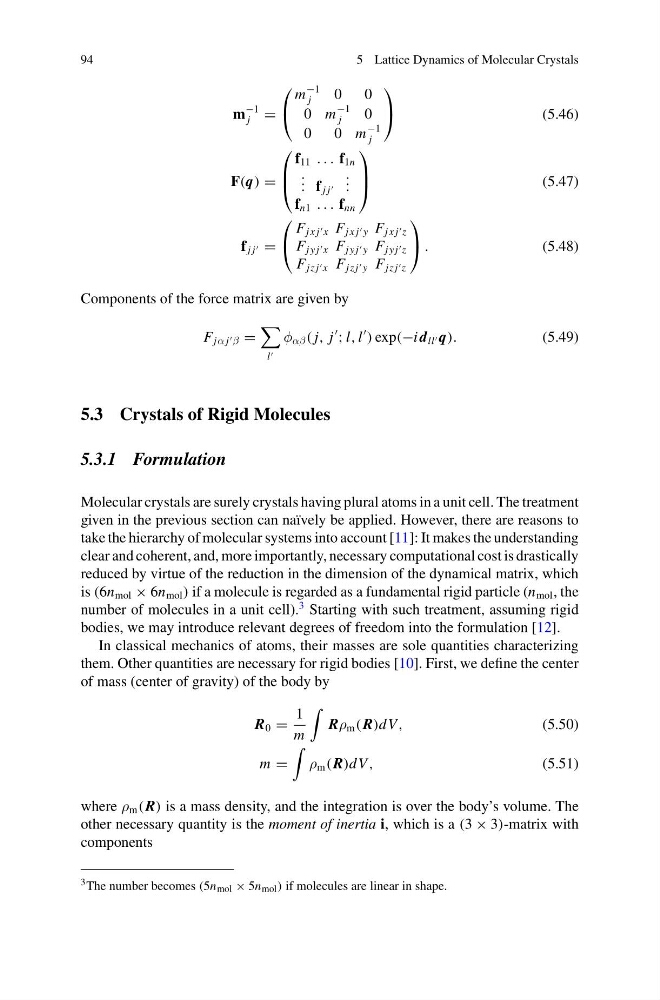
Components of the force matrix are given by
F jα j β =
l
φ αβ ( j, j
; l, l
) exp(−i d ll q).
(5.49)
5.3 Crystals of Rigid Molecules
5.3.1 Formulation
Molecular crystals are surely crystals having plural atoms in a unit cell. The treatment
given in the previous section can naïvely be applied. However, there are reasons to
take the hierarchy of molecular systems into account [11]: It makes the understanding
clear and coherent, and, more importantly, necessary computational cost is drastically
reduced by virtue of the reduction in the dimension of the dynamical matrix, which
is (6n mol × 6n mol ) if a molecule is regarded as a fundamental rigid particle (n mol , the
number of molecules in a unit cell).
3 Starting with such treatment, assuming rigid
bodies, we may introduce relevant degrees of freedom into the formulation [12].
In classical mechanics of atoms, their masses are sole quantities characterizing
them. Other quantities are necessary for rigid bodies [10]. First, we define the center
of mass (center of gravity) of the body by
R 0 =
1
m
Rρ m (R)dV,
(5.50)
m =
ρ m (R)dV,
(5.51)
where ρ m (R) is a mass density, and the integration is over the body’s volume. The
other necessary quantity is the moment of inertia i, which is a (3 × 3)-matrix with
components
3 The number becomes (5n mol × 5n mol ) if molecules are linear in shape.
5 Lattice Dynamics of Molecular Crystals
m
−1
j =
⎛
⎝
m
−1
j
0
0
0 m
−1
j
0
0
0 m
−1
j
⎞
⎠
(5.46)
F(q) =
⎛
⎜
⎝
f 11 . . . f 1n
. . . f j j
. . .
f n1 . . . f nn
⎞
⎟
⎠
(5.47)
f j j =
⎛
⎝
F j x j x F j x j y F j x j z
F j yj x F j yj y F j yj z
F jzj x F jzj y F jzj z
⎞
⎠ .
(5.48)
Components of the force matrix are given by
F jα j β =
l
φ αβ ( j, j
; l, l
) exp(−i d ll q).
(5.49)
5.3 Crystals of Rigid Molecules
5.3.1 Formulation
Molecular crystals are surely crystals having plural atoms in a unit cell. The treatment
given in the previous section can naïvely be applied. However, there are reasons to
take the hierarchy of molecular systems into account [11]: It makes the understanding
clear and coherent, and, more importantly, necessary computational cost is drastically
reduced by virtue of the reduction in the dimension of the dynamical matrix, which
is (6n mol × 6n mol ) if a molecule is regarded as a fundamental rigid particle (n mol , the
number of molecules in a unit cell).
3 Starting with such treatment, assuming rigid
bodies, we may introduce relevant degrees of freedom into the formulation [12].
In classical mechanics of atoms, their masses are sole quantities characterizing
them. Other quantities are necessary for rigid bodies [10]. First, we define the center
of mass (center of gravity) of the body by
R 0 =
1
m
Rρ m (R)dV,
(5.50)
m =
ρ m (R)dV,
(5.51)
where ρ m (R) is a mass density, and the integration is over the body’s volume. The
other necessary quantity is the moment of inertia i, which is a (3 × 3)-matrix with
components
3 The number becomes (5n mol × 5n mol ) if molecules are linear in shape.