

1.2 Classification of Surface Water
Calcification of water quality has been reported by Water framework directive
(WFD) in 2012 [16]. WFD specified the quality elements that are used to assess
the ecological and chemical status of a water body. Quality elements are generally
biological (e.g. fish, invertebrates, macrophytes) or chemical (e.g., heavy metals,
pesticides, nutrients). Classifications indicate where the quality of the environment is
good, where it may need improvement, and what may need to be improved. They
can also be used, over the years, to plan improvements, show trends, and to monitor
success. Based on WFD, there are two status classifications which are commonly
reported: ecological and chemical.
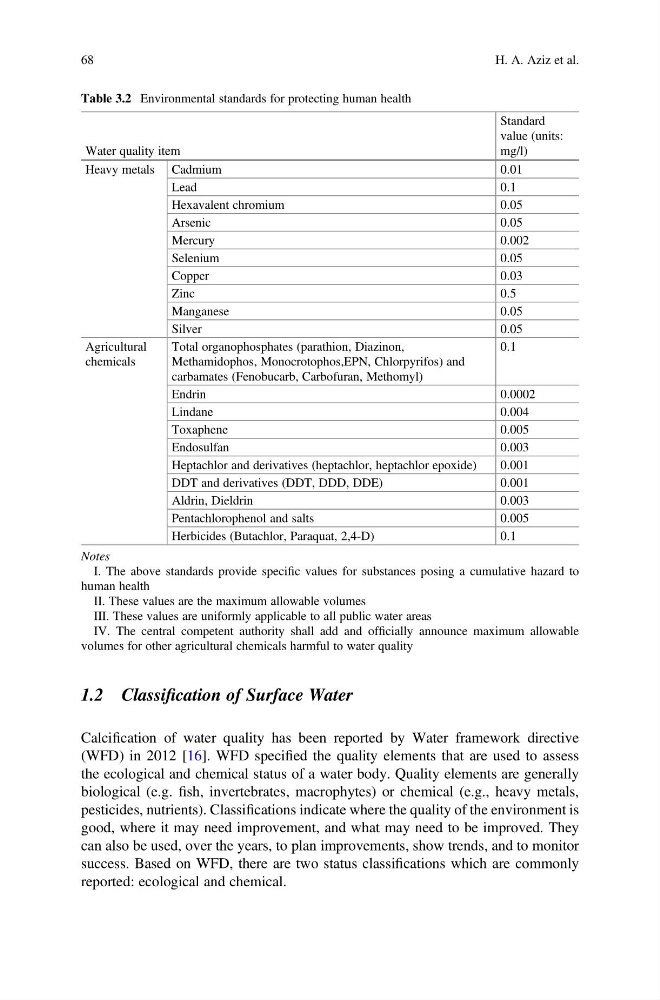
Table 3.2 Environmental standards for protecting human health
Water quality item
Standard
value (units:
mg/l)
Heavy metals Cadmium
0.01
Lead
0.1
Hexavalent chromium
0.05
Arsenic
0.05
Mercury
0.002
Selenium
0.05
Copper
0.03
Zinc
0.5
Manganese
0.05
Silver
0.05
Agricultural
chemicals
Total organophosphates (parathion, Diazinon,
Methamidophos, Monocrotophos,EPN, Chlorpyrifos) and
carbamates (Fenobucarb, Carbofuran, Methomyl)
0.1
Endrin
0.0002
Lindane
0.004
Toxaphene
0.005
Endosulfan
0.003
Heptachlor and derivatives (heptachlor, heptachlor epoxide)
0.001
DDT and derivatives (DDT, DDD, DDE)
0.001
Aldrin, Dieldrin
0.003
Pentachlorophenol and salts
0.005
Herbicides (Butachlor, Paraquat, 2,4-D)
0.1
Notes
I. The above standards provide specific values for substances posing a cumulative hazard to
human health
II. These values are the maximum allowable volumes
III. These values are uniformly applicable to all public water areas
IV. The central competent authority shall add and officially announce maximum allowable
volumes for other agricultural chemicals harmful to water quality
68
H. A. Aziz et al.
Calcification of water quality has been reported by Water framework directive
(WFD) in 2012 [16]. WFD specified the quality elements that are used to assess
the ecological and chemical status of a water body. Quality elements are generally
biological (e.g. fish, invertebrates, macrophytes) or chemical (e.g., heavy metals,
pesticides, nutrients). Classifications indicate where the quality of the environment is
good, where it may need improvement, and what may need to be improved. They
can also be used, over the years, to plan improvements, show trends, and to monitor
success. Based on WFD, there are two status classifications which are commonly
reported: ecological and chemical.
Table 3.2 Environmental standards for protecting human health
Water quality item
Standard
value (units:
mg/l)
Heavy metals Cadmium
0.01
Lead
0.1
Hexavalent chromium
0.05
Arsenic
0.05
Mercury
0.002
Selenium
0.05
Copper
0.03
Zinc
0.5
Manganese
0.05
Silver
0.05
Agricultural
chemicals
Total organophosphates (parathion, Diazinon,
Methamidophos, Monocrotophos,EPN, Chlorpyrifos) and
carbamates (Fenobucarb, Carbofuran, Methomyl)
0.1
Endrin
0.0002
Lindane
0.004
Toxaphene
0.005
Endosulfan
0.003
Heptachlor and derivatives (heptachlor, heptachlor epoxide)
0.001
DDT and derivatives (DDT, DDD, DDE)
0.001
Aldrin, Dieldrin
0.003
Pentachlorophenol and salts
0.005
Herbicides (Butachlor, Paraquat, 2,4-D)
0.1
Notes
I. The above standards provide specific values for substances posing a cumulative hazard to
human health
II. These values are the maximum allowable volumes
III. These values are uniformly applicable to all public water areas
IV. The central competent authority shall add and officially announce maximum allowable
volumes for other agricultural chemicals harmful to water quality
68
H. A. Aziz et al.