

5.4 Case Study Lessons Learned
The VIP toilet technology has been a welcome relief to the Kikoo community, with
the following lessons:
1. Floor Sealing. Toilet floors have to be sealed completely to prevent vectors such
as snakes and flies from having access to feces. This was a success story of the
project since most toilet floors in the community either with wooden cross bars
are sealed with soil or slabs which sealed the toilets completely.
2. Build Close to Home. Another success of the project was to show that with good
ventilation, a VIP toilet can be located close to the home rather than far in the
woods or farm. This is very secure for children and women especially at night and
gives them pride and dignity.
3. Ventilated Pipe. The ventilated pipe for latrines has been replicated in two
community houses since the project was realized.
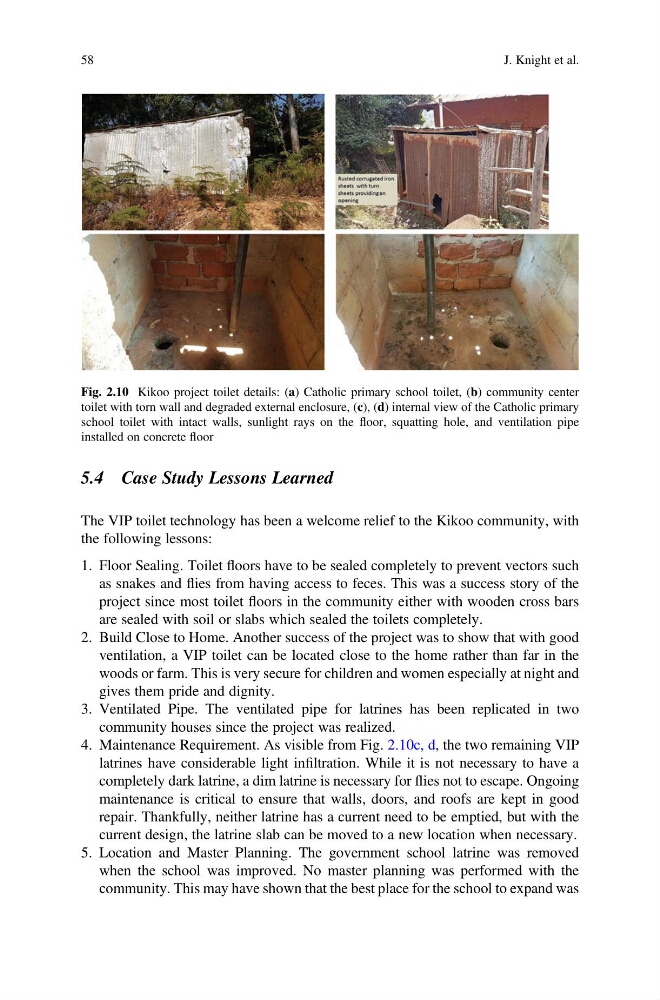
4. Maintenance Requirement. As visible from Fig. 2.10c, d, the two remaining VIP
latrines have considerable light infiltration. While it is not necessary to have a
completely dark latrine, a dim latrine is necessary for flies not to escape. Ongoing
maintenance is critical to ensure that walls, doors, and roofs are kept in good
repair. Thankfully, neither latrine has a current need to be emptied, but with the
current design, the latrine slab can be moved to a new location when necessary.
5. Location and Master Planning. The government school latrine was removed
when the school was improved. No master planning was performed with the
community. This may have shown that the best place for the school to expand was
Fig. 2.10 Kikoo project toilet details: (a) Catholic primary school toilet, (b) community center
toilet with torn wall and degraded external enclosure, (c), (d) internal view of the Catholic primary
school toilet with intact walls, sunlight rays on the floor, squatting hole, and ventilation pipe
installed on concrete floor
58
J. Knight et al.
The VIP toilet technology has been a welcome relief to the Kikoo community, with
the following lessons:
1. Floor Sealing. Toilet floors have to be sealed completely to prevent vectors such
as snakes and flies from having access to feces. This was a success story of the
project since most toilet floors in the community either with wooden cross bars
are sealed with soil or slabs which sealed the toilets completely.
2. Build Close to Home. Another success of the project was to show that with good
ventilation, a VIP toilet can be located close to the home rather than far in the
woods or farm. This is very secure for children and women especially at night and
gives them pride and dignity.
3. Ventilated Pipe. The ventilated pipe for latrines has been replicated in two
community houses since the project was realized.
4. Maintenance Requirement. As visible from Fig. 2.10c, d, the two remaining VIP
latrines have considerable light infiltration. While it is not necessary to have a
completely dark latrine, a dim latrine is necessary for flies not to escape. Ongoing
maintenance is critical to ensure that walls, doors, and roofs are kept in good
repair. Thankfully, neither latrine has a current need to be emptied, but with the
current design, the latrine slab can be moved to a new location when necessary.
5. Location and Master Planning. The government school latrine was removed
when the school was improved. No master planning was performed with the
community. This may have shown that the best place for the school to expand was
Fig. 2.10 Kikoo project toilet details: (a) Catholic primary school toilet, (b) community center
toilet with torn wall and degraded external enclosure, (c), (d) internal view of the Catholic primary
school toilet with intact walls, sunlight rays on the floor, squatting hole, and ventilation pipe
installed on concrete floor
58
J. Knight et al.