

with EWB-USA. The Yale University EWB-USA chapter accepted the request
which began with a successful water project. After the water project was completed,
it was followed by a latrine project for which the Yale chapter provided 90% of the
cash needs for three latrines, while the community provided 10% cash and in-kind
contributions (labor, food for the visiting engineers). The EWB-USA Yale teams
identified open pit toilets common in the community as one of the sanitary problems
affecting the livelihood of the people.
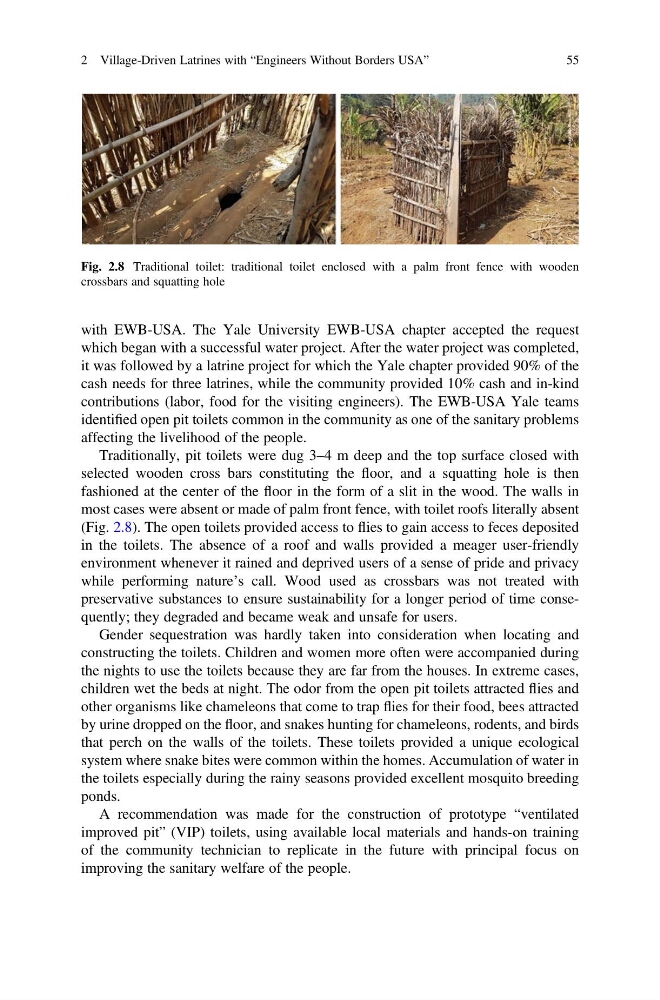
Traditionally, pit toilets were dug 3–4 m deep and the top surface closed with
selected wooden cross bars constituting the floor, and a squatting hole is then
fashioned at the center of the floor in the form of a slit in the wood. The walls in
most cases were absent or made of palm front fence, with toilet roofs literally absent
(Fig. 2.8). The open toilets provided access to flies to gain access to feces deposited
in the toilets. The absence of a roof and walls provided a meager user-friendly
environment whenever it rained and deprived users of a sense of pride and privacy
while performing nature’s call. Wood used as crossbars was not treated with
preservative substances to ensure sustainability for a longer period of time consequently; they degraded and became weak and unsafe for users.
Gender sequestration was hardly taken into consideration when locating and
constructing the toilets. Children and women more often were accompanied during
the nights to use the toilets because they are far from the houses. In extreme cases,
children wet the beds at night. The odor from the open pit toilets attracted flies and
other organisms like chameleons that come to trap flies for their food, bees attracted
by urine dropped on the floor, and snakes hunting for chameleons, rodents, and birds
that perch on the walls of the toilets. These toilets provided a unique ecological
system where snake bites were common within the homes. Accumulation of water in
the toilets especially during the rainy seasons provided excellent mosquito breeding
ponds.
A recommendation was made for the construction of prototype “ventilated
improved pit” (VIP) toilets, using available local materials and hands-on training
of the community technician to replicate in the future with principal focus on
improving the sanitary welfare of the people.
Fig. 2.8 Traditional toilet: traditional toilet enclosed with a palm front fence with wooden
crossbars and squatting hole
2 Village-Driven Latrines with “Engineers Without Borders USA”
55
which began with a successful water project. After the water project was completed,
it was followed by a latrine project for which the Yale chapter provided 90% of the
cash needs for three latrines, while the community provided 10% cash and in-kind
contributions (labor, food for the visiting engineers). The EWB-USA Yale teams
identified open pit toilets common in the community as one of the sanitary problems
affecting the livelihood of the people.
Traditionally, pit toilets were dug 3–4 m deep and the top surface closed with
selected wooden cross bars constituting the floor, and a squatting hole is then
fashioned at the center of the floor in the form of a slit in the wood. The walls in
most cases were absent or made of palm front fence, with toilet roofs literally absent
(Fig. 2.8). The open toilets provided access to flies to gain access to feces deposited
in the toilets. The absence of a roof and walls provided a meager user-friendly
environment whenever it rained and deprived users of a sense of pride and privacy
while performing nature’s call. Wood used as crossbars was not treated with
preservative substances to ensure sustainability for a longer period of time consequently; they degraded and became weak and unsafe for users.
Gender sequestration was hardly taken into consideration when locating and
constructing the toilets. Children and women more often were accompanied during
the nights to use the toilets because they are far from the houses. In extreme cases,
children wet the beds at night. The odor from the open pit toilets attracted flies and
other organisms like chameleons that come to trap flies for their food, bees attracted
by urine dropped on the floor, and snakes hunting for chameleons, rodents, and birds
that perch on the walls of the toilets. These toilets provided a unique ecological
system where snake bites were common within the homes. Accumulation of water in
the toilets especially during the rainy seasons provided excellent mosquito breeding
ponds.
A recommendation was made for the construction of prototype “ventilated
improved pit” (VIP) toilets, using available local materials and hands-on training
of the community technician to replicate in the future with principal focus on
improving the sanitary welfare of the people.
Fig. 2.8 Traditional toilet: traditional toilet enclosed with a palm front fence with wooden
crossbars and squatting hole
2 Village-Driven Latrines with “Engineers Without Borders USA”
55