

3.3.3 Composting Latrine
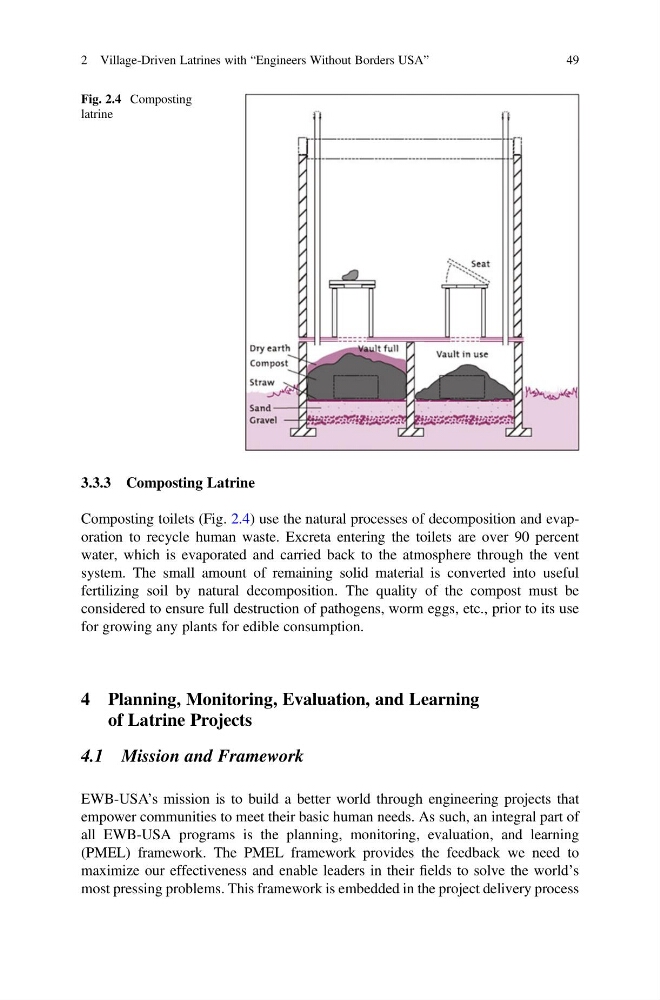
Composting toilets (Fig. 2.4) use the natural processes of decomposition and evaporation to recycle human waste. Excreta entering the toilets are over 90 percent
water, which is evaporated and carried back to the atmosphere through the vent
system. The small amount of remaining solid material is converted into useful
fertilizing soil by natural decomposition. The quality of the compost must be
considered to ensure full destruction of pathogens, worm eggs, etc., prior to its use
for growing any plants for edible consumption.
4 Planning, Monitoring, Evaluation, and Learning
of Latrine Projects
4.1 Mission and Framework
EWB-USA’s mission is to build a better world through engineering projects that
empower communities to meet their basic human needs. As such, an integral part of
all EWB-USA programs is the planning, monitoring, evaluation, and learning
(PMEL) framework. The PMEL framework provides the feedback we need to
maximize our effectiveness and enable leaders in their fields to solve the world’s
most pressing problems. This framework is embedded in the project delivery process
Fig. 2.4 Composting
latrine
2 Village-Driven Latrines with “Engineers Without Borders USA”
49
Composting toilets (Fig. 2.4) use the natural processes of decomposition and evaporation to recycle human waste. Excreta entering the toilets are over 90 percent
water, which is evaporated and carried back to the atmosphere through the vent
system. The small amount of remaining solid material is converted into useful
fertilizing soil by natural decomposition. The quality of the compost must be
considered to ensure full destruction of pathogens, worm eggs, etc., prior to its use
for growing any plants for edible consumption.
4 Planning, Monitoring, Evaluation, and Learning
of Latrine Projects
4.1 Mission and Framework
EWB-USA’s mission is to build a better world through engineering projects that
empower communities to meet their basic human needs. As such, an integral part of
all EWB-USA programs is the planning, monitoring, evaluation, and learning
(PMEL) framework. The PMEL framework provides the feedback we need to
maximize our effectiveness and enable leaders in their fields to solve the world’s
most pressing problems. This framework is embedded in the project delivery process
Fig. 2.4 Composting
latrine
2 Village-Driven Latrines with “Engineers Without Borders USA”
49