

14. Education. Water, sanitation, and hygiene (WASH) considerations must be
included to truly reduce waterborne and water-related diseases, as a latrine
alone is not enough. Monitoring (soap and water availability, latrine cleanliness,
clean water sources), education, and future project plans should be included, as
appropriate.
3.3 Existing Latrine Technologies
Several latrine technologies are widely used today. Selection of the technology
depends on water and material availability, soil analysis, community practices, and
estimated population growth, as explained in the previous section.
The three most common types of latrines are:
1. Ventilated improved pit latrine
2. Pour-flush latrine
3. Composting latrine
3.3.1 Ventilated Improved Pit (VIP)
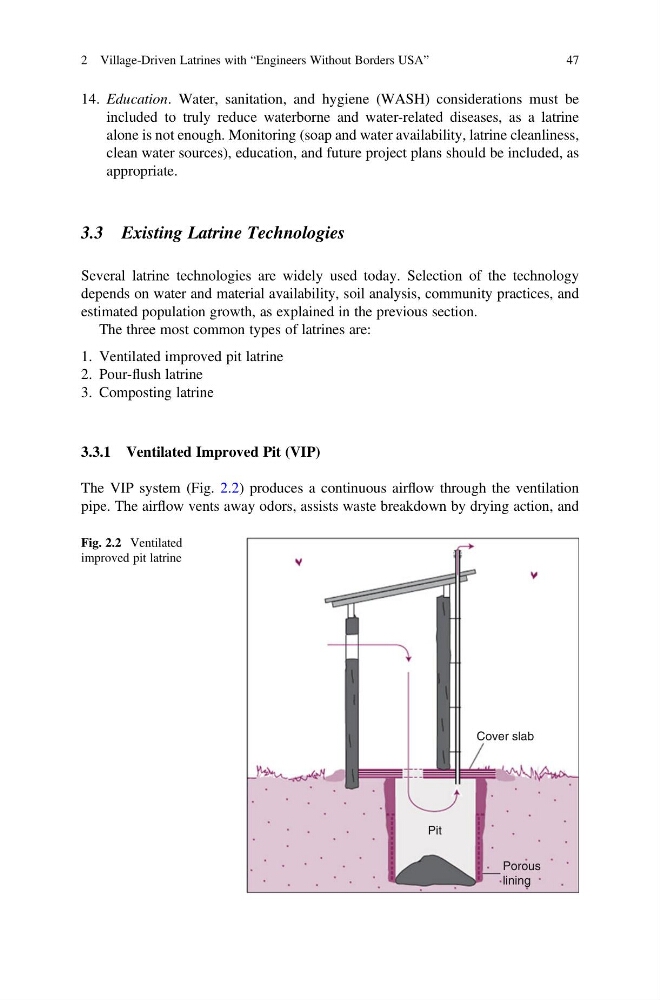
The VIP system (Fig. 2.2) produces a continuous airflow through the ventilation
pipe. The airflow vents away odors, assists waste breakdown by drying action, and
Cover slab
Pit
Porous
lining
Fig. 2.2 Ventilated
improved pit latrine
2 Village-Driven Latrines with “Engineers Without Borders USA”
47
included to truly reduce waterborne and water-related diseases, as a latrine
alone is not enough. Monitoring (soap and water availability, latrine cleanliness,
clean water sources), education, and future project plans should be included, as
appropriate.
3.3 Existing Latrine Technologies
Several latrine technologies are widely used today. Selection of the technology
depends on water and material availability, soil analysis, community practices, and
estimated population growth, as explained in the previous section.
The three most common types of latrines are:
1. Ventilated improved pit latrine
2. Pour-flush latrine
3. Composting latrine
3.3.1 Ventilated Improved Pit (VIP)
The VIP system (Fig. 2.2) produces a continuous airflow through the ventilation
pipe. The airflow vents away odors, assists waste breakdown by drying action, and
Cover slab
Pit
Porous
lining
Fig. 2.2 Ventilated
improved pit latrine
2 Village-Driven Latrines with “Engineers Without Borders USA”
47