

On the application of an external magnetic field, the magnetic adsorbents can be
rapidly and easily separated from water due to the presence of the metal components
which are oxides of metals such as Fe, Co, Ni, and Cu in the adsorbent. Since
magnetic particles were modified with polymer, carbon nanotubes deserve due
attention to be used commercially for water treatment due to chemical stability,
mechanical and thermal stability, and high surface area.
In addition, spinel ferrite magnetic materials with the general structural formula
MFe 2 O 4 (M ¼ Ca, Co, Cu, Mg, Mn, Ni, Zn) are becoming more popular for
remediation of metal ions due to their tunable sizes, diverse structures, high surface
areas, excellent chemical and thermal stabilities, ease of separation, high sorption
performance, and wide pH ranges [49]. A ferromagnetic NiFe 2 O 4 which is synthesized by a sol-gel method using egg white shows high adsorption capacity for Cu
2+ ,
Cr
4+ , and Ni
2+ because its 3D interconnected porous structure was reported to keep
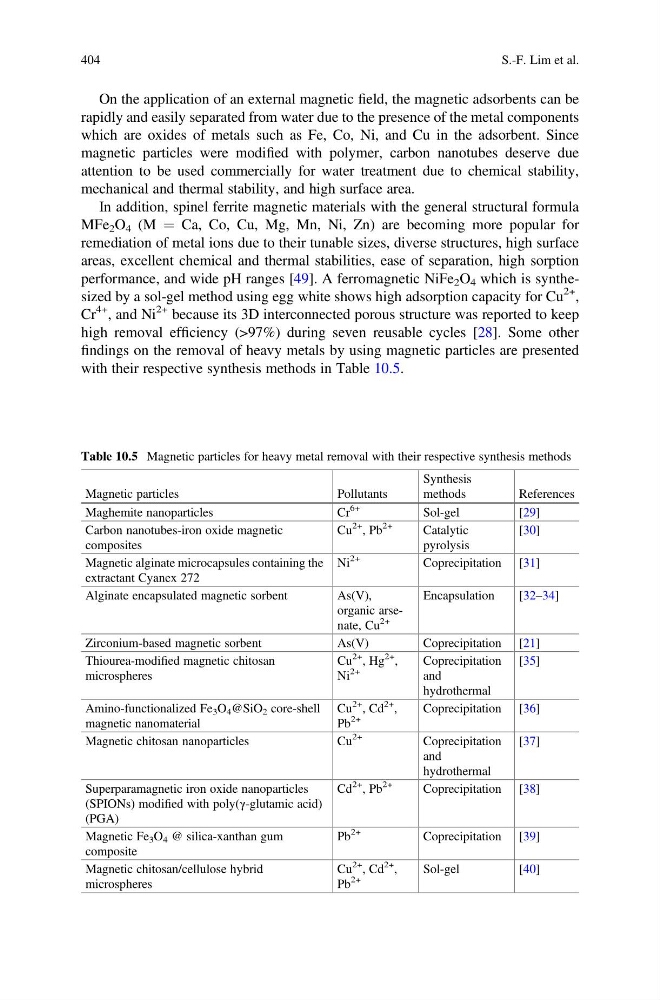
high removal efficiency (>97%) during seven reusable cycles [28]. Some other
findings on the removal of heavy metals by using magnetic particles are presented
with their respective synthesis methods in Table 10.5.
Table 10.5 Magnetic particles for heavy metal removal with their respective synthesis methods
Magnetic particles
Pollutants
Synthesis
methods
References
Maghemite nanoparticles
Cr
6+
Sol-gel
[29]
Carbon nanotubes-iron oxide magnetic
composites
Cu
2+ , Pb
2+
Catalytic
pyrolysis
[30]
Magnetic alginate microcapsules containing the
extractant Cyanex 272
Ni
2+
Coprecipitation [31]
Alginate encapsulated magnetic sorbent
As(V),
organic arsenate, Cu
2+
Encapsulation
[32–34]
Zirconium-based magnetic sorbent
As(V)
Coprecipitation [21]
Thiourea-modified magnetic chitosan
microspheres
Cu
2+ , Hg
2+ ,
Ni
2+
Coprecipitation
and
hydrothermal
[35]
Amino-functionalized Fe 3 O 4 @SiO 2 core-shell
magnetic nanomaterial
Cu
2+ , Cd
2+ ,
Pb
2+
Coprecipitation [36]
Magnetic chitosan nanoparticles
Cu
2+
Coprecipitation
and
hydrothermal
[37]
Superparamagnetic iron oxide nanoparticles
(SPIONs) modified with poly(γ-glutamic acid)
(PGA)
Cd
2+ , Pb
2+
Coprecipitation [38]
Magnetic Fe 3 O 4 @ silica-xanthan gum
composite
Pb
2+
Coprecipitation [39]
Magnetic chitosan/cellulose hybrid
microspheres
Cu
2+ , Cd
2+ ,
Pb
2+
Sol-gel
[40]
404
S.-F. Lim et al.
rapidly and easily separated from water due to the presence of the metal components
which are oxides of metals such as Fe, Co, Ni, and Cu in the adsorbent. Since
magnetic particles were modified with polymer, carbon nanotubes deserve due
attention to be used commercially for water treatment due to chemical stability,
mechanical and thermal stability, and high surface area.
In addition, spinel ferrite magnetic materials with the general structural formula
MFe 2 O 4 (M ¼ Ca, Co, Cu, Mg, Mn, Ni, Zn) are becoming more popular for
remediation of metal ions due to their tunable sizes, diverse structures, high surface
areas, excellent chemical and thermal stabilities, ease of separation, high sorption
performance, and wide pH ranges [49]. A ferromagnetic NiFe 2 O 4 which is synthesized by a sol-gel method using egg white shows high adsorption capacity for Cu
2+ ,
Cr
4+ , and Ni
2+ because its 3D interconnected porous structure was reported to keep
high removal efficiency (>97%) during seven reusable cycles [28]. Some other
findings on the removal of heavy metals by using magnetic particles are presented
with their respective synthesis methods in Table 10.5.
Table 10.5 Magnetic particles for heavy metal removal with their respective synthesis methods
Magnetic particles
Pollutants
Synthesis
methods
References
Maghemite nanoparticles
Cr
6+
Sol-gel
[29]
Carbon nanotubes-iron oxide magnetic
composites
Cu
2+ , Pb
2+
Catalytic
pyrolysis
[30]
Magnetic alginate microcapsules containing the
extractant Cyanex 272
Ni
2+
Coprecipitation [31]
Alginate encapsulated magnetic sorbent
As(V),
organic arsenate, Cu
2+
Encapsulation
[32–34]
Zirconium-based magnetic sorbent
As(V)
Coprecipitation [21]
Thiourea-modified magnetic chitosan
microspheres
Cu
2+ , Hg
2+ ,
Ni
2+
Coprecipitation
and
hydrothermal
[35]
Amino-functionalized Fe 3 O 4 @SiO 2 core-shell
magnetic nanomaterial
Cu
2+ , Cd
2+ ,
Pb
2+
Coprecipitation [36]
Magnetic chitosan nanoparticles
Cu
2+
Coprecipitation
and
hydrothermal
[37]
Superparamagnetic iron oxide nanoparticles
(SPIONs) modified with poly(γ-glutamic acid)
(PGA)
Cd
2+ , Pb
2+
Coprecipitation [38]
Magnetic Fe 3 O 4 @ silica-xanthan gum
composite
Pb
2+
Coprecipitation [39]
Magnetic chitosan/cellulose hybrid
microspheres
Cu
2+ , Cd
2+ ,
Pb
2+
Sol-gel
[40]
404
S.-F. Lim et al.