

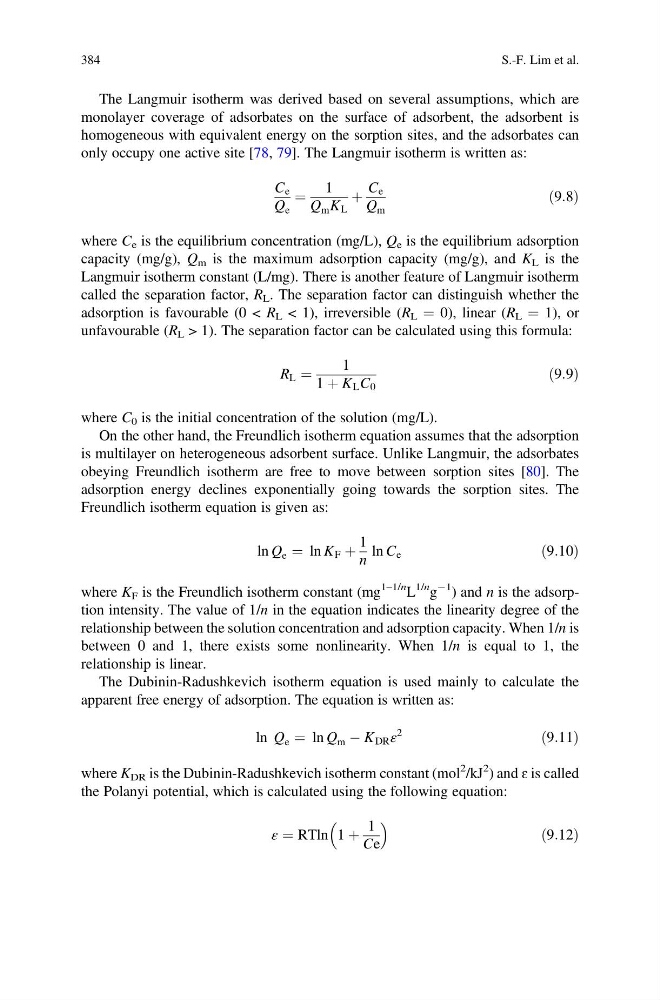
The Langmuir isotherm was derived based on several assumptions, which are
monolayer coverage of adsorbates on the surface of adsorbent, the adsorbent is
homogeneous with equivalent energy on the sorption sites, and the adsorbates can
only occupy one active site [78, 79]. The Langmuir isotherm is written as:
C e
Q e
¼
1
Q m K L
þ
C e
Q m
ð9:8Þ
where C e is the equilibrium concentration (mg/L), Q e is the equilibrium adsorption
capacity (mg/g), Q m is the maximum adsorption capacity (mg/g), and K L is the
Langmuir isotherm constant (L/mg). There is another feature of Langmuir isotherm
called the separation factor, R L . The separation factor can distinguish whether the
adsorption is favourable (0 < R L < 1), irreversible (R L ¼ 0), linear (R L ¼ 1), or
unfavourable (R L > 1). The separation factor can be calculated using this formula:
R L ¼
1
1 þ K L C 0
ð9:9Þ
where C 0 is the initial concentration of the solution (mg/L).
On the other hand, the Freundlich isotherm equation assumes that the adsorption
is multilayer on heterogeneous adsorbent surface. Unlike Langmuir, the adsorbates
obeying Freundlich isotherm are free to move between sorption sites [80]. The
adsorption energy declines exponentially going towards the sorption sites. The
Freundlich isotherm equation is given as:
ln Q e ¼ ln K F þ
1
n
ln C e
ð9:10Þ
where K F is the Freundlich isotherm constant (mg
1–1/n L
1/n g
À1 ) and n is the adsorption intensity. The value of 1/n in the equation indicates the linearity degree of the
relationship between the solution concentration and adsorption capacity. When 1/n is
between 0 and 1, there exists some nonlinearity. When 1/n is equal to 1, the
relationship is linear.
The Dubinin-Radushkevich isotherm equation is used mainly to calculate the
apparent free energy of adsorption. The equation is written as:
ln Q e ¼ ln Q m À K DR ε
2
ð9:11Þ
where K DR is the Dubinin-Radushkevich isotherm constant (mol
2 /kJ
2 ) and ɛ is called
the Polanyi potential, which is calculated using the following equation:
ε ¼ RTln 1 þ
1
Ce
ð9:12Þ
384
S.-F. Lim et al.
monolayer coverage of adsorbates on the surface of adsorbent, the adsorbent is
homogeneous with equivalent energy on the sorption sites, and the adsorbates can
only occupy one active site [78, 79]. The Langmuir isotherm is written as:
C e
Q e
¼
1
Q m K L
þ
C e
Q m
ð9:8Þ
where C e is the equilibrium concentration (mg/L), Q e is the equilibrium adsorption
capacity (mg/g), Q m is the maximum adsorption capacity (mg/g), and K L is the
Langmuir isotherm constant (L/mg). There is another feature of Langmuir isotherm
called the separation factor, R L . The separation factor can distinguish whether the
adsorption is favourable (0 < R L < 1), irreversible (R L ¼ 0), linear (R L ¼ 1), or
unfavourable (R L > 1). The separation factor can be calculated using this formula:
R L ¼
1
1 þ K L C 0
ð9:9Þ
where C 0 is the initial concentration of the solution (mg/L).
On the other hand, the Freundlich isotherm equation assumes that the adsorption
is multilayer on heterogeneous adsorbent surface. Unlike Langmuir, the adsorbates
obeying Freundlich isotherm are free to move between sorption sites [80]. The
adsorption energy declines exponentially going towards the sorption sites. The
Freundlich isotherm equation is given as:
ln Q e ¼ ln K F þ
1
n
ln C e
ð9:10Þ
where K F is the Freundlich isotherm constant (mg
1–1/n L
1/n g
À1 ) and n is the adsorption intensity. The value of 1/n in the equation indicates the linearity degree of the
relationship between the solution concentration and adsorption capacity. When 1/n is
between 0 and 1, there exists some nonlinearity. When 1/n is equal to 1, the
relationship is linear.
The Dubinin-Radushkevich isotherm equation is used mainly to calculate the
apparent free energy of adsorption. The equation is written as:
ln Q e ¼ ln Q m À K DR ε
2
ð9:11Þ
where K DR is the Dubinin-Radushkevich isotherm constant (mol
2 /kJ
2 ) and ɛ is called
the Polanyi potential, which is calculated using the following equation:
ε ¼ RTln 1 þ
1
Ce
ð9:12Þ
384
S.-F. Lim et al.