

4 Kinetic Models
Kinetic models are often used to determine the reaction rate constant and equilibrium
adsorption capacity [68]. This section discusses briefly several of the most widely
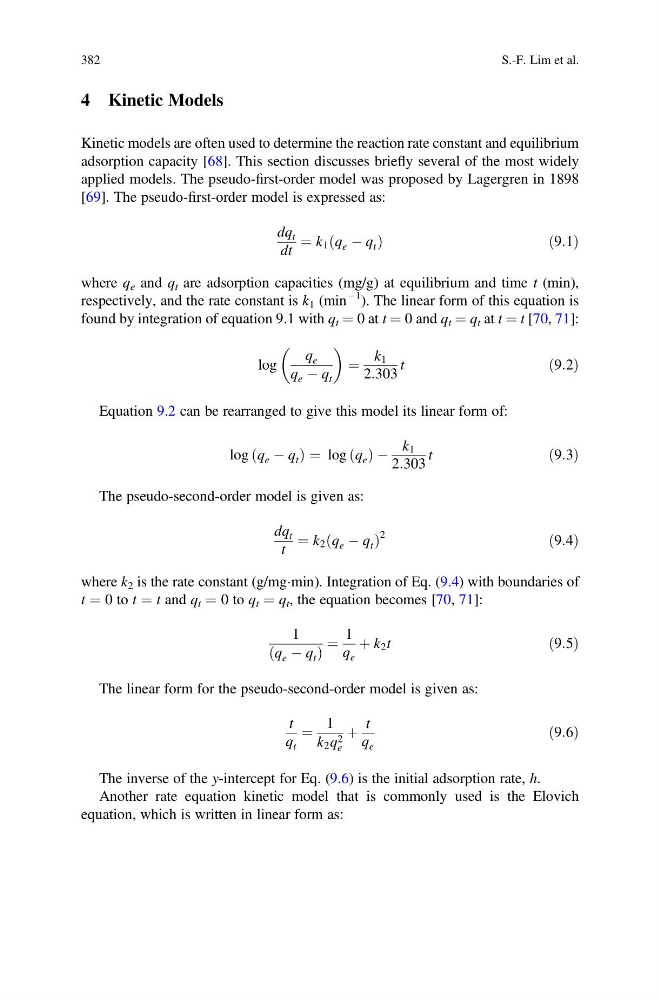
applied models. The pseudo-first-order model was proposed by Lagergren in 1898
[69]. The pseudo-first-order model is expressed as:
dq t
dt
¼ k 1 q e À q t
ð
Þ
ð9:1Þ
where q e and q t are adsorption capacities (mg/g) at equilibrium and time t (min),
respectively, and the rate constant is k 1 (min
À1 ). The linear form of this equation is
found by integration of equation 9.1 with q t ¼ 0 at t ¼ 0 and q t ¼ q t at t ¼ t [70, 71]:
log
q e
q e À q t
¼
k 1
2:303
t
ð9:2Þ
Equation 9.2 can be rearranged to give this model its linear form of:
log q e À q t
ð
Þ¼ log q e
ð Þ À
k 1
2:303
t
ð9:3Þ
The pseudo-second-order model is given as:
dq t
t
¼ k 2 q e À q t
ð
Þ
2
ð9:4Þ
where k 2 is the rate constant (g/mgÁmin). Integration of Eq. (9.4) with boundaries of
t ¼ 0 to t ¼ t and q t ¼ 0 to q t ¼ q t , the equation becomes [70, 71]:
1
q e À q t
ð
Þ
¼
1
q e
þ k 2 t
ð9:5Þ
The linear form for the pseudo-second-order model is given as:
t
q t
¼
1
k 2 q 2
e
þ
t
q e
ð9:6Þ
The inverse of the y-intercept for Eq. (9.6) is the initial adsorption rate, h.
Another rate equation kinetic model that is commonly used is the Elovich
equation, which is written in linear form as:
382
S.-F. Lim et al.
Kinetic models are often used to determine the reaction rate constant and equilibrium
adsorption capacity [68]. This section discusses briefly several of the most widely
applied models. The pseudo-first-order model was proposed by Lagergren in 1898
[69]. The pseudo-first-order model is expressed as:
dq t
dt
¼ k 1 q e À q t
ð
Þ
ð9:1Þ
where q e and q t are adsorption capacities (mg/g) at equilibrium and time t (min),
respectively, and the rate constant is k 1 (min
À1 ). The linear form of this equation is
found by integration of equation 9.1 with q t ¼ 0 at t ¼ 0 and q t ¼ q t at t ¼ t [70, 71]:
log
q e
q e À q t
¼
k 1
2:303
t
ð9:2Þ
Equation 9.2 can be rearranged to give this model its linear form of:
log q e À q t
ð
Þ¼ log q e
ð Þ À
k 1
2:303
t
ð9:3Þ
The pseudo-second-order model is given as:
dq t
t
¼ k 2 q e À q t
ð
Þ
2
ð9:4Þ
where k 2 is the rate constant (g/mgÁmin). Integration of Eq. (9.4) with boundaries of
t ¼ 0 to t ¼ t and q t ¼ 0 to q t ¼ q t , the equation becomes [70, 71]:
1
q e À q t
ð
Þ
¼
1
q e
þ k 2 t
ð9:5Þ
The linear form for the pseudo-second-order model is given as:
t
q t
¼
1
k 2 q 2
e
þ
t
q e
ð9:6Þ
The inverse of the y-intercept for Eq. (9.6) is the initial adsorption rate, h.
Another rate equation kinetic model that is commonly used is the Elovich
equation, which is written in linear form as:
382
S.-F. Lim et al.