

or their combinations. For example, Zhang et al. [146] reported that acidification of
corn stalk waste enhanced its bioconversion to H 2 during dark fermentation using
inoculum derived from cow dung compost. Alkaline (0.2% NaOH boiling for
30 min) and acid (0.2% HCl boiling for 30 min) treatments of corn stalk increased
the H 2 yield (mL/g VS) in dark fermentation from 4 (control) to 57 (alkaline) and
150 (acid) [146]. Cellulose is abundant in waste from industries such as pulp, paper,
and food processing. However, the presence of increased cellulose content decreases
the H 2 yields; thus, a substrate pretreatment may be required to hydrolyze the
cellulose prior to dark fermentation.
Food processing industries generate waste containing high COD and readily
biodegradable organics. However, it varies in nature and composition; therefore,
the specific characteristics of the waste affect the operational condition (OLR, HRT,
substrate pretreatment) as well as the yield and the rate of H 2 production. Yasin et al.
[161] reviewed the H 2 production potential of food and food processing waste and
pointed out that the lipid, protein, and carbohydrate components in food waste are
convertible to H 2 with a maximum yield around 0.67 L H 2 /g substrate of food waste.
As an example of how the characteristics of the waste affect the operation
parameters of H 2 production by dark fermentation process, the optimum HRT for
H 2 production from cheese processing wastewater (3 h) [162] is shorter than that for
olive oil mill effluent (14.5 h) [24]. The production of H 2 from carbohydrate-rich
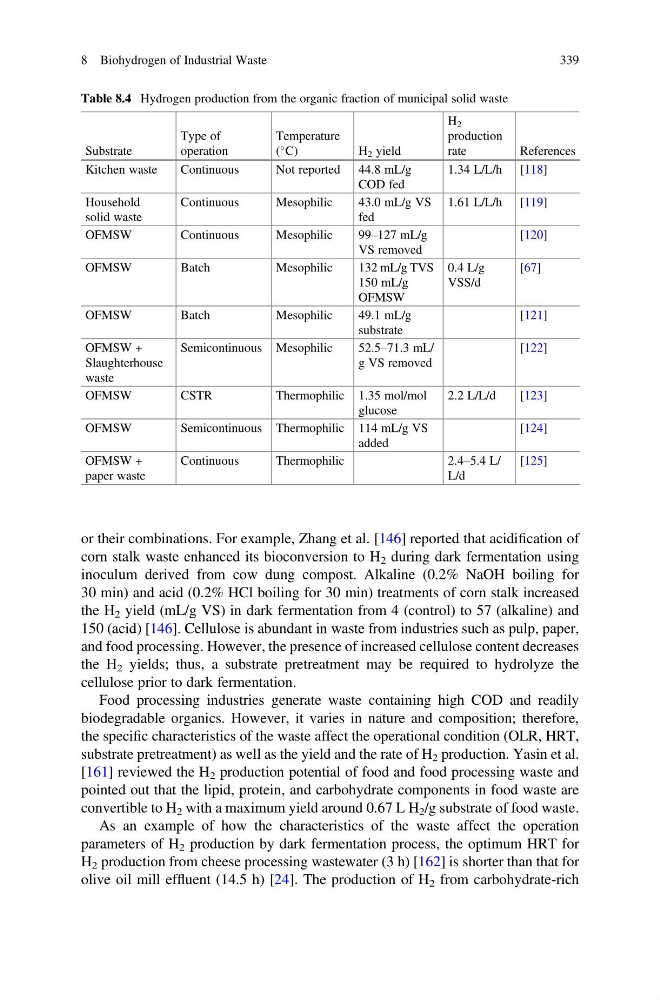
Table 8.4 Hydrogen production from the organic fraction of municipal solid waste
Substrate
Type of
operation
Temperature
(
C)
H 2 yield
H 2
production
rate
References
Kitchen waste
Continuous
Not reported 44.8 mL/g
COD fed
1.34 L/L/h [118]
Household
solid waste
Continuous
Mesophilic
43.0 mL/g VS
fed
1.61 L/L/h [119]
OFMSW
Continuous
Mesophilic
99–127 mL/g
VS removed
[120]
OFMSW
Batch
Mesophilic
132 mL/g TVS
150 mL/g
OFMSW
0.4 L/g
VSS/d
[67]
OFMSW
Batch
Mesophilic
49.1 mL/g
substrate
[121]
OFMSW +
Slaughterhouse
waste
Semicontinuous Mesophilic
52.5–71.3 mL/
g VS removed
[122]
OFMSW
CSTR
Thermophilic 1.35 mol/mol
glucose
2.2 L/L/d
[123]
OFMSW
Semicontinuous Thermophilic 114 mL/g VS
added
[124]
OFMSW +
paper waste
Continuous
Thermophilic
2.4–5.4 L/
L/d
[125]
8 Biohydrogen of Industrial Waste
339
corn stalk waste enhanced its bioconversion to H 2 during dark fermentation using
inoculum derived from cow dung compost. Alkaline (0.2% NaOH boiling for
30 min) and acid (0.2% HCl boiling for 30 min) treatments of corn stalk increased
the H 2 yield (mL/g VS) in dark fermentation from 4 (control) to 57 (alkaline) and
150 (acid) [146]. Cellulose is abundant in waste from industries such as pulp, paper,
and food processing. However, the presence of increased cellulose content decreases
the H 2 yields; thus, a substrate pretreatment may be required to hydrolyze the
cellulose prior to dark fermentation.
Food processing industries generate waste containing high COD and readily
biodegradable organics. However, it varies in nature and composition; therefore,
the specific characteristics of the waste affect the operational condition (OLR, HRT,
substrate pretreatment) as well as the yield and the rate of H 2 production. Yasin et al.
[161] reviewed the H 2 production potential of food and food processing waste and
pointed out that the lipid, protein, and carbohydrate components in food waste are
convertible to H 2 with a maximum yield around 0.67 L H 2 /g substrate of food waste.
As an example of how the characteristics of the waste affect the operation
parameters of H 2 production by dark fermentation process, the optimum HRT for
H 2 production from cheese processing wastewater (3 h) [162] is shorter than that for
olive oil mill effluent (14.5 h) [24]. The production of H 2 from carbohydrate-rich
Table 8.4 Hydrogen production from the organic fraction of municipal solid waste
Substrate
Type of
operation
Temperature
(
C)
H 2 yield
H 2
production
rate
References
Kitchen waste
Continuous
Not reported 44.8 mL/g
COD fed
1.34 L/L/h [118]
Household
solid waste
Continuous
Mesophilic
43.0 mL/g VS
fed
1.61 L/L/h [119]
OFMSW
Continuous
Mesophilic
99–127 mL/g
VS removed
[120]
OFMSW
Batch
Mesophilic
132 mL/g TVS
150 mL/g
OFMSW
0.4 L/g
VSS/d
[67]
OFMSW
Batch
Mesophilic
49.1 mL/g
substrate
[121]
OFMSW +
Slaughterhouse
waste
Semicontinuous Mesophilic
52.5–71.3 mL/
g VS removed
[122]
OFMSW
CSTR
Thermophilic 1.35 mol/mol
glucose
2.2 L/L/d
[123]
OFMSW
Semicontinuous Thermophilic 114 mL/g VS
added
[124]
OFMSW +
paper waste
Continuous
Thermophilic
2.4–5.4 L/
L/d
[125]
8 Biohydrogen of Industrial Waste
339