

The competition between NAD
+ and H
+ for Fd red (reaction 2) controls the H 2
yield [86]. Coupling Fd red and NAD
+ generates NADH 2 which is required for
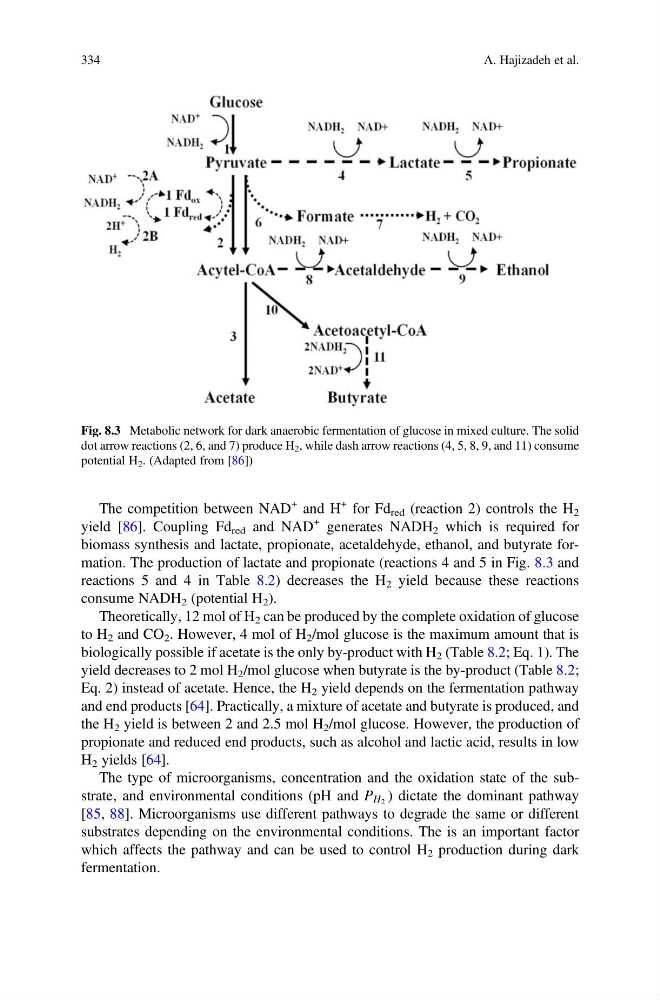
biomass synthesis and lactate, propionate, acetaldehyde, ethanol, and butyrate formation. The production of lactate and propionate (reactions 4 and 5 in Fig. 8.3 and
reactions 5 and 4 in Table 8.2) decreases the H 2 yield because these reactions
consume NADH 2 (potential H 2 ).
Theoretically, 12 mol of H 2 can be produced by the complete oxidation of glucose
to H 2 and CO 2 . However, 4 mol of H 2 /mol glucose is the maximum amount that is
biologically possible if acetate is the only by-product with H 2 (Table 8.2; Eq. 1). The
yield decreases to 2 mol H 2 /mol glucose when butyrate is the by-product (Table 8.2;
Eq. 2) instead of acetate. Hence, the H 2 yield depends on the fermentation pathway
and end products [64]. Practically, a mixture of acetate and butyrate is produced, and
the H 2 yield is between 2 and 2.5 mol H 2 /mol glucose. However, the production of
propionate and reduced end products, such as alcohol and lactic acid, results in low
H 2 yields [64].
The type of microorganisms, concentration and the oxidation state of the substrate, and environmental conditions (pH and P H 2 ) dictate the dominant pathway
[85, 88]. Microorganisms use different pathways to degrade the same or different
substrates depending on the environmental conditions. The is an important factor
which affects the pathway and can be used to control H 2 production during dark
fermentation.
Fig. 8.3 Metabolic network for dark anaerobic fermentation of glucose in mixed culture. The solid
dot arrow reactions (2, 6, and 7) produce H 2 , while dash arrow reactions (4, 5, 8, 9, and 11) consume
potential H 2 . (Adapted from [86])
334
A. Hajizadeh et al.
+ and H
+ for Fd red (reaction 2) controls the H 2
yield [86]. Coupling Fd red and NAD
+ generates NADH 2 which is required for
biomass synthesis and lactate, propionate, acetaldehyde, ethanol, and butyrate formation. The production of lactate and propionate (reactions 4 and 5 in Fig. 8.3 and
reactions 5 and 4 in Table 8.2) decreases the H 2 yield because these reactions
consume NADH 2 (potential H 2 ).
Theoretically, 12 mol of H 2 can be produced by the complete oxidation of glucose
to H 2 and CO 2 . However, 4 mol of H 2 /mol glucose is the maximum amount that is
biologically possible if acetate is the only by-product with H 2 (Table 8.2; Eq. 1). The
yield decreases to 2 mol H 2 /mol glucose when butyrate is the by-product (Table 8.2;
Eq. 2) instead of acetate. Hence, the H 2 yield depends on the fermentation pathway
and end products [64]. Practically, a mixture of acetate and butyrate is produced, and
the H 2 yield is between 2 and 2.5 mol H 2 /mol glucose. However, the production of
propionate and reduced end products, such as alcohol and lactic acid, results in low
H 2 yields [64].
The type of microorganisms, concentration and the oxidation state of the substrate, and environmental conditions (pH and P H 2 ) dictate the dominant pathway
[85, 88]. Microorganisms use different pathways to degrade the same or different
substrates depending on the environmental conditions. The is an important factor
which affects the pathway and can be used to control H 2 production during dark
fermentation.
Fig. 8.3 Metabolic network for dark anaerobic fermentation of glucose in mixed culture. The solid
dot arrow reactions (2, 6, and 7) produce H 2 , while dash arrow reactions (4, 5, 8, 9, and 11) consume
potential H 2 . (Adapted from [86])
334
A. Hajizadeh et al.