

4. Homoacetogenic bacteria
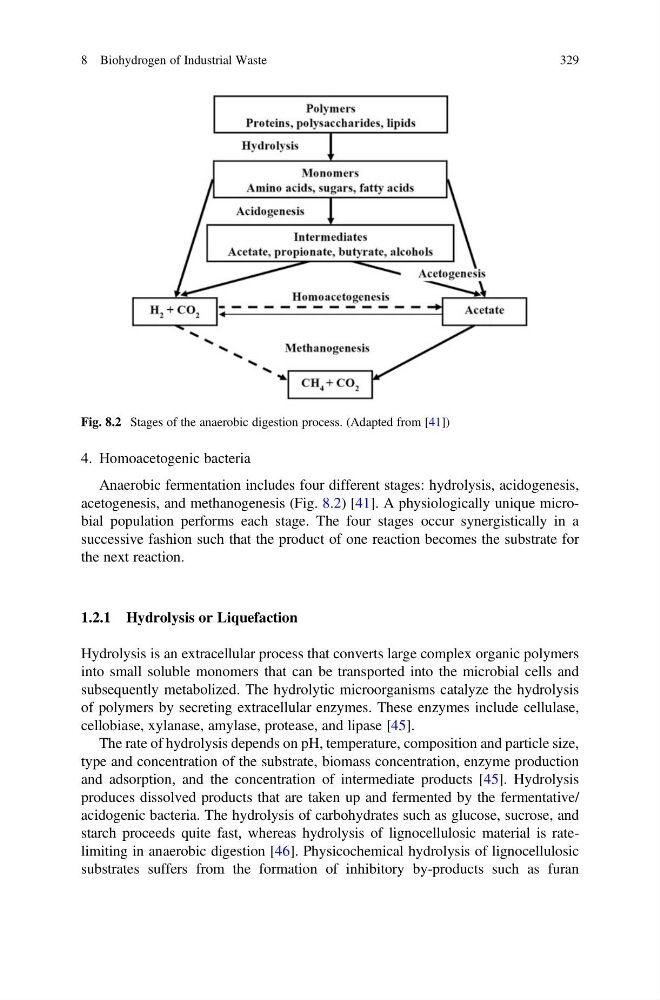
Anaerobic fermentation includes four different stages: hydrolysis, acidogenesis,
acetogenesis, and methanogenesis (Fig. 8.2) [41]. A physiologically unique microbial population performs each stage. The four stages occur synergistically in a
successive fashion such that the product of one reaction becomes the substrate for
the next reaction.
1.2.1 Hydrolysis or Liquefaction
Hydrolysis is an extracellular process that converts large complex organic polymers
into small soluble monomers that can be transported into the microbial cells and
subsequently metabolized. The hydrolytic microorganisms catalyze the hydrolysis
of polymers by secreting extracellular enzymes. These enzymes include cellulase,
cellobiase, xylanase, amylase, protease, and lipase [45].
The rate of hydrolysis depends on pH, temperature, composition and particle size,
type and concentration of the substrate, biomass concentration, enzyme production
and adsorption, and the concentration of intermediate products [45]. Hydrolysis
produces dissolved products that are taken up and fermented by the fermentative/
acidogenic bacteria. The hydrolysis of carbohydrates such as glucose, sucrose, and
starch proceeds quite fast, whereas hydrolysis of lignocellulosic material is ratelimiting in anaerobic digestion [46]. Physicochemical hydrolysis of lignocellulosic
substrates suffers from the formation of inhibitory by-products such as furan
Fig. 8.2 Stages of the anaerobic digestion process. (Adapted from [41])
8 Biohydrogen of Industrial Waste
329
Anaerobic fermentation includes four different stages: hydrolysis, acidogenesis,
acetogenesis, and methanogenesis (Fig. 8.2) [41]. A physiologically unique microbial population performs each stage. The four stages occur synergistically in a
successive fashion such that the product of one reaction becomes the substrate for
the next reaction.
1.2.1 Hydrolysis or Liquefaction
Hydrolysis is an extracellular process that converts large complex organic polymers
into small soluble monomers that can be transported into the microbial cells and
subsequently metabolized. The hydrolytic microorganisms catalyze the hydrolysis
of polymers by secreting extracellular enzymes. These enzymes include cellulase,
cellobiase, xylanase, amylase, protease, and lipase [45].
The rate of hydrolysis depends on pH, temperature, composition and particle size,
type and concentration of the substrate, biomass concentration, enzyme production
and adsorption, and the concentration of intermediate products [45]. Hydrolysis
produces dissolved products that are taken up and fermented by the fermentative/
acidogenic bacteria. The hydrolysis of carbohydrates such as glucose, sucrose, and
starch proceeds quite fast, whereas hydrolysis of lignocellulosic material is ratelimiting in anaerobic digestion [46]. Physicochemical hydrolysis of lignocellulosic
substrates suffers from the formation of inhibitory by-products such as furan
Fig. 8.2 Stages of the anaerobic digestion process. (Adapted from [41])
8 Biohydrogen of Industrial Waste
329