

distilleries, sugar factories, dairies, and pulp and paper mills are rich in organic
pollutants, mainly carbohydrates. Therefore, they can be treated biologically through
the process of anaerobic digestion to combine waste stabilization with energy
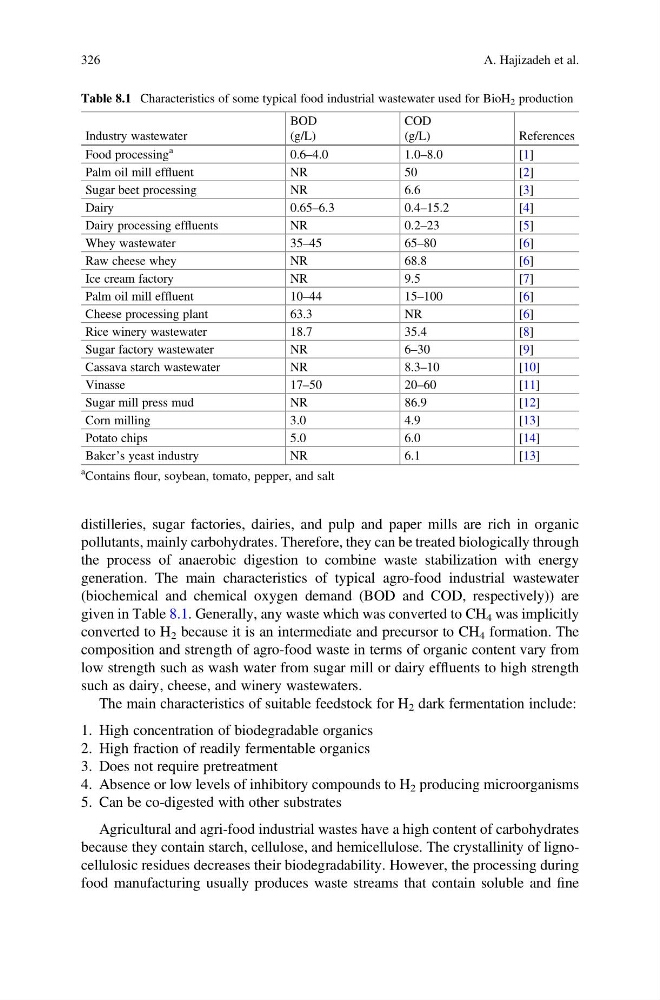
generation. The main characteristics of typical agro-food industrial wastewater
(biochemical and chemical oxygen demand (BOD and COD, respectively)) are
given in Table 8.1. Generally, any waste which was converted to CH 4 was implicitly
converted to H 2 because it is an intermediate and precursor to CH 4 formation. The
composition and strength of agro-food waste in terms of organic content vary from
low strength such as wash water from sugar mill or dairy effluents to high strength
such as dairy, cheese, and winery wastewaters.
The main characteristics of suitable feedstock for H 2 dark fermentation include:
1. High concentration of biodegradable organics
2. High fraction of readily fermentable organics
3. Does not require pretreatment
4. Absence or low levels of inhibitory compounds to H 2 producing microorganisms
5. Can be co-digested with other substrates
Agricultural and agri-food industrial wastes have a high content of carbohydrates
because they contain starch, cellulose, and hemicellulose. The crystallinity of lignocellulosic residues decreases their biodegradability. However, the processing during
food manufacturing usually produces waste streams that contain soluble and fine
Table 8.1 Characteristics of some typical food industrial wastewater used for BioH 2 production
Industry wastewater
BOD
(g/L)
COD
(g/L)
References
Food processing
a
0.6–4.0
1.0–8.0
[1]
Palm oil mill effluent
NR
50
[2]
Sugar beet processing
NR
6.6
[3]
Dairy
0.65–6.3
0.4–15.2
[4]
Dairy processing effluents
NR
0.2–23
[5]
Whey wastewater
35–45
65–80
[6]
Raw cheese whey
NR
68.8
[6]
Ice cream factory
NR
9.5
[7]
Palm oil mill effluent
10–44
15–100
[6]
Cheese processing plant
63.3
NR
[6]
Rice winery wastewater
18.7
35.4
[8]
Sugar factory wastewater
NR
6–30
[9]
Cassava starch wastewater
NR
8.3–10
[10]
Vinasse
17–50
20–60
[11]
Sugar mill press mud
NR
86.9
[12]
Corn milling
3.0
4.9
[13]
Potato chips
5.0
6.0
[14]
Baker’s yeast industry
NR
6.1
[13]
a Contains flour, soybean, tomato, pepper, and salt
326
A. Hajizadeh et al.
pollutants, mainly carbohydrates. Therefore, they can be treated biologically through
the process of anaerobic digestion to combine waste stabilization with energy
generation. The main characteristics of typical agro-food industrial wastewater
(biochemical and chemical oxygen demand (BOD and COD, respectively)) are
given in Table 8.1. Generally, any waste which was converted to CH 4 was implicitly
converted to H 2 because it is an intermediate and precursor to CH 4 formation. The
composition and strength of agro-food waste in terms of organic content vary from
low strength such as wash water from sugar mill or dairy effluents to high strength
such as dairy, cheese, and winery wastewaters.
The main characteristics of suitable feedstock for H 2 dark fermentation include:
1. High concentration of biodegradable organics
2. High fraction of readily fermentable organics
3. Does not require pretreatment
4. Absence or low levels of inhibitory compounds to H 2 producing microorganisms
5. Can be co-digested with other substrates
Agricultural and agri-food industrial wastes have a high content of carbohydrates
because they contain starch, cellulose, and hemicellulose. The crystallinity of lignocellulosic residues decreases their biodegradability. However, the processing during
food manufacturing usually produces waste streams that contain soluble and fine
Table 8.1 Characteristics of some typical food industrial wastewater used for BioH 2 production
Industry wastewater
BOD
(g/L)
COD
(g/L)
References
Food processing
a
0.6–4.0
1.0–8.0
[1]
Palm oil mill effluent
NR
50
[2]
Sugar beet processing
NR
6.6
[3]
Dairy
0.65–6.3
0.4–15.2
[4]
Dairy processing effluents
NR
0.2–23
[5]
Whey wastewater
35–45
65–80
[6]
Raw cheese whey
NR
68.8
[6]
Ice cream factory
NR
9.5
[7]
Palm oil mill effluent
10–44
15–100
[6]
Cheese processing plant
63.3
NR
[6]
Rice winery wastewater
18.7
35.4
[8]
Sugar factory wastewater
NR
6–30
[9]
Cassava starch wastewater
NR
8.3–10
[10]
Vinasse
17–50
20–60
[11]
Sugar mill press mud
NR
86.9
[12]
Corn milling
3.0
4.9
[13]
Potato chips
5.0
6.0
[14]
Baker’s yeast industry
NR
6.1
[13]
a Contains flour, soybean, tomato, pepper, and salt
326
A. Hajizadeh et al.