

9.3 Restoration of Lake Apopka, FL, USA
Environmental problems led the governor of Florida on April 4, 1967, to appoint a
technical committee to evaluate the restoration of Lake Apopka [34]. Sixteen agencies,
including the Federal Water Pollution Control Administration (FWPCA), agreed to
participate in the project. An FWPCA study begun in 1968 revealed that 90% of the
bottom was covered with unconsolidated bottom sediment (muck) averaging 1.5 m thick.
These sediments and peat sediments found along the shoreline were anaerobic and
provided limited suitable substrate for desirable biota. Only 5% of the bottom was covered
with sand, clay, and shell. The top meter of lake sediment contained 225 million kg of total
nitrogen and 2 million to 4 million kg of total phosphorus. Chemical oxygen demand
(COD) in the muck samples (dry weight) was 1,100 mg/g. The FWPCA also made a
crude nutrient budget and emphasized that restoration of the lake must include reduction of
nutrient input. Although direct rainfall on the lake and high nutrient input from citrus grove
runoff were important, the principal controls on inputs emphasized by the FWPCA were
point sources such as agricultural runoff pumped directly into the lake from muck farms
and municipal and industrial wastes. In addition to control of external nutrient sources,
several solutions for improving lake water quality are listed below. These include [35]:
1. Dredging to remove nutrient-rich unconsolidated bottom sediments to increase
lake depth and reduce internal nutrient recycling.
2. Using lake drawdown to expose and subsequently consolidate large areas of lake
bottom by oxidation and compaction.
3. Adding an inert sealing material to stabilize bottom sediments.
4. Engaging in hydroponic farming to remove dissolved nutrients.
5. Harvesting to remove algae by flotation, filtration, precipitation (not within the
lake), or centrifugation (recovered algae could be used as a feed supplement).
6. Harvesting fish to remove nutrients “on a large scale.” Harvested fish could be
used as a protein supplement.
The governor of Florida assigned complete responsibility for a 1970 restoration
of Lake Apopka to the Florida Air and Water Pollution Control Commission. This
agency decided to proceed with the lake drawdown approach by allowing gravity
drainage to lower the lake level 60 cm beginning in December 1970. The effect of
this lowering was to be evaluated, and the lake would then be drained further by
pumping to 25% of its original area. This final drawdown would occur in the spring
of 1971. It was anticipated that two beneficial effects would result from the
drawdown:
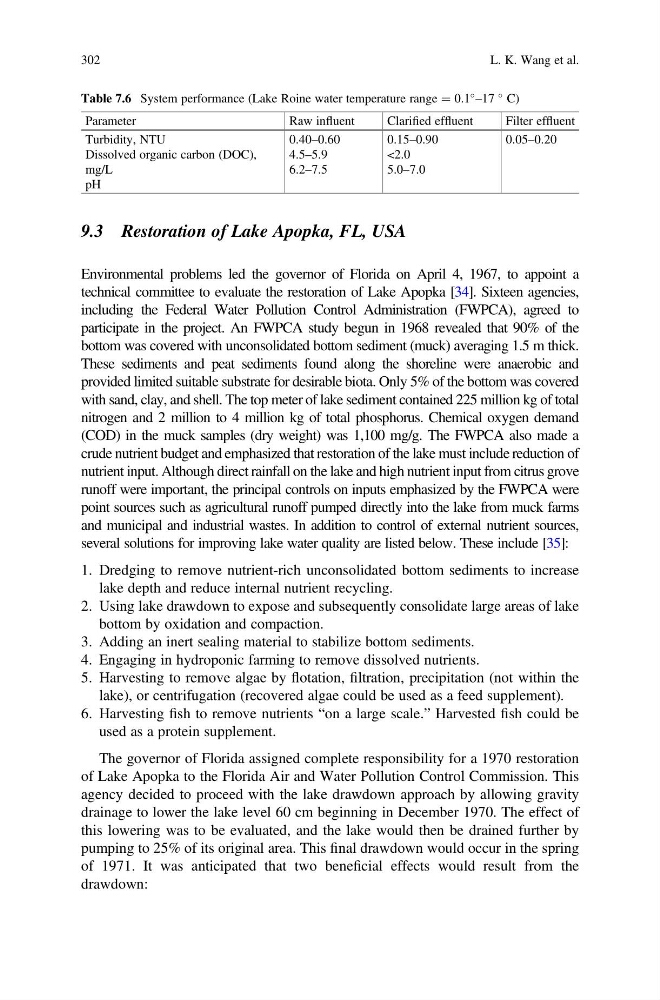
Table 7.6 System performance (Lake Roine water temperature range ¼ 0.1
–17
C)
Parameter
Raw influent
Clarified effluent
Filter effluent
Turbidity, NTU
Dissolved organic carbon (DOC),
mg/L
pH
0.40–0.60
4.5–5.9
6.2–7.5
0.15–0.90
<2.0
5.0–7.0
0.05–0.20
302
L. K. Wang et al.
Environmental problems led the governor of Florida on April 4, 1967, to appoint a
technical committee to evaluate the restoration of Lake Apopka [34]. Sixteen agencies,
including the Federal Water Pollution Control Administration (FWPCA), agreed to
participate in the project. An FWPCA study begun in 1968 revealed that 90% of the
bottom was covered with unconsolidated bottom sediment (muck) averaging 1.5 m thick.
These sediments and peat sediments found along the shoreline were anaerobic and
provided limited suitable substrate for desirable biota. Only 5% of the bottom was covered
with sand, clay, and shell. The top meter of lake sediment contained 225 million kg of total
nitrogen and 2 million to 4 million kg of total phosphorus. Chemical oxygen demand
(COD) in the muck samples (dry weight) was 1,100 mg/g. The FWPCA also made a
crude nutrient budget and emphasized that restoration of the lake must include reduction of
nutrient input. Although direct rainfall on the lake and high nutrient input from citrus grove
runoff were important, the principal controls on inputs emphasized by the FWPCA were
point sources such as agricultural runoff pumped directly into the lake from muck farms
and municipal and industrial wastes. In addition to control of external nutrient sources,
several solutions for improving lake water quality are listed below. These include [35]:
1. Dredging to remove nutrient-rich unconsolidated bottom sediments to increase
lake depth and reduce internal nutrient recycling.
2. Using lake drawdown to expose and subsequently consolidate large areas of lake
bottom by oxidation and compaction.
3. Adding an inert sealing material to stabilize bottom sediments.
4. Engaging in hydroponic farming to remove dissolved nutrients.
5. Harvesting to remove algae by flotation, filtration, precipitation (not within the
lake), or centrifugation (recovered algae could be used as a feed supplement).
6. Harvesting fish to remove nutrients “on a large scale.” Harvested fish could be
used as a protein supplement.
The governor of Florida assigned complete responsibility for a 1970 restoration
of Lake Apopka to the Florida Air and Water Pollution Control Commission. This
agency decided to proceed with the lake drawdown approach by allowing gravity
drainage to lower the lake level 60 cm beginning in December 1970. The effect of
this lowering was to be evaluated, and the lake would then be drained further by
pumping to 25% of its original area. This final drawdown would occur in the spring
of 1971. It was anticipated that two beneficial effects would result from the
drawdown:
Table 7.6 System performance (Lake Roine water temperature range ¼ 0.1
–17
C)
Parameter
Raw influent
Clarified effluent
Filter effluent
Turbidity, NTU
Dissolved organic carbon (DOC),
mg/L
pH
0.40–0.60
4.5–5.9
6.2–7.5
0.15–0.90
<2.0
5.0–7.0
0.05–0.20
302
L. K. Wang et al.