

Holding allowances does not automatically allow a plant to emit SO 2 . They are
still subject to other state and federal permit conditions, which may further limit their
emissions. Also, they may not cause exceedances of US EPA’s National Ambient
Air Quality Standards (NAAQS) or Prevention of Significant Deterioration (PSD)
limits.
8.8 Acid Rain Measurement
In the 1970s, we realized the importance of monitoring the acidity of rainfall. The
National Atmospheric Deposition Program (NADP) was formed in 1977 to investigate and measure acid deposition. There were 22 stations nationwide in 1978.
Currently, the National Trends Network, which now conducts measurements for
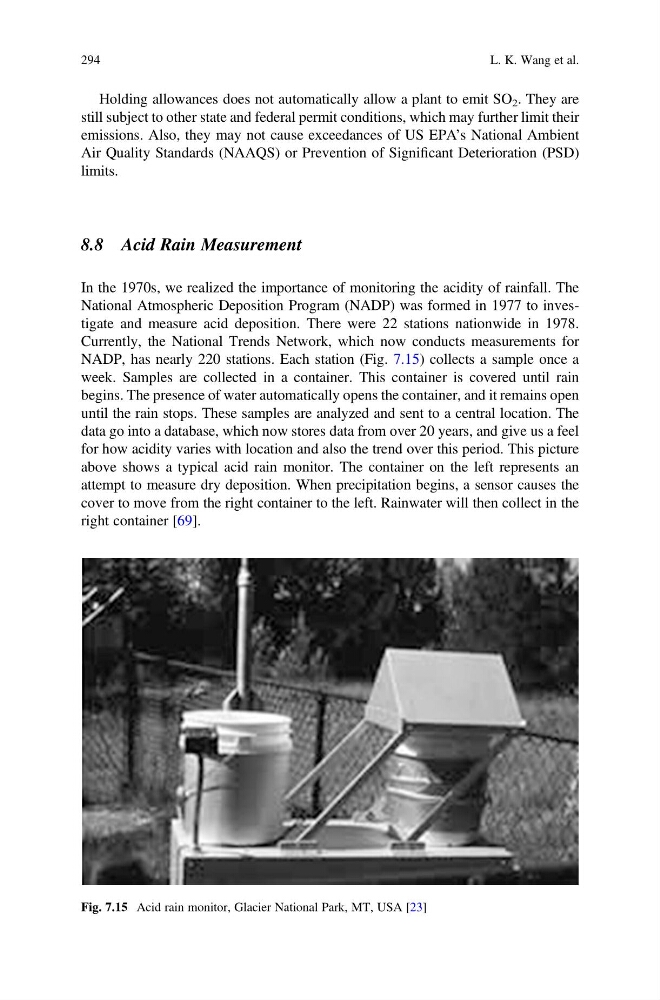
NADP, has nearly 220 stations. Each station (Fig. 7.15) collects a sample once a
week. Samples are collected in a container. This container is covered until rain
begins. The presence of water automatically opens the container, and it remains open
until the rain stops. These samples are analyzed and sent to a central location. The
data go into a database, which now stores data from over 20 years, and give us a feel
for how acidity varies with location and also the trend over this period. This picture
above shows a typical acid rain monitor. The container on the left represents an
attempt to measure dry deposition. When precipitation begins, a sensor causes the
cover to move from the right container to the left. Rainwater will then collect in the
right container [69].
Fig. 7.15 Acid rain monitor, Glacier National Park, MT, USA [23]
294
L. K. Wang et al.
still subject to other state and federal permit conditions, which may further limit their
emissions. Also, they may not cause exceedances of US EPA’s National Ambient
Air Quality Standards (NAAQS) or Prevention of Significant Deterioration (PSD)
limits.
8.8 Acid Rain Measurement
In the 1970s, we realized the importance of monitoring the acidity of rainfall. The
National Atmospheric Deposition Program (NADP) was formed in 1977 to investigate and measure acid deposition. There were 22 stations nationwide in 1978.
Currently, the National Trends Network, which now conducts measurements for
NADP, has nearly 220 stations. Each station (Fig. 7.15) collects a sample once a
week. Samples are collected in a container. This container is covered until rain
begins. The presence of water automatically opens the container, and it remains open
until the rain stops. These samples are analyzed and sent to a central location. The
data go into a database, which now stores data from over 20 years, and give us a feel
for how acidity varies with location and also the trend over this period. This picture
above shows a typical acid rain monitor. The container on the left represents an
attempt to measure dry deposition. When precipitation begins, a sensor causes the
cover to move from the right container to the left. Rainwater will then collect in the
right container [69].
Fig. 7.15 Acid rain monitor, Glacier National Park, MT, USA [23]
294
L. K. Wang et al.